







Weight Loss After 40: 9 Recommended Strategies
Authored by
The Evolv Research Team
You haven’t changed. Your body has.
The same approach that worked at 30 — eating less, moving more, cutting sugar — stopped working somewhere around 40, and no one explains why. You’re putting in the same effort and getting different results. That’s not failure. That’s a biological shift in four systems happening simultaneously.
Evolv co-founder Becca McCarthy knows this firsthand. On the Mom Curious podcast, she described what triggered her own GLP-1 journey: “My journey with GLP-1 started with my perimenopause journey… All these changes happen in your body — brain fog, irregular periods, crippling pain, cognitive issues.” The same midlife metabolic shift that affects millions of women sent her searching for answers in biology, not the calorie math.
What follows are 9 strategies that address the actual mechanisms driving weight gain after 40: muscle loss, hormonal shifts, appetite dysregulation, cortisol, and sleep. None of them involves eating less through willpower. All of them work with biology.
Why Weight Loss Gets Harder After 40
Before the strategies: the mechanisms. Understanding these is the difference between fighting your biology and working with it.
Muscle Loss Slows Your Metabolism
Adults lose 0.6–1% of muscle mass per year after 40. Nearly 9% of adults aged 40–64 have sarcopenia (clinically significant muscle loss), and that rate nearly doubles by age 65.
The metabolic consequence is direct: muscle burns more calories at rest than fat. As muscle declines, resting calorie burn falls — meaning the same food intake now creates a surplus. Menopause accelerates this, as estrogen has a protective effect on muscle tissue.
Hormonal Shifts Change Where Fat Is Stored
Estrogen decline does two things to fat distribution: it shifts fat deposition from the hips and thighs (subcutaneous) to the abdomen (visceral), and it increases insulin resistance. Visceral fat is metabolically active in the wrong direction — it drives more insulin resistance, more cortisol sensitivity, and more inflammatory signaling.
Lower estrogen also reduces leptin (the fullness hormone) and, when sleep is disrupted, allows ghrelin (the hunger hormone) to rise unchecked. The result: a body that stores fat more readily and signals hunger more persistently.
GLP-1 Signaling Becomes Less Efficient
GLP-1 is a gut hormone released after meals to signal satiety, slow gastric emptying, and support blood sugar stability. Its efficiency declines with age and metabolic changes — meaning post-meal fullness signals become weaker, appetite returns faster, and food noise gets louder. This is the biological explanation for why “you can’t eat the same things you used to” and why appetite seems harder to manage, not because discipline has weakened but because the signaling machinery has.
Sleep Disruption Compounds Everything
47% of perimenopausal women experience sleep disorders; that number rises to 60% post-menopause. Poor sleep raises cortisol, suppresses leptin, elevates ghrelin, and impairs insulin sensitivity. A single bad night can shift next-day calorie intake by 200–500 calories — not because of conscious decisions but because the hunger hormones have been altered. When sleep problems are structural (night sweats, hormonal insomnia), the appetite consequences are structural too.
9 Recommended Strategies for Weight Loss After 40
1. Front-Load Your Protein
After 40, anabolic resistance sets in: the body requires more dietary protein to achieve the same muscle-protein synthesis effect that smaller amounts produced at 25. The practical implication is a higher protein target.
Research supports 1.2–1.6 grams of protein per kilogram of body weight daily as a baseline — rising to 1.6–2.2 g/kg if you’re exercising intensively or in an aggressive calorie deficit. For a 150-lb (68 kg) woman: 82–110 grams minimum, 109–150 grams optimal. Studies show high-protein diets during a deficit result in only 0.3 kg of muscle loss, compared to 1.6 kg on lower-protein diets at the same deficit.
Distribute protein across meals rather than concentrating it at dinner. A protein-first breakfast is particularly important for appetite regulation — it blunts the morning ghrelin surge before it builds. Sources: Greek yogurt, eggs, chicken, fatty fish, tofu, legumes.
Concerned about protein and muscle on GLP-1 or appetite-reducing protocols? Read does GLP-1 cause muscle loss for the full picture.
2. Make Strength Training Non-Negotiable
Sarcopenia is the engine of metabolic slowdown after 40. Resistance training is the first-line clinical intervention. The goal isn’t aesthetics — it’s preserving and rebuilding the metabolically active tissue that determines how many calories you burn at rest.
Two to three strength sessions per week using compound movements: squats, deadlifts, rows, push-ups, farmer’s carries. “More reps, lighter weights” works as well as heavier weights for this age group, and carries lower injury risk. Adding lean mass raises resting metabolic rate — the opposite of what happens when you rely on cardio and restriction alone.
Cardio remains important for cardiovascular health (150 minutes of moderate activity per week is the standard recommendation), but it’s not a substitute for resistance training in addressing metabolic slowdown.
3. Stabilize Blood Sugar
Estrogen decline directly reduces insulin sensitivity, which creates a compounding cycle: worse insulin response → more visceral fat → worse insulin response. Targeting blood sugar stability is one of the highest-leverage interventions for visceral fat.
Concrete strategies: reduce ultra-processed carbohydrates, increase dietary fiber, and walk after meals (working muscles absorb blood glucose more efficiently than resting tissue). Pair carbohydrates with protein or healthy fat to slow the glucose response. A metabolic health diet that prioritizes whole food sources over processed carbs addresses this directly.
4. Eat Earlier in the Day
Circadian metabolism is real and measurable: the body processes the same food more efficiently in the morning than at night. Pancreatic insulin response is stronger and faster in the morning hours, which means the same meal produces a more moderate glucose spike at 8 a.m. than at 8 p.m.
Shifting your eating window earlier — not by skipping meals, but by front-loading your calories — reduces insulin demand during the evening hours when sensitivity is naturally lower. Time-restricted eating with an earlier window (roughly 8 a.m.–6 p.m.) supports metabolic efficiency and can meaningfully improve satiety through the rest of the day. Strategies for staying full longer are easier to sustain when you’re eating in alignment with your circadian biology.
5. Manage Cortisol and Stress
Chronically elevated cortisol is a direct driver of visceral fat accumulation, independent of calorie intake. Cortisol signals the body to store fat centrally and raises appetite — the same cortisol cascade that makes stress eating so biologically difficult to resist.
At midlife, cortisol management is also load-bearing for sleep: elevated evening cortisol delays sleep onset and reduces sleep quality, which creates the hormonal disruption described in the mechanisms section. Movement itself is a cortisol regulator — this is another reason strength training matters beyond its direct metabolic effect. Breathwork, mindfulness, and addressing structural stressors (not just symptoms) all contribute. Read about GLP-1 and inflammation for the downstream metabolic connection.
6. Treat Sleep as a Weight Loss Strategy
Appetite hormones reset during sleep. Leptin rises, ghrelin falls, cortisol normalizes — the biological conditions for appetite regulation are restored during adequate sleep in a way they simply cannot be patched by willpower during the day.
Seven to nine hours of quality sleep, with a consistent bedtime, is the target. Consistency of timing matters as much as duration — irregular sleep schedules disrupt circadian hormone rhythms even when total sleep hours are adequate.
For women navigating perimenopause and menopause, sleep disruption is often physiological: night sweats, hormonal insomnia, temperature dysregulation. As podcast host Daniela Ravani described her own experience: “All the peri/meno symptoms can make it hard to sleep, which spikes cortisol, which leads to more fat storage.” Addressing menopause-specific sleep disruptions isn’t optional for this population — it’s structural.
Alcohol worsens sleep architecture even when it feels sedating. It suppresses REM sleep, elevates nighttime cortisol, and impairs recovery. Many women over 40 report alcohol as the single factor that most disrupts sleep quality without recognizing the connection.
7. Cut Alcohol and Ultra-Processed Foods
Alcohol is calorie-dense, disrupts sleep, and suppresses fat oxidation while present in the system — the body prioritizes clearing ethanol before burning fat. Among women over 40, reducing or eliminating alcohol is one of the most consistently cited interventions that moves the needle when other changes stall.
Ultra-processed foods impair GLP-1 receptor sensitivity, disrupt satiety signaling, and drive overconsumption in ways that go beyond their calorie content. The issue isn’t just total calories — it’s that ultra-processed foods consistently undermine the appetite biology that makes weight management possible. Addressing emotional eating patterns is significantly harder when ultra-processed foods are regularly disrupting the underlying signaling.
This isn’t about perfection. It’s about reducing the burden on biological systems that are already under metabolic strain.
8. Support Your GLP-1 Pathway
GLP-1 pathway support is where the other eight strategies converge. GLP-1 controls satiety, gastric emptying, and post-meal blood sugar stability — the biology behind appetite regulation and the mechanism that becomes less efficient after 40.
Natural ways to support GLP-1 signaling include high-protein meals, fermentable fiber, regular exercise, and quality sleep — all strategies already on this list. When lifestyle strategies need additional support, biomimetic products designed to support GLP-1 and GIP appetite pathways offer a different approach.
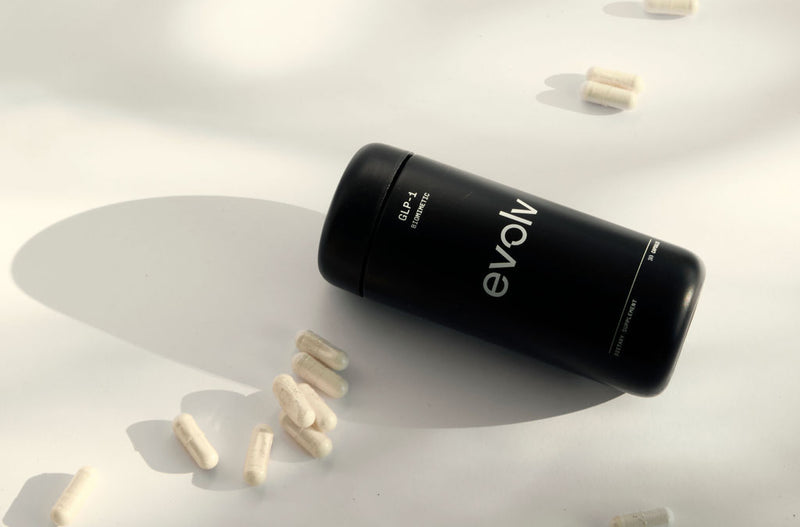
Evolv GLP-1 is a natural biomimetic dietary supplement built around a proprietary bioengineered, yeast-derived peptide designed to support GLP-1 and GIP appetite pathways. Its active ingredient — the bioengineered, yeast-derived EV1 Peptide — is designed to support the body’s natural GLP-1 and GIP appetite pathways. In Evolv’s randomized controlled study, with results read out at 8 weeks, participants consumed approximately 750 fewer calories per day and lost up to 12+ lbs.
Becca McCarthy has been direct about her own experience combining GLP-1 pathway support with HRT: “It was that really unique cocktail of HRT and GLP-1 that worked in tandem to help me not only tackle those symptoms, but also lose those extra five pounds.” The point isn’t that everyone needs both — it’s that addressing the underlying biology, rather than fighting it, produces a fundamentally different experience. Learn more about the science behind GLP-1 and GIP pathway support and GLP-1 supplements for weight loss, or explore Evolv GLP-1 directly.
9. Track Progress Beyond the Scale
Muscle weighs more than fat. As body composition improves — less fat, more lean mass — the scale often stalls or moves slowly, even when progress is real. Tracking only weight obscures what’s actually happening.
More useful metrics after 40: waist circumference (the single most important indicator of visceral fat reduction), how clothes fit, strength gains, energy levels, and appetite-related shifts — reduced food noise, fewer cravings, longer intervals between hunger signals.
Realistic pace: 0.5–1 lb per week is successful weight loss after 40. Plateaus are biologically normal during hormonal transitions, not failure. The women who sustain results are the ones who recognize they’re playing a long-game biology project, not running a sprint. If persistent hunger is interfering with your ability to stay consistent, that’s a hormonal signal worth addressing directly — not a test of willpower.
When to Seek Professional Support
Some weight-management challenges after 40 warrant a clinician’s attention rather than a protocol adjustment.
Consider consulting a physician if you’re experiencing unexplained fatigue even with adequate sleep (thyroid screening is appropriate), if weight isn’t moving despite consistent documented effort over several months, if hunger is intense enough to interfere with daily functioning, if you’re noticing mood changes affecting motivation and eating patterns, or if a bed partner has noted loud snoring and daytime sleepiness (sleep apnea is underdiagnosed in women and directly affects weight management).
A physician can screen for thyroid dysfunction, evaluate hormonal status, and assess whether HRT or other clinical interventions are appropriate for your situation. Always consult a healthcare provider before combining GLP-1 supplement support with existing medications or medical conditions.
Making Weight Loss Work After 40
Weight loss after 40 is harder because four biological systems change simultaneously, not because discipline weakened. The strategies that work address those systems: protein and strength training counteract muscle loss; blood sugar stabilization and earlier eating windows address insulin dysregulation; sleep and cortisol management reset the hormonal environment; GLP-1 pathway support addresses the appetite biology at the source.
The goal isn’t finding willpower you didn’t have before. It’s building a protocol that makes the biology work with you instead of against you. Evolv GLP-1 is one tool in that protocol for women navigating midlife metabolic change — designed for the specific appetite biology that changes with age, not for the 25-year-old metabolism most supplements were built around.
Frequently Asked Questions
Why is weight loss harder after 40?
Muscle loss, hormonal shifts (especially estrogen decline), declining GLP-1 signaling efficiency, and sleep disruption all compound simultaneously after 40. These aren’t willpower issues — they’re biological changes that require different strategies than calorie restriction alone. The women who get results after 40 address these mechanisms directly rather than applying harder versions of the same old approach.
Does metabolism really slow down after 40?
Yes, but the primary driver is muscle loss (0.6–1% per year after 40), not an inevitable slowing of baseline metabolic rate. Since muscle burns more calories at rest than fat, declining muscle mass directly reduces resting energy expenditure. Hormonal changes — especially declining estrogen and testosterone — also contribute to reduced metabolic rate. The good news: consistent strength training and adequate protein intake can substantially counteract this decline.
What exercises work best for weight loss after 40?
Strength training is the first-line intervention for age-related metabolic slowdown. Two to three sessions per week using compound movements — squats, deadlifts, rows, push-ups — preserves and rebuilds the muscle that drives resting metabolism. Pair with 150 minutes of moderate cardio weekly for cardiovascular health. Cardio alone is not sufficient at this stage because it doesn’t address the muscle loss driving the slowdown.
How much protein should I eat after 40 for weight loss?
Research supports 1.2–1.6 grams per kilogram of body weight daily as a baseline, rising to 1.6–2.2 g/kg for active individuals or those in an aggressive calorie deficit. For a 150-lb (68 kg) woman, that’s 82–110 grams minimum. Distribute protein across all meals rather than concentrating it at dinner — anabolic resistance after 40 means muscle synthesis is more sensitive to per-meal protein dosing than at younger ages.
Do GLP-1 pathway supplements help with weight loss after 40?
GLP-1 is a naturally occurring gut hormone that controls satiety, gastric emptying, and blood sugar stability after meals — and its signaling efficiency declines with age and metabolic change. Oral GLP-1 biomimetic products are designed to support these pathways at the appetite-biology level. They operate differently from injectable GLP-1 medications (a physician-managed intervention for a different use case) and differently from stimulant-based or fiber-only supplements that don’t engage the underlying signaling machinery.
These statements have not been evaluated by the Food and Drug Administration. This product is not intended to diagnose, treat, cure, or prevent any disease.