







How to Stop Emotional Eating: 12 Science-Backed Strategies That Work
Authored by
The Evolv Research Team
It’s 9 pm. The kids are in bed. The dishwasher is running. You’re not hungry — you ate a real dinner two hours ago. But you’re opening the freezer anyway.
Emotional eating is the pattern of using food to manage emotions, not to fuel the body. It shows up after a stressful workday, during the loneliness of a quiet evening, after an argument, or just because of boredom. It’s not a weakness. It’s not a lack of discipline. It’s a learned coping mechanism that works — short-term — and that almost everyone uses occasionally.
The question isn’t whether you emotionally eat. It’s whether the pattern is helping you cope or quietly hijacking your relationship with food. This article walks through what’s actually driving emotional eating, how to tell it apart from physical hunger, and the 12 most evidence-backed strategies to manage it. Evolv, the brand built around supporting the GLP-1 and GIP appetite pathways, has a particular interest in the satiety hormone side of the equation — but most of the work here is behavioral and psychological.
What Is Emotional Eating?
Emotional eating is eating in response to feelings rather than physical hunger. It’s a coping behavior — food temporarily soothes stress, fills boredom, distracts from sadness, or celebrates joy. The pattern itself is universal; the problem only emerges when emotional eating becomes the primary way of managing emotions.
Houston Methodist’s dietitian guide frames it simply: emotional eating happens when food becomes a tool for managing feelings rather than meeting energy needs. The distinction matters because the interventions are different — you can’t out-eat an emotional need, and you can’t out-willpower a learned coping pattern.
Emotional eating is related to but distinct from food noise. Food noise is the persistent mental preoccupation with food — constant thoughts about eating regardless of feelings. Emotional eating is the specific act of using food to cope with feelings. They can co-occur, but they have different drivers and different solutions.
What Causes Emotional Eating?
Emotional eating has multiple drivers: some psychological, some biological, some environmental.
Stress and cortisol. Chronic stress elevates cortisol, which directly increases appetite and amplifies the hedonic reward value of food. A double-blind crossover study found that physiologically-relevant cortisol infusion raised hunger ratings from 3.4 to 5.3 (p=0.04) while reducing blood flow to the brain’s eating-restraint regions. Stress eating has a measurable hormonal mechanism, not just a behavioral one.
Unmet emotional needs. Boredom, loneliness, sadness, and anxiety drive emotional eating in different ways. The shared mechanism: food provides a quick dopamine hit that temporarily distracts from the uncomfortable feeling.
Learned associations. If food was used as comfort, reward, or celebration in childhood, the brain encodes that pattern. Emotional eating in adulthood is often the unexamined continuation of patterns established 20-40 years earlier.
Restrictive dieting. Caloric restriction reliably raises ghrelin and amplifies cravings. The mental discipline of restriction depletes self-regulation reserves, making emotional urges harder to resist. This is why diet cycles often end in emotional eating bouts.
Sleep deprivation. A single night of restricted sleep raises ghrelin by about 22% and suppresses leptin. The hormonal pattern that follows poor sleep amplifies food-seeking behavior the next day, including emotionally driven seeking.
Dopamine reward learning. Eating, especially of ultra-processed and high-sugar foods, releases dopamine — the same neurotransmitter implicated in addictive behaviors. The brain learns: when distressed, eat, feel better. This learning persists even after the rational mind recognizes the pattern.
Emotional Eating vs. Physical Hunger: How to Tell the Difference
The distinction matters because the interventions diverge. Physical hunger needs food. Emotional hunger needs something else.
Physical hunger:
- Builds gradually
- Located in the stomach (rumbling, emptiness)
- Most foods sound appealing
- Patient, can wait
- Satisfied by a regular meal
- Doesn’t come with guilt afterward
Emotional hunger:
- Appears suddenly, often after an emotional trigger
- Located in the head or chest (urge, restlessness, craving)
- Has very specific cravings, usually for sweet, salty, or ultra-processed foods
- Feels urgent, can’t wait
- Not satisfied even after eating, sometimes amplifies into “why did I do that?”
- Often paired with guilt, shame, or self-criticism
When the urge appears, a single question helps: “Am I physically hungry, or am I feeling something else?” If you can name the feeling, you’re likely facing emotional hunger.
12 Evidence-Backed Strategies to Stop Emotional Eating
No single technique works for everyone, and most people benefit from layering several. These 12 strategies are organized roughly from foundational (start here) to advanced.
1. Practice the Pause
When the urge hits, wait 10 minutes before acting. Set a timer. Often, the urge fades on its own as the emotional spike passes. This isn’t suppression — it’s giving your prefrontal cortex time to come back online after the emotional trigger.
2. Name the Feeling
Ask yourself: “What am I actually feeling right now?” Stressed, lonely, bored, anxious, sad? Naming the emotion engages a different brain region than acting on it. Harvard Health’s guidance on emotional eating frames this as foundational — labels reduce intensity.
3. Address the Actual Need
If you’re bored, the answer isn’t food — it’s stimulation. If you’re lonely, it’s a connection. If you’re stressed, it’s decompression. Match the intervention to the feeling. A 10-minute walk, a text to a friend, or a quick breathwork session targets the real need.
4. Eat Enough During the Day
This is the most underrated lever. People who under-eat during the day — whether intentionally or just by skipping meals — set themselves up for emotional eating in the evening. Eating regular, protein-rich meals every 3-5 hours keeps hunger hormones stable and removes the biological drive that amplifies emotional urges.
5. Prioritize Sleep
7+ hours nightly. Poor sleep raises ghrelin by 22% the next day and lowers leptin — a double hit that makes emotional eating biologically easier. Sleep isn’t optional for stopping emotional eating.
6. Manage Stress Directly
Daily movement, breathwork, time outdoors, and lowered psychological load all reduce baseline cortisol. There’s no food intervention strong enough to override sustained stress. Stress management is the prerequisite to behavioral change working.
7. Remove Easy Access to Trigger Foods
This isn’t about willpower — it’s about reducing the friction between the urge and the action. If a specific food category triggers emotional eating, not buying it isn’t restriction; it’s environmental design.
8. Eat Mindfully
When you do eat, eat without screens. Put utensils down between bites. Notice flavor, texture, and fullness. Heart and Stroke Foundation’s guidance on mindful eating frames it as the technique dietitians use most often. The practice trains your brain to recognize satiety signals it currently ignores.
9. Keep a Brief Emotion-Food Log
For two weeks, write down what you ate, when, and what you were feeling immediately before. Patterns emerge fast — many people discover that 80% of their emotional eating happens at a specific time of day or in response to specific triggers. Awareness is the first step toward change.
10. Build a “Feelings Menu”
Pre-list 5-10 non-food ways to address common emotions. Stressed: 4-7-8 breathing, walk, call a friend. Bored: read a chapter, do a 10-minute project, stretch. Sad: text someone who cares, listen to a specific song, write briefly. Having the list ready beats trying to think clearly mid-urge.
11. Address the Underlying Hormonal Pattern
Emotional eating is harder to stop when ghrelin is chronically elevated (from dieting, sleep loss, or stress). For a deeper look at the hormonal drivers, see 14 reasons you might always feel hungry and foods that keep you full longer. Stable appetite hormones make emotional eating less biologically magnetic.
12. Get Professional Support When Needed
If emotional eating is severe, persistent, paired with binge episodes, or accompanied by shame and secrecy, a registered dietitian, therapist (CBT for eating behavior is well-supported), or physician can help. The National Eating Disorders Association provides free helpline access and screening tools. This isn’t a sign of failure — it’s recognizing that some patterns benefit from clinical support.
How the Satiety System Connects
For most of the 12 strategies above, the goal is to address the trigger — stress, sleep, environment, and emotional need. But there’s also a biological angle worth understanding.
Emotional eating is amplified when the body’s satiety signaling is weak. When ghrelin is high (from dieting, sleep loss, or stress) and GLP-1 signaling is dampened (from refined-carb diets, poor sleep, or chronic stress), the body is in a hormonal state that makes resisting emotional urges harder. The reverse is also true: when satiety hormones are working well, emotional eating is biologically easier to interrupt.
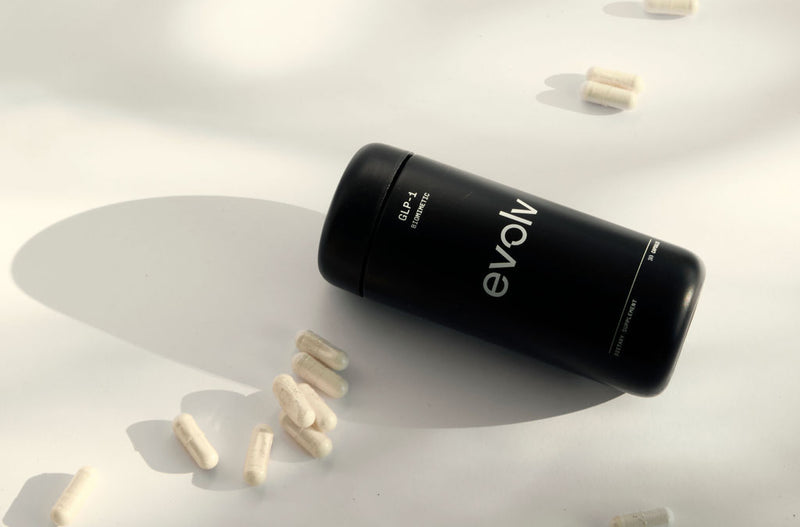
This is the system Evolv works with. Evolv GLP-1 is a natural biomimetic dietary supplement built around a proprietary yeast-derived peptide designed to support GLP-1 and GIP appetite pathways.
The active ingredient — the bioengineered, yeast-derived EV1 Peptide — is designed to engage the body’s natural GLP-1 and GIP signaling, the satiety side of the appetite system that opposes ghrelin’s hunger drive. In the data read-out from an 8-week randomized controlled study, participants consumed approximately 750 fewer calories per day. The mechanism isn’t appetite suppression — it’s pathway-based support for the system underneath the behavioral patterns.
This doesn’t replace stress management, mindful eating, or therapy. It supports the biological side of the equation while the behavioral side gets addressed. For more on the underlying mechanism, see how Evolv’s EV1 Peptide supports GLP-1 and GIP appetite pathways and how appetite control supplements support weight loss.
For readers whose emotional eating is rooted in chronic blood sugar instability or post-diet hormonal patterns — and who’ve worked the behavioral side without lasting change — Evolv’s oral GLP-1 biomimetic peptide is a daily tablet designed for sustained pathway engagement.
Frequently Asked Questions
What are the root causes of emotional eating?
Emotional eating is typically driven by a combination of stress (elevated cortisol that amplifies appetite and reward signaling), unmet emotional needs (boredom, loneliness, sadness, anxiety), restrictive dieting that creates rebound urges, sleep deprivation that dysregulates hunger hormones, and learned associations between food and comfort from earlier in life. Most people experience a mix of these drivers rather than a single cause.
What are the 4 types of emotional eating?
Researchers commonly describe four overlapping patterns: stress eating (eating to cope with cortisol-driven anxiety or overwhelm), boredom eating (eating in the absence of hunger when underoccupied), comfort eating (using food to soothe sadness, loneliness, or low mood), and reward eating (using food to celebrate, mark milestones, or as a planned “treat”). These patterns often blend rather than appearing as discrete categories.
Is emotional eating a mental disorder?
Emotional eating on its own is not classified as a mental disorder — it’s a coping pattern most people experience occasionally. However, when emotional eating becomes the dominant way of managing emotions, including loss of control around food, or significantly disrupts daily life, it can overlap with binge eating disorder (BED) — a recognized eating disorder. If emotional eating is severe, persistent, or paired with shame, secrecy, or post-eating distress, a clinical evaluation can clarify whether it crosses into disordered eating territory.
Why is it so hard to stop emotional eating?
Emotional eating is hard to stop because it works — at least short-term. Eating triggers dopamine release in the brain’s reward system, which genuinely reduces stress and improves mood for a few minutes. The body learns this association quickly. Combined with elevated cortisol (which directly increases appetite), restrictive dieting (which raises ghrelin), and sleep deprivation (which raises ghrelin and lowers leptin), the biological deck is stacked against willpower-based strategies. Effective change requires addressing the underlying stress and hormonal patterns, not just resisting the urge.
Do supplements help reduce emotional eating?
Some supplement categories help indirectly. Magnesium and ashwagandha support stress response and lower cortisol. Omega-3 fatty acids help regulate mood. Soluble fiber and protein support stable appetite hormones throughout the day, reducing the hormonal drivers that amplify emotional urges. Biomimetic products that support the body’s natural GLP-1 and GIP appetite pathways — including Evolv GLP-1 — work on the satiety hormone side of the system, which can reduce reward-driven food seeking. Supplements work best as part of a broader approach that includes stress management, sleep, and behavioral strategies.
These statements have not been evaluated by the Food and Drug Administration. This product is not intended to diagnose, treat, cure, or prevent any disease.
Sources
- Bini J, et al. “Stress-level glucocorticoids increase fasting hunger and decrease cerebral blood flow in regions regulating eating.” NeuroImage: Clinical, 2022. https://pmc.ncbi.nlm.nih.gov/articles/PMC9486604/
- Benedict C, et al. “A single night of sleep deprivation increases ghrelin.” PMID 18564298. https://pubmed.ncbi.nlm.nih.gov/18564298/
- Harvard Health. “Struggling with emotional eating?” https://www.health.harvard.edu/diet-and-weight-loss/struggling-with-emotional-eating
- Houston Methodist. “A Dietitian’s No-Nonsense Guide to Fighting Emotional Eating.” https://www.houstonmethodist.org/blog/articles/2020/dec/a-dietitians-no-nonsense-guide-to-fighting-emotional-eating/
- Heart and Stroke Foundation. “How to curb emotional eating.” https://www.heartandstroke.ca/articles/how-to-curb-emotional-eating
- PeaceHealth. “How to stop emotional eating: 5 coping skills.” https://www.peacehealth.org/healthy-you/how-stop-emotional-eating-5-coping-skills-you-can-practice-right-now
- National Eating Disorders Association. https://www.nationaleatingdisorders.org/