







Does GLP-1 cause muscle loss? What the research says
Authored by
The Evolv Research Team
Few questions have shaped the GLP-1 conversation more than this one. Between the headlines warning about “Ozempic face,” the Reddit threads debating lean mass loss, and the friend who swore their muscle tone disappeared on semaglutide — the concern about GLP-1 muscle loss has become the biggest hesitation people have before starting any GLP-1 therapy.
The number most often cited is alarming: up to 40-60% of weight lost on GLP-1 drugs is lean mass. It shows up in medical journals, news articles, and forums alike. But that statistic deserves more context than most articles give it.
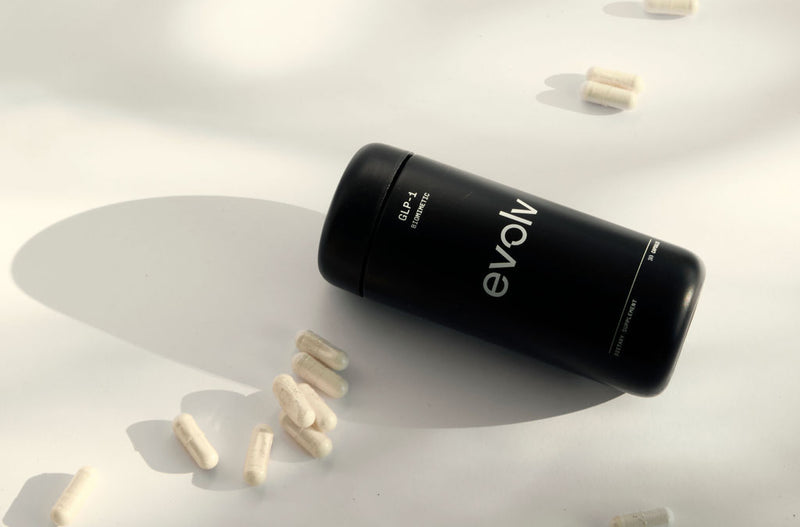
The relationship between GLP-1 and muscle is more nuanced than headlines suggest, and the most recent research (2025-2026) paints a meaningfully different picture than what you may have read even a year ago. This nuance is exactly what shaped the design behind Evolv — a biotech supplement company focused on the GLP-1 pathway. Its oral biomimetic peptide engages both GLP-1 and GIP appetite pathways with a daily oral, dietary-supplement profile rather than the sustained pharmacological exposure of injectable GLP-1 drugs.
Here’s what the clinical evidence actually shows about GLP-1 weight loss and muscle preservation, why the alarming numbers are partly a measurement artifact, and what you can do to protect lean mass — whether you’re on a GLP-1 medication, considering one, or exploring natural GLP-1 pathway support.
What the research actually says about GLP-1 and muscle loss
Let’s start with the data. The most-cited meta-analysis on this topic — Neeland et al. (2024, cited over 300 times) — reports that “reductions in lean mass range between 40% and 60% as a proportion of total weight lost” in GLP-1 medication studies.
That sounds alarming. But there’s a critical methodological caveat that most articles skip.
The DXA measurement problem
Most of these studies use DXA (dual-energy X-ray absorptiometry) to measure body composition. DXA divides your body into “fat mass” and “lean mass” — but “lean mass” isn’t just skeletal muscle. It includes organs, bone mineral content, body water, and connective tissue.
When you lose weight, your body naturally retains less water, your organs can reduce slightly in size, and glycogen stores deplete. All of that registers as “lean mass loss” on a DXA scan without representing actual skeletal muscle degradation.
Neeland’s own review acknowledges this: when MRI-based studies (which measure actual skeletal muscle directly) are used instead of DXA, muscle reductions are “adaptive” and “commensurate with what is expected given ageing, disease status, and weight loss achieved.”
What the numbers actually look like
The most precise data comes from the SURMOUNT-1 DXA sub-study (2025), which measured body composition in 160 participants on tirzepatide:
- Total body weight reduction: 21.3%
- Fat mass reduction: 33.9%
- Lean mass reduction: 10.9%
- Split: approximately 75% of total weight lost was fat, 25% was lean mass
A 2024 meta-analysis of 19 randomized controlled trials found that GLP-1 receptor agonists reduced lean body mass by a weighted mean difference of just 1.02 kg compared to non-users. The authors’ conclusion: “changes in lean mass percentage were comparable between GLP-1 receptor agonist users and non-users” — meaning proportional lean mass loss was no worse than expected for that degree of weight loss.
To put it plainly: some lean mass loss during weight loss is biologically inevitable. The question is whether GLP-1 makes it worse than other weight loss methods.
Does GLP-1 directly cause muscle loss — or is caloric restriction the real driver?
Here’s where the “40-60%” headline starts to look different.
A 2025 study in Nature Communications found that GLP-1 receptor agonists cause muscle loss “via appetite suppression and caloric restriction” — through the body’s normal energy-conservation response to eating less, not through any direct catabolic effect of the drug itself. The deeper the caloric deficit, the more lean mass loss you’d expect, regardless of how that deficit was created.
This is the reframing that matters. The concern people often express as “muscle loss on Ozempic” is less about the drug’s direct effect on muscle tissue and more about how aggressively the drug suppresses appetite — and how that caloric drop is (or isn’t) offset by protein intake, resistance training, and a reasonable caloric floor.
Emerging 2025-2026 research even suggests GLP-1 may actively preserve lean mass in some contexts, compared to equivalent dieting alone. That’s a separate (and still-developing) story. For the deeper look at how GLP-1 may actively support muscle and bone health, read what if GLP-1 supports muscle and bone: inside the emerging research.
For this article, the takeaway is simpler: if caloric restriction is the real driver of muscle loss on GLP-1, then the levers for protecting muscle are the same levers you’d use during any weight loss effort — just applied more deliberately when appetite is suppressed.
How to prevent muscle loss on GLP-1: 5 evidence-based strategies
Even with the more nuanced data, lean mass preservation matters — especially for long-term metabolic health. Here’s what the research supports for GLP-1 weight loss and muscle preservation, whether you’re on an injectable or exploring a natural GLP-1 pathway support option.
1. Resistance training — the single strongest lever
A review in Diabetes Care (2024) found that supervised resistance exercise training for more than 10 weeks produces approximately 3 kg of lean mass gain and roughly 25% strength improvement in men and women. This can recover about half of the ~6 kg lean mass typically lost on GLP-1 medications.
Aim for 2-3 resistance training sessions per week targeting all major muscle groups. Combining resistance training with aerobic exercise appears more effective for overall metabolic health than either alone.
2. Prioritize protein intake
Protein provides the amino acid substrate your body needs to maintain and rebuild muscle. During weight loss, protein needs increase — not decrease.
The general recommendation during GLP-1 weight management: 1.2-1.6g of protein per kg of body weight daily, spread across meals. Front-loading protein at breakfast and lunch can help when appetite is most suppressed.
3. Maintain an adequate caloric floor
Since muscle loss appears driven primarily by caloric restriction (not GLP-1 itself), ensuring you’re not drastically undereating is protective. An excessively low caloric intake accelerates lean mass breakdown.
Work with your provider to establish a minimum daily caloric target — even if your appetite is significantly reduced. Eating “enough” becomes a conscious effort when GLP-1 signaling is working effectively.
4. Consider creatine monohydrate
Creatine is the most-studied supplement for lean mass and strength preservation. While no GLP-1-specific randomized controlled trial has been published yet, the general weight loss literature consistently shows creatine supports muscle retention during caloric deficit.
Standard dosing: 3-5g daily.
5. Explore oral GLP-1 pathway support
Early research on oral GLP-1 approaches suggests a potentially different risk profile for muscle. A 24-week study of oral semaglutide found lean mass showed no significant change despite fat mass reduction. A separate 26-week study confirmed that fat-free mass and skeletal muscle mass were preserved during oral therapy.
This pattern is part of what shaped Evolv’s design. Its active ingredient — the bioengineered, yeast-derived EV1 Peptide — is composed of canonical, naturally occurring amino acids and is designed to support both GLP-1 and GIP appetite pathways at a daily oral, dietary-supplement signaling level rather than the sustained pharmacological exposure of injectable receptor agonists.
Evolv GLP-1 is designed for daily oral use with no harsh side effects. In Evolv’s 8-week randomized controlled study, participants consumed approximately 750 fewer calories per day and lost up to 12+ lbs, and no participants reported hair loss or muscle loss during the study. Individual results may vary, and the trial doesn’t establish that muscle preservation is guaranteed for every user — but it represents a meaningful data point in this conversation. These outcomes sit in the same magnitude range that published prescription GLP-1 trials report at the 8-week timepoint.
Learn more about the research behind Evolv GLP-1 and how the biomimetic mechanism works.
The bottom line on GLP-1 and muscle
GLP-1 muscle loss is real — but it’s more nuanced than the alarming headlines suggest. The 40-60% figures are inflated by DXA measurement limitations. The caloric deficit the drug creates — not a direct catabolic effect — appears to be the primary driver of lean mass change. And with the right combination of resistance training, adequate protein, and smart caloric management, much of the lean mass impact is preventable or recoverable.
If you’re exploring GLP-1 pathway support and muscle preservation matters to you, consider how oral biomimetic approaches work — and look at the data for Evolv GLP-1, where the 8-week clinical study showed no participant-reported hair or muscle concerns.
The science is evolving. Your approach should be informed by the latest data — not last year’s headlines.
Frequently Asked Questions
How much muscle do you actually lose on GLP-1 medications?
In the SURMOUNT-1 DXA sub-study, approximately 25% of total weight lost on tirzepatide was lean mass — meaning 75% was fat. Other DXA-based estimates range from 40-60%, but DXA “lean mass” includes organs, fluids, and bone water — not just skeletal muscle. MRI-based studies suggest actual skeletal muscle loss is proportional to what’s expected with any weight loss of similar magnitude.
How can I gain muscle while on GLP-1?
Resistance training is the strongest evidence-based strategy. Research shows supervised resistance training for over 10 weeks can produce approximately 3 kg of lean mass gain and 25% strength improvement. Combine with adequate protein intake (1.2-1.6g per kg of body weight daily) and ensure you’re not drastically undereating. Start early — ideally alongside GLP-1 use, not after muscle loss has occurred.
Does natural GLP-1 support carry the same muscle loss risk as injections?
The muscle loss associated with GLP-1 medications appears driven by the caloric deficit they create, not a direct drug effect. Oral GLP-1 approaches that produce more moderate caloric changes may carry a different risk profile for muscle. Evolv GLP-1 is designed for daily oral use with no harsh side effects — in our 8-week clinical study, no participants reported hair loss or muscle loss. Consult your physician about which approach is appropriate for your goals.
Why shouldn’t you panic about GLP-1 muscle loss?
The 40-60% lean mass figures cited in most articles are partly a measurement artifact — DXA “lean mass” includes organs, body water, and connective tissue, not just skeletal muscle. MRI-based studies show actual skeletal muscle loss is proportional to what’s expected with any weight loss of similar magnitude. A 2025 Nature Communications study also clarified that GLP-1 muscle loss is driven by the caloric restriction the drug creates, not a direct catabolic drug effect. With resistance training, adequate protein, and a reasonable caloric floor, much of the lean mass impact is preventable.
Can you reverse muscle loss from GLP-1 medications?
Yes. Research shows resistance training can recover roughly half of the lean mass lost during GLP-1 therapy. The key is starting resistance training early. Adequate protein and maintaining a caloric floor also support recovery. For broader context on how GLP-1 impacts weight, hormones, and longevity, explore the full science.
Sources
- Neeland IJ, et al. GLP-1 receptor agonists and body composition: a systematic review and meta-analysis of clinical trials. (2024).
- SURMOUNT-1 DXA sub-study: Tirzepatide and body composition changes. (2025, 160 participants).
- Meta-analysis of 19 randomized controlled trials on GLP-1 receptor agonists and lean body mass. (2024).
- GLP-1 receptor agonist–induced muscle loss is mediated by appetite suppression and caloric restriction. Nature Communications. (2025).
- Diabetes Care review: Supervised resistance training and lean mass during weight loss. (2024).
- 24-week oral semaglutide body composition study.
- 26-week oral semaglutide fat-free mass and skeletal muscle preservation study.
- Evolv GLP-1 8-week randomized controlled study.
For deeper citations on emerging “GLP-1 supports muscle and bone” research (Wu 2022 / AMPK pathway, Li 2024 / bone mineral density, Jensen 2024 / JAMA Network Open), see our companion piece: what if GLP-1 supports muscle and bone.
These statements have not been evaluated by the Food and Drug Administration. This product is not intended to diagnose, treat, cure, or prevent any disease.
Individual results may vary. Consult your physician before starting any new supplement or making changes to your medication regimen.