










September 15, 2026
GLP-1 and Aging: Can It Turn Back the Clock on Longevity?
Authored by
Dr. Cory Henderson
Co-Founder of Evolv
Some researchers are calling GLP-1 “the first real longevity drug.” Some Reddit threads underneath those headlines are asking whether it’ll just trade short-term weight loss for long-term damage. Both reactions are honest. Both are missing the same point.
GLP-1 isn’t a drug. It’s a hormone your body produces every time you eat. The question isn’t whether to “take GLP-1” — it’s how to support the pathway it works through, and what mechanisms of aging that engages.
Here’s what the research actually shows about GLP-1 and aging — and what “turn back the clock” really means in terms of measurable longevity biology.
This matters because supporting the body’s natural GLP-1 signaling now has more than one form. The injectable GLP-1 medications dominate the conversation, but they’re not the only way to engage the pathway.
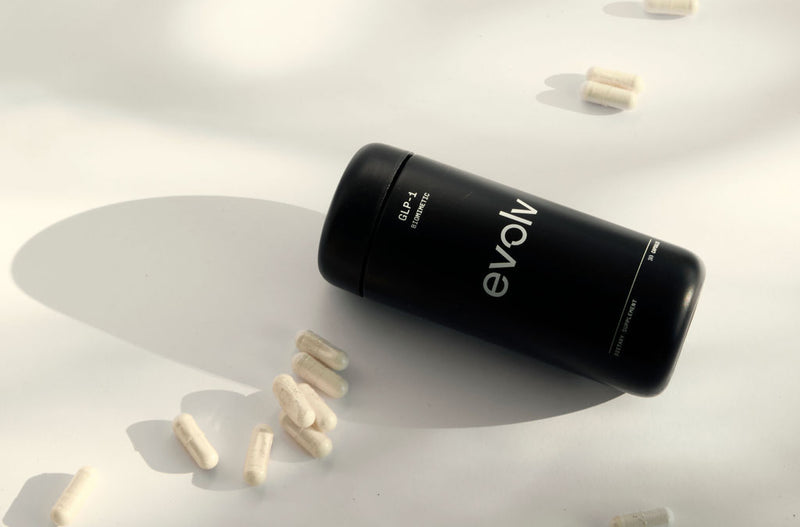
Evolv GLP-1 is a natural biomimetic dietary supplement built around a proprietary yeast-derived peptide designed to support GLP-1 and GIP appetite pathways.
Its active ingredient — the bioengineered, yeast-derived EV1 Peptide — is the first of its kind to show results in a daily oral tablet. Across Evolv’s randomized controlled study, with results read out at 8 weeks, participants lost up to 12+ lbs and consumed approximately 750 fewer calories per day, with no participant-reported hair or muscle concerns. That last finding — no muscle concerns — is the longevity-audience headline, and we’ll come back to it.
GLP-1: A Quick Refresher
GLP-1 (glucagon-like peptide-1) is a hormone the body produces in the gut in response to food. Within minutes of eating, GLP-1 levels rise; the hormone meets its receptors across the pancreas, stomach, brain, and liver, and signals the systems that handle blood sugar, fullness, and appetite to respond accordingly.
This is the pathway prescription GLP-1 medications target. Semaglutide (sold as Ozempic and Wegovy), tirzepatide, dulaglutide, and liraglutide are GLP-1 receptor agonists — molecules designed to engage GLP-1 signaling and trigger the same downstream effects as the natural hormone. They’re a physician-managed, injectable form of engaging the pathway.
That’s not the only form. A newer category of biomimetic products is designed to support the body’s own GLP-1 signaling through a daily oral tablet. For the foundational explainer on what GLP-1 actually is, that’s the starting point.
The pathway matters here because the longevity question isn’t really “should I take an injectable?” — it’s “what does engaging GLP-1 signaling do across systems, and how can I support it?”
GLP-1 and Weight
GLP-1’s most studied effect is on appetite and satiety. It slows gastric emptying so food stays in the stomach longer, signals the brain to register fullness, and helps regulate post-meal glucose response — three mechanisms that together reduce caloric intake without willpower as the primary lever.
That’s why “food noise” — the constant low-grade chatter in your head about the next meal — quiets when GLP-1 signaling is strong.
In Evolv’s randomized controlled study — with results read out at 8 weeks — participants lost up to 12+ lbs and consumed approximately 750 fewer calories per day. That’s not through forced restriction — it’s through biology. When the satiety signal is on, the calorie reduction follows naturally.
Evolv’s mechanism is worth being specific about: the EV1 Peptide is designed to support both GLP-1 and GIP appetite pathways. GIP (glucose-dependent insulinotropic polypeptide) is GLP-1’s co-incretin — the second satiety hormone that works in tandem with GLP-1 to regulate post-meal response. Pairing the two is closer to how the body’s own appetite regulation actually works.
GLP-1 and Hormonal Balance
GLP-1 doesn’t act in isolation. It sits inside a network of metabolic hormones — insulin, glucagon, leptin, cortisol, and estrogen — that together regulate energy balance, fat storage, and appetite.
When GLP-1 signaling is strong, insulin sensitivity tends to improve and post-meal glucose responses smooth out. That matters because chronic insulin elevation drives fat storage and inflammation — two of the biggest accelerators of unwanted weight gain in midlife. Lower glucose excursions also reduce the cortisol and inflammatory load that come with frequent blood sugar swings.
For women navigating perimenopause and menopause, the picture gets more complex. Estrogen decline shifts where the body stores fat, alters insulin sensitivity, and changes how leptin (the satiety hormone) works. GLP-1 signaling can act as a stabilizer across that shift — supporting appetite regulation when estrogen is no longer doing as much of the work.
For a deeper walkthrough of the full hormone-and-weight conversation, see hormone balance and weight loss.
The takeaway: GLP-1 isn’t a standalone lever. It’s part of the signal network. Supporting it supports the network.
GLP-1 and Longevity: What’s the Relationship?
GLP-1 is a hormone your body produces in response to food, and emerging research shows it engages several pathways linked to aging biology — reducing chronic low-grade inflammation, supporting autophagy, slowing epigenetic-clock measures of biological age, and supporting cardiovascular and cognitive health.
The longevity conversation is where GLP-1 stops being “a weight loss tool” and starts looking like something broader. The evidence is real, but it’s also genuinely early — the field is moving fast, and the strongest claims should still come with caveats.
How Evolv Supports the GLP-1 Pathway
The longevity case for GLP-1 is no longer just about weight loss — it’s about engaging a pathway that touches inflammation, autophagy, cardiovascular aging, and (more cautiously) cognitive health. The question for the longevity-focused reader is how to engage that pathway in a way that fits the rest of their protocol.
Biomimetic products are the newer category designed to do exactly that: pathway-based wellness products built to engage biological signaling systems through daily oral support rather than injection. The category was a structural gap in the supplement industry until recently — most “GLP-1 supplements” relied on plant extracts that elicit short, indirect responses rather than engaging the signaling pathway directly.
Evolv GLP-1 is a natural biomimetic dietary supplement built around a proprietary yeast-derived peptide designed to support GLP-1 and GIP appetite pathways.
Its active ingredient — the bioengineered, yeast-derived EV1 Peptide — is designed for sustained pathway engagement through a daily oral tablet. In Evolv’s randomized controlled study, with results read out at 8 weeks, participants lost up to 12+ lbs, consumed approximately 750 fewer calories per day, and reported no harsh side effects or hair or muscle concerns. For the longevity audience, that last data point matters disproportionately — it’s the direct counter to the sarcopenia anxiety that drives a lot of the GLP-1 skepticism in r/longevity and the biohacker forums.
Evolv’s positioning on long-term safety stays in structure-function language by design. The supplement is built for daily oral use and sustained pathway engagement; long-term data on biomimetic peptides is still being built, the same way long-term data on every newer intervention is. Talk with your doctor before combining with medications, and especially if you’re pregnant or breastfeeding.
For people who want to engage the GLP-1 longevity pathway but don’t want or need a prescription injectable, the biomimetic category is the option that didn’t exist five years ago. For more on how the biomimetic mechanism works, how natural GLP-1 pathway support compares to other approaches, and natural ways to increase GLP-1, those are the dedicated walkthroughs. For biomimetic supplements for metabolic health as a category, the category explainer is here. For the underlying science, the Evolv science page is the source of record.
The Future Is Biological
The first generation of weight management was behavioral — diet, exercise, willpower. The second generation was pharmaceutical — appetite suppressants, then statins, then the GLP-1 receptor agonists that defined the pharmaceutical layer of the 2020s. The third generation is biological: supporting the body’s own pathways through products built to work with the underlying biology rather than override it.
That’s where the biomimetic category sits. It’s not a replacement for any of the prior generations — it’s a new layer with its own use case. For the longevity-focused reader specifically, it’s the form of GLP-1 engagement that’s lowest-friction to integrate into a long-horizon healthspan protocol: daily oral, no prescription, designed for sustained pathway support, and (in Evolv’s clinical data) without the body composition tradeoffs that drove a lot of the early longevity skepticism around injectables.
The future of metabolic health and longevity isn’t a needle. It’s a tablet — and a deeper understanding of which biological systems to engage, and how.
Frequently Asked Questions
Can GLP-1 reverse aging?
Research on GLP-1 and aging is emerging — not yet definitive. A 2026 randomized controlled trial published in Nature Communications found that semaglutide slowed biological aging by approximately 9% on the DunedinPACE epigenetic clock over 32 weeks in 108 adults with HIV-associated lipohypertrophy. Other peer-reviewed work suggests GLP-1 signaling reduces chronic inflammation, supports autophagy, and engages the Nrf2 antioxidant pathway. The honest framing: GLP-1 engages multiple longevity mechanisms, but “reversing aging” overstates today’s evidence. Supporting the pathway is well-supported; reversal is hype.
Is 70 too old for GLP-1?
Age alone is not a disqualifier for GLP-1 pathway support. The bigger concern for older adults is preserving muscle mass while losing fat — sarcopenia, or age-related muscle loss, accelerates frailty. Whatever approach you take (injectable, natural pathway support, or lifestyle alone), at least 30 g of protein at the first meal and resistance training are non-negotiable. Discuss any GLP-1 protocol with your doctor first, particularly if you have existing conditions or take medications.
Do GLP-1 deplete collagen?
There is no direct evidence that GLP-1 itself depletes collagen. What people sometimes call “Ozempic face” reflects the effect of rapid weight loss on skin elasticity — the skin doesn’t always shrink as fast as the fat underneath. A 2025 review in Endocrine (Paschou et al.) actually suggests GLP-1 receptor agonists may delay skin aging by reducing systemic inflammation and advanced glycation end-product (AGE) buildup, though the same review notes the mechanisms can run in both directions. Maintaining protein intake and pacing weight loss are the better levers for skin appearance.
What about the long-term safety of GLP-1?
Long-term safety data for injectable GLP-1 medications is still maturing — they’ve been on the market for diabetes for roughly a decade, but use specifically for weight management at scale is more recent. A 2026 Penn study published in Nature Health used AI to analyze more than 400,000 Reddit posts and surfaced patient-reported symptoms not always captured in clinical trial reporting, including fatigue and temperature dysregulation. Natural GLP-1 pathway support via biomimetic peptides offers a different risk profile — Evolv’s randomized controlled study, read out at 8 weeks, reported no harsh side effects and no participant-reported hair or muscle concerns. Longer-term data on biomimetic approaches is also still being built.
Can supplements support GLP-1 for longevity?
It depends on what you mean. Generic appetite products (caffeine, fiber, plant extracts) don’t directly engage GLP-1 signaling. The newer biomimetic category engages GLP-1 and GIP appetite pathways more directly. Evolv GLP-1 is the clinically studied example in this category — built around a bioengineered, yeast-derived peptide. Evolv’s randomized controlled study, read out at 8 weeks, showed participants lost up to 12+ lbs with no participant-reported muscle concerns — particularly relevant for the longevity audience worried about sarcopenia.
These statements have not been evaluated by the Food and Drug Administration. This product is not intended to diagnose, treat, cure, or prevent any disease.