









Stress Eating: Why It Happens and How to Break the Cycle
Authored by
The Evolv Research Team
You ate lunch an hour ago. Then the email lands, and twenty minutes later you’re standing at the pantry with no memory of deciding to go there.
Stress eating is eating for relief rather than hunger, and it almost always goes for the same sweet, salty, or fatty comfort foods. It’s common: in the American Psychological Association’s Stress in America survey, 38% of adults said they’d overeaten or eaten unhealthy foods in the past month because of stress. It also has a specific biology. When tension doesn’t let up, cortisol, the hormone your body releases under pressure, stays elevated, and it raises appetite, points it at the most rewarding food in reach, and weakens the part of the brain that would normally put on the brakes.
That’s why “just stop” so rarely works, and why the fixes that hold up target the stress response itself.
What Is Stress Eating?
Stress eating means using food to handle pressure, tension, or overload instead of to meet a physical need. Two things give it away. The urge follows a stressor, either right away or in the decompression window at the end of a hard day, and it’s narrow, aimed at something specific rather than anything edible.
It’s one branch of emotional eating, the wider habit of using food to manage feelings like boredom, loneliness, or sadness. If those other feelings are what send you to the kitchen, our guide on how to stop emotional eating covers the broader toolkit. Stress eating runs on a defined hormonal trigger, your body’s stress-response system, and that changes which fixes are worth your time.
Why Does Stress Make You Eat More? The Cortisol Connection
Stress eating happens because of cortisol, but only once stress drags on. A sudden scare shuts appetite down; stress that lingers turns it back up.
A Sudden Scare Usually Shuts Appetite Down
In the first minutes of a fright, adrenaline (epinephrine) moves energy toward your muscles and brain and away from digestion. In their review of stress and eating, researchers Yau and Potenza describe appetite suppression as part of the textbook acute stress response. It’s why a near-miss on the highway doesn’t leave you hungry.
Stress That Lingers Turns It Back Up
When the stress doesn’t resolve, a second system takes over. The HPA axis is a chain of signals that runs from the hypothalamus in your brain to the pituitary gland and on to the adrenal glands above your kidneys, and it keeps cortisol flowing. Cortisol’s job is to keep fuel available for a threat that never seems to end, and one way it does that is by raising appetite.
According to Harvard Health, high cortisol together with high insulin may be part of what pushes people toward fatty, sugary food, and ghrelin, a hunger hormone, may play a role too. Over months, Yau and Potenza note, repeated stress you can’t control can knock the HPA axis out of calibration, which affects both energy balance and eating behavior.
Why It’s Always the Same Few Foods
Stress also changes what appetite goes looking for. Brain imaging work in the Yau and Potenza review found that stress and cortisol both increased dopamine release in the brain’s reward center, and that people with bigger cortisol responses released more of it. Dopamine is the chemical that flags something as worth going after.
Food that’s high in sugar and fat sends its own dopamine signal on top of that. Researchers call these foods hyperpalatable, meaning they’re built in a way that makes them hard to stop eating. So the pull toward chips or chocolate under stress has a logic to it: the reward system is already primed, and those foods answer it fastest.
Why Stopping Feels Harder Than Starting
Chronic stress also changes the brain’s wiring. It adds connections in the amygdala, the region that processes threat and emotion, and trims connections to the prefrontal cortex, the area behind your forehead that handles planning and impulse control. Yau and Potenza sum up the result in one line: the stressed brain shows “both a strong drive to eat and an impaired capacity to inhibit eating.”
People describe the same thing in plainer words. “Every time I’m stressed… the urge to eat… overcomes me,” one Reddit user wrote, which is a fair description of a brain with the accelerator pressed and the brake loosened at the same time.
Why the Relief Keeps the Loop Running
Stress eating is sticky for an uncomfortable reason: it works, briefly. In animal studies, rats given palatable food during chronic stress showed a damped stress-hormone response. Comfort food really does quiet the alarm for a while.
Your brain files that away as a solution, so the next stressor brings the urge back faster. Meanwhile, the stress itself hasn’t moved. As another Reddit user put it, “stress will still be there after you indulge.”
Signs of Stress Eating
Any single snack is hard to judge. A week of them is easier to read. These patterns point to stress rather than hunger.
The Timing Follows Your Stress, Not Your Meals
The urge shows up after the tense call, during the deadline crunch, or at 9 p.m. once the day finally lets go, rather than four or five hours after you last ate.
It’s the Same Two or Three Foods Every Time
Stress cravings are specific. If almost anything would do, it’s more likely real hunger.
You Graze While You Work
A bite here and a handful there, taken without much notice, is one of the common forms of stress eating Harvard Health describes.
Busy Days Start With Skipped Meals and End With Overeating
Stress pushes meals aside, and the hunger you postponed tends to arrive all at once in the evening.
Thoughts About Food Get Louder
Evolv co-founder Becca McCarthy described food noise on the Mom Curious podcast as “that constant chatter in your mind that is compelling you to snack.” Stress turns that chatter up, and our piece on how to stop food noise goes deeper on where it comes from.
The Guilt Becomes Part of the Stress
Feeling bad afterward is common, and it adds one more stressor to the pile that sets off the next round.
If the hunger feels constant rather than tied to stressful moments, the causes are usually different, and it’s worth reading about why you might always feel hungry.
Most people stress eat now and then. Talk to a doctor or registered dietitian if episodes happen often, involve eating a large amount quickly with a sense of losing control, or are followed by purging, fasting, or exercise to make up for it. Those can be signs of an eating disorder rather than a stress habit, and a professional can help sort out which it is.
How to Stop Stress Eating
Pausing before you eat or naming the feeling helps with any kind of emotional eating. Stress eating also gives you levers further upstream: the stress response, the reward pull, and the appetite signal it runs on.
1. Burn Off the Stress Response
Movement is the most direct lever, because it works on the stress itself rather than the snack. The research is early but points the same way. In small lab studies reviewed in the journal Nutrients in 2018, a 15-minute brisk walk before a stressful task reduced sugary-snack cravings in one study and cut chocolate intake in another.
In those studies, the walk came before the stressor, not after the craving, which makes it a planning tool. A walk before a hard meeting or between back-to-back calls can head off stress. Harvard Health’s everyday version is a short walk or stretch between tasks instead of a trip to the snack drawer.
2. Keep Meals on the Calendar When Stress Spikes
The adrenaline of a frantic morning mutes hunger, so lunch slides, and Harvard Health lists skipped meals as one of the forms of stress eating that sets up overeating later. By evening the postponed hunger arrives at the same time as the lingering cortisol and a primed reward system, which is the hardest combination to manage.
On high-pressure days, make lunch a meeting you can’t move. Building it around protein and fiber, the nutrients that help you feel full longer, gives the evening less hunger to work with.
3. Protect Sleep During Stressful Stretches
Stress and short sleep tend to arrive together. Roughly 30% of US adults sleep less than six hours a night, according to Yau and Potenza, and Harvard Health notes that stressed people often sleep less and that fatigue can amplify cravings. Put that next to the loosened brakes of a chronically stressed brain, and a tired, stressed evening leaves very little impulse control to spare.
If your stress eating clusters after dark, our article on night cravings explains why appetite shifts in the evening.
4. Give Your Brain a Non-Food Way Down
Comfort food works because it calms the stress response, so the replacement has to calm it too. Social support can act as a buffer: Harvard Health points to research in which emergency department staff with adequate support from others had better mental health. Meditation is another, and it may also help you notice the impulse to eat before you act on it.
A ten-minute call with a friend won’t fix the deadline. It does give your stress response somewhere to go that isn’t the pantry.
5. Support the Appetite Signal
Some people do all of the above and still feel the pull, because the appetite system underneath is running hot. That’s the layer GLP-1 sits in.
GLP-1 is a hormone your own gut releases after you eat. It carries the message to your brain and other organs that you’ve had enough, which makes it central to the feeling of fullness. There are natural ways to support GLP-1 signaling through food, and what any GLP-1 product works on is that same signaling pathway.
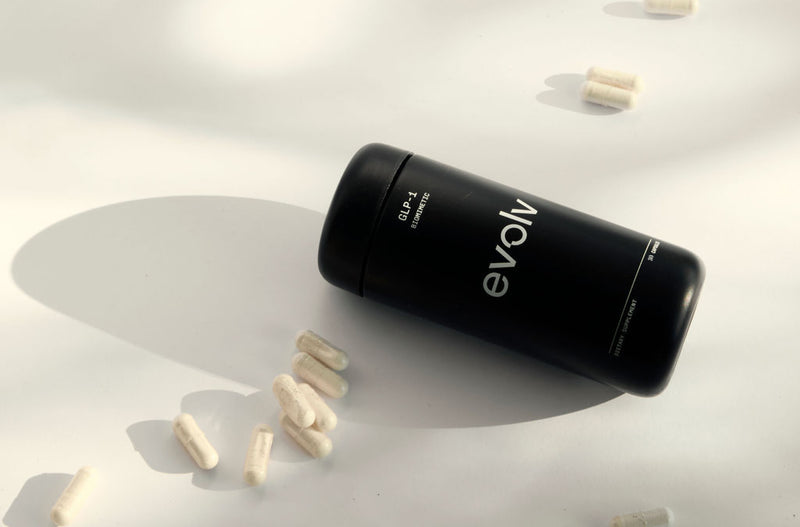
Evolv GLP-1 is a natural biomimetic dietary supplement built around a proprietary yeast-derived peptide designed to support GLP-1 and GIP appetite pathways.
Its active ingredient, the bioengineered, yeast-derived EV1 Peptide, is designed to support your own GLP-1 and GIP signaling, the fullness side of the appetite system. In Evolv’s clinical study, participants consumed approximately 750 fewer calories per day and lost up to 12+ lbs in 8 weeks.
Mom Curious host Daniela Ravani described the shift in her own eating on the same episode: “I’m not driven by compulsion. I’m driven by, okay, I’m hungry.” For someone caught in a stress-eating loop, compulsion is exactly the problem, because cortisol and dopamine make the urge feel more pressing than hunger ever does.
Pathway support is designed to work alongside the four habits above: they turn down the stress response, and supporting your GLP-1 and GIP pathways works on the appetite side. Read more about the science behind GLP-1 and GIP pathway support, or explore Evolv GLP-1.
Stress eating makes more sense once you can see the machinery. Cortisol raises appetite, dopamine aims it at comfort food, and a stressed brain has less brake to apply. Each of those has a lever: move when the pressure peaks, keep meals and sleep steady through hard weeks, give your stress response a way down that isn’t food, and support the appetite signal alongside all of it.
Frequently Asked Questions
Why does stress make some people lose their appetite?
It depends on the kind of stress and on the person. A sudden shock triggers adrenaline, which pushes digestion down the body’s priority list, so appetite often disappears for a while. With stress that drags on, people split: a review by Yau and Potenza puts it at roughly 40% eating more and 40% eating less, with the rest showing little change. Even the people who eat less tend to shift toward sweeter, richer food, so a smaller appetite under stress doesn’t always mean better choices.
Do men and women stress eat differently?
On average, somewhat. Harvard Health cites research finding that women are more likely to turn to food under stress and men more likely to turn to alcohol or smoking, and a Finnish study of more than 5,000 people linked stress-related eating with higher body weight in women but not in men. Those are population averages, so plenty of men stress eat, and plenty of women don’t. The underlying biology (cortisol plus the brain’s reward system) works the same way in everyone.
Does stress eating always lead to weight gain?
Not always. Harvard researchers found that work stress and other stress tracked with weight gain mainly in people who already carried more weight when the study began, and one theory is that higher insulin levels in that group make the extra calories easier to store. For people outside that group, the higher cost may be what stress eating crowds out: regular meals, decent sleep, and a sense that your appetite is yours to run.
How long does it take to break a stress-eating habit?
There’s no fixed number, but habit research gives a realistic range. In a well-known University College London study (Lally and colleagues, 2010), new daily habits took a median of 66 days to feel automatic, and individual times ran anywhere from 18 to 254 days. Swapping a stress-eating response for a new one is a habit change too, so plan on weeks to months rather than days. Missing a single day didn’t derail progress in that study, so one rough evening doesn’t reset the clock.
Is it normal to stress eat?
Yes, it’s one of the most common ways people respond to pressure. What separates an occasional reaction from a pattern is frequency. Among adults in the American Psychological Association’s 2013 Stress in America survey who had overeaten because of stress in the past month, about half said it happened weekly or more. Once it’s that regular, stress eating behaves like a routine, and routines respond better to changing the stress side of the equation than to resisting the urge each time.
Why do I crave crunchy or sweet food when I’m stressed?
The specific craving often tracks the specific feeling. Harvard Health notes that frustration or anger tends to bring on a pull toward something crunchy, as if the chewing could release the tension, while an encounter that leaves you bitter or sour makes sweet treats more appealing. Underneath both is the same reward system that stress primes. Noticing which craving shows up can tell you which kind of stress you’re carrying, and which kind of relief to look for instead.
Sources
-
Yau YHC, Potenza MN. “Stress and Eating Behaviors.” Minerva Endocrinologica, 2013 (acute vs chronic stress, HPA axis, dopamine imaging, brain changes under chronic stress, the 40/40 intake split, sleep under six hours). https://pmc.ncbi.nlm.nih.gov/articles/PMC4214609/
-
Harvard Health Publishing. “Why stress causes people to overeat.” 2021 (cortisol, insulin and ghrelin; sex differences; the Finnish study; weight gain in people already overweight; social support; meditation). https://www.health.harvard.edu/healthy-aging-and-longevity/why-stress-causes-people-to-overeat
-
Harvard Health Publishing. “How to curb your stress eating.” 2026 (common forms of stress eating, skipped meals, movement, sleep and cravings). https://www.health.harvard.edu/diet-and-nutrition/how-to-curb-your-stress-eating
-
American Psychological Association. “Stress and eating,” Stress in America survey, 2013. https://www.apa.org/news/press/releases/stress/2013/eating
-
Leow S, Jackson B, Alderson JA, Guelfi KJ, Dimmock JA. “A Role for Exercise in Attenuating Unhealthy Food Consumption in Response to Stress.” Nutrients, 2018. https://pmc.ncbi.nlm.nih.gov/articles/PMC5852752/
-
Lally P, van Jaarsveld CHM, Potts HWW, Wardle J. “How are habits formed: Modelling habit formation in the real world.” European Journal of Social Psychology, 2010. https://doi.org/10.1002/ejsp.674
-
Mom Curious podcast, hosted by Daniela Ravani, with Evolv co-founder Becca McCarthy. https://www.youtube.com/watch?v=AfX4Pim56xY
These statements have not been evaluated by the Food and Drug Administration. This product is not intended to diagnose, treat, cure, or prevent any disease.