







Night Cravings: Why They Hit After Dark and How to Curb Them
Authored by
The Evolv Research Team
It’s 9 PM. Dinner was two hours ago. You weren’t hungry five minutes ago. Then something flipped.
Most people blame willpower when this happens. The science points somewhere else entirely.
Late-night cravings are not a character flaw or a symptom of emotional dysfunction — they are a scheduled biological event. Your body’s circadian clock is programmed to elevate ghrelin (the hunger hormone) in the evening. When the appetite-regulating pathways that naturally modulate this peak are disrupted by modern diet and lifestyle, the evening hunger drive goes unmodulated. Understanding what’s driving the craving is the first step to breaking the cycle — and willpower alone will never be enough to override a hormonal clock.
This article covers the specific biology behind evening appetite, the triggers that amplify it, and a practical protocol that works with the circadian system rather than against it. For daytime hunger patterns, see constant hunger throughout the day — the mechanism is distinct from what happens at night.
How to Stop Late Night Cravings
Fix the Dinner That’s Setting Up the Craving
The most effective thing you can do for 9 PM cravings is change what happens at 7 PM.
A protein-first, fiber-adequate dinner significantly slows gastric emptying, blunts the glucose spike, and reduces the post-meal blood sugar dip that triggers craving round two. Target 25–30g protein at dinner alongside 5–8g fiber from vegetables or legumes. Avoid making high-glycemic carbs the centerpiece of the meal without a protein and fat buffer — rice, bread, or pasta alone is a setup for a blood sugar dip 90 minutes later.
Meal timing matters too. Research on restricted eating windows shows that eating earlier in the day improves glycemic control and reduces evening hunger. Keeping dinner at a consistent time also helps regulate the ghrelin rhythm — irregular eating worsens the evening peak.
Stabilize the Circadian Clock
The ghrelin surge is hardwired, but its amplitude and timing can be modulated.
Consistent meal timing across the week trains the ghrelin rhythm toward predictability. Exposure to bright artificial light after 8 PM delays circadian phase, which extends the ghrelin peak later into the night and worsens cravings — dimming lights after 8 PM is a low-effort adjustment with real downstream effects. A short walk after dinner significantly improves post-meal glucose clearance, reducing the blood sugar dip that triggers the secondary craving wave.
Sleep quality is the most underrated lever here. Seven to eight hours of quality sleep supports GLP-1 pathway signaling rhythm and prevents the ghrelin elevation that comes with sleep deprivation. If you’re sleeping 5–6 hours and struggling with nighttime cravings, the sleep problem is upstream of the craving problem.
Support the GLP-1 Pathway
GLP-1 has its own circadian rhythm — it signals the brain after meals, modulates appetite timing, and supports glucose regulation. When GLP-1 pathway signaling is disrupted by poor diet, inadequate sleep, irregular meals, or gut microbiome imbalance, the evening ghrelin peak goes unmodulated. The appetite regulation system loses its anchor.
Daniela Ravani, host of the Mom Curious podcast and long-term GLP-1 user, described the shift directly: “I realize now that food noise had a lot to do with my blood sugar fluctuations. But it also was a pattern in my body and in my brain and in my life — and it was disrupted by this technology.”
Natural ways to support GLP-1 include protein at every meal, a fiber-rich diet, quality sleep, and consistent meal timing. These are the foundations.
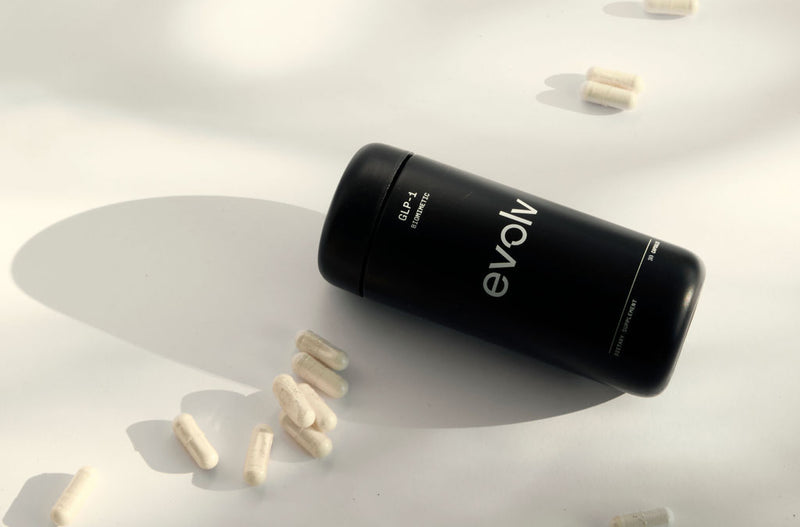
For those who want to address the underlying pathway more directly: Evolv GLP-1 is a natural biomimetic dietary supplement built around a proprietary bioengineered, yeast-derived peptide designed to support GLP-1 and GIP appetite pathways.
Its active ingredient — the bioengineered, yeast-derived EV1 Peptide — is designed to support the body’s natural GLP-1 and GIP appetite pathways. Unlike stimulant-based products that suppress surface-level hunger signals, this is designed to support the underlying pathway that regulates appetite timing and satiety. See how Evolv GLP-1 works for the mechanistic detail.
In Evolv’s randomized controlled study, with results read out at 8 weeks, participants consumed approximately 750 fewer calories per day and lost up to 12+ lbs. The appetite regulation effect — fewer calories consumed without hunger suppression through stimulants — is consistent with GLP-1 and GIP pathway engagement operating at the circadian level, not just at meals. See Evolv’s clinical research for the study methodology.
In-the-Moment Tactics for the Craving Window
When the craving hits before the longer interventions have had time to work:
Drink 12–16 oz of water first. Thirst and hunger signals overlap significantly in the brain — genuine thirst is commonly misread as hunger, especially in the evening.
Apply the 10-minute delay rule. Most cravings peak and subside within 10–15 minutes. Bridging the craving with a non-food activity — a walk, a quick task, stretching — often breaks the habit loop without requiring suppression.
Create behavioral finality. Brushing teeth + dimming lights + herbal tea signals the brain that the eating window is closed. These are environmental cues that the food-seeking loop is over for the day.
If genuinely hungry, healthy snack options:
Not every late-night craving is false hunger. When the genuine article arrives, choose options that satisfy without restarting the blood sugar cycle:
-
Greek yogurt (20–25g protein) — low glycemic, high satiety
-
Cottage cheese (~25g protein per cup) — fills without spiking blood sugar
-
Hard-boiled egg + small handful of nuts — protein and fat together slow digestion and extend satiety past the craving window
-
Sliced cucumber or celery with hummus — high fiber, low calorie density, something to chew
Avoid chips, crackers, granola bars, or cereal — most are high enough in refined carbs to trigger another blood sugar dip and a second craving wave within the hour.
Why Are Cravings Worse at Night?
Your Hunger Hormone Peaks at 8 PM
Ghrelin — the primary hunger-signaling hormone — doesn’t just respond to empty-stomach cues. It follows its own circadian rhythm that fires independently of food intake.
Research from Brigham and Women’s Hospital tracking ghrelin across 24 hours found a peak at approximately 8 PM and a trough at approximately 8 AM — a 17% amplitude difference that held up regardless of when subjects had last eaten. The cells that secrete ghrelin in the stomach contain their own internal clock (regulated by Bmal1), which means this evening surge is scheduled into your biology, not a signal of under-eating.
This matters because it reframes the problem. Feeling hungry at 9 PM is not evidence that you “failed” your diet that day. It’s the biological clock doing exactly what it was designed to do.
Your Brain Shifts to Reward-Seeking Mode
As cortisol declines through the afternoon and into the evening, appetite shifts from homeostatic (metabolic — the body needs fuel) to hedonic (reward-driven — the brain wants pleasure).
This is why late-night cravings tend toward ice cream, chips, and chocolate rather than a bowl of spinach. The hedonic drive to eat is biologically higher in the evening — it’s not irrational, it’s the reward circuitry responding to a cortisol shift.
There’s a counterintuitive layer: striatal dopamine reward activation is actually reduced at night. That reduced satisfaction signal may explain the “I ate a lot but still don’t feel settled” pattern — you consume more, looking for a reward response that doesn’t quite arrive.
As Evolv co-founder Becca McCarthy shared on the Mom Curious podcast: “The biggest impact beyond the weight loss for me was that ability to sustain my high performance throughout the whole day. I am somebody who always hits that 3:00 wall. In fact, I used to block my calendar from 3 to 5 because I knew I’m not at my best during that time. GLP-1 changed that for me.” The cortisol dip and the hedonic appetite shift are part of the same cascade — and it affects performance and appetite together.
Post-Dinner Blood Sugar Sets Up a Second Craving Wave
High-carb, low-protein dinners spike blood sugar. Insulin clears it quickly. The resulting glucose dip — arriving approximately 60–90 minutes after dinner — signals the brain to seek quick energy. For a 7 PM dinner, that craving hits right at 9–10 PM.
Evening insulin resistance compounds this: the same meal consumed at night produces a larger glucose spike and a steeper subsequent dip than the same meal eaten at noon. Habit conditioning then layers on: if dessert or a snack reliably follows dinner, the brain begins automating the craving through conditioned association — the post-dinner couch itself can trigger appetite before any biological signal does.
What Triggers Late Night Snacking Beyond Hunger?
The circadian ghrelin peak is the root cause, but several factors amplify it:
Under-eating earlier in the day. When total caloric intake is consistently too low through breakfast and lunch, the body executes a genuine metabolic catch-up in the evening. This is not emotional eating — it’s the system balancing the energy deficit.
Sleep deprivation. Poor sleep elevates ghrelin and suppresses leptin (the satiety hormone), making the next evening’s craving window even more intense. It creates a feedback loop: craving → poor sleep → worse craving the next night.
Decision fatigue. By 9 PM, impulse control is depleted. The prefrontal cortex — the executive function center — is tired. Quick pleasure wins over long-term goals not because of moral failure, but because self-regulatory capacity is a finite daily resource.
Habit and conditioning. The neural pathway connecting couch → TV → snack is reinforced every time it fires. Eventually, the environmental cue (sitting down at night) triggers the craving behavior independent of biology. This is distinct from emotional eating, which is driven by mood state, and from food noise, which is the cognitive preoccupation with food throughout the day.
Is Nighttime Snacking Bad for Weight Loss?
It depends less on timing and more on what and why.
Total daily calories remain the primary driver of weight loss — consuming the same amount at 9 PM versus noon isn’t categorically harmful. But the circadian context matters: evening insulin resistance means that the same meal eaten at night produces a larger glycemic response and is metabolized less efficiently than the same meal earlier in the day.
The practical problem with nighttime eating isn’t the timing itself — it’s that nighttime snacking is usually habitual and high-glycemic (chips, cookies, ice cream), driven by the conditioned craving loop rather than genuine caloric need. That pattern reliably creates a caloric surplus without satisfying hunger.
Night Eating Syndrome (NES) represents a distinct clinical pattern worth knowing: characterized by consuming 25% or more of daily calories after dinner, morning appetite suppression (not hungry at breakfast), and sleep disturbance. Occasional late-evening hunger is normal circadian biology; NES is a recurrent pattern that benefits from clinical evaluation.
The practical rule: nighttime eating that is consistent, planned, and protein-based is metabolically less harmful. Nighttime eating that is impulsive, carb-heavy, and guilt-laden is the conditioned craving loop in action — and addressing that requires addressing the biology, not just the behavior.
Night cravings are mostly biological on a schedule. Ghrelin peaks at 8 PM by design, cortisol decline shifts appetite to reward-driven, post-dinner blood sugar dips fire a second craving wave, and GLP-1 pathway disruption removes the natural modulator of all of it.
Willpower applied against a programmed hormonal clock loses every time. The right response is understanding the mechanism and building habits that work with the biology — a dinner that doesn’t set up a glucose crash, a sleep schedule that keeps GLP-1 pathway signaling intact, and a circadian routine that gives the craving clock less to work with.
For those who recognize the pattern and want to support the underlying signaling directly, Evolv GLP-1 is the oral biomimetic designed to support GLP-1 and GIP appetite pathways. See the science platform and GLP-1 supplements for weight loss for a deeper context. And if staying full through the day is part of the pattern, how to feel full longer after meals covers the daytime satiety side of the same system.
Frequently Asked Questions
Is snacking at night bad for weight loss?
Not inherently — total daily calories matter more than timing alone. But the context matters: evening insulin resistance means the same calories consumed at night are metabolized less efficiently than earlier in the day. The real problem is that nighttime snacking tends to be habitual, impulsive, and high-glycemic — not driven by genuine hunger — which creates a reliable caloric surplus.
What causes the urge to eat right before bed?
Usually, a post-dinner blood sugar dip. High-carb, low-protein dinners spike blood sugar, which insulin clears quickly. The resulting glucose dip 60–90 minutes later signals the brain to seek quick energy — carb and sugar cravings reliably fire at exactly 9–10 PM for a 7 PM dinner. Habit conditioning layers on: if snacking reliably follows dinner, the brain begins automating the craving independently of actual caloric need.
How do I stop waking up hungry at night?
Waking from sleep to eat suggests a more significant pattern — potentially Night Eating Syndrome, characterized by 25%+ of daily calories consumed after dinner, morning appetite suppression, and sleep disturbance. Practical interventions: higher-protein dinner to stabilize post-meal glucose, consistent meal timing to regulate the ghrelin rhythm, and quality sleep to support GLP-1 pathway signaling. A physician can evaluate whether an underlying pattern is driving it.
Do supplements help with nighttime cravings?
Stimulant-based suppressants work temporarily but address the surface symptom, not the circadian mechanism behind it. Supporting the GLP-1 pathway — the same pathway that naturally regulates appetite timing — is the mechanistically different approach. Evolv GLP-1 is a natural biomimetic dietary supplement built around a proprietary bioengineered, yeast-derived peptide designed to support GLP-1 and GIP appetite pathways, working with the biology rather than suppressing signals with stimulants.*
These statements have not been evaluated by the Food and Drug Administration. This product is not intended to diagnose, treat, cure, or prevent any disease.