








GLP-1 and Dopamine: How It Quiets Cravings and Affects Mood
Authored by
The Evolv Research Team
A lot of people describe the same moment: the running mental debate about the next meal, often called food noise, goes quiet. The usual explanation is “it’s a dopamine thing.”
There’s real science behind that. GLP-1 and dopamine meet in the brain’s reward system, and the research points to a specific role for GLP-1 there: it appears to turn down how strongly food pulls at you, more than how much you enjoy eating. That’s what a quieter food mind feels like.
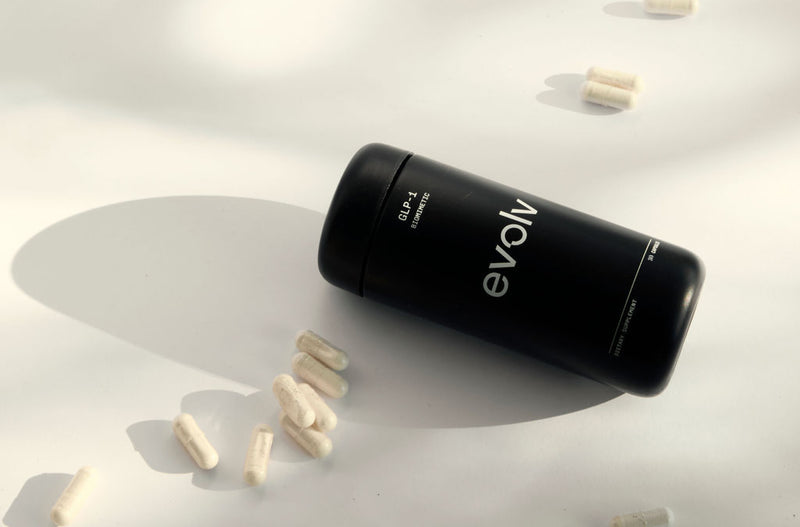
GLP-1 is a hormone your body makes. Your gut releases it after you eat, and a small group of cells in your brainstem makes it too. It’s also the biology Evolv builds on. Evolv GLP-1 is a natural biomimetic dietary supplement built around a proprietary yeast-derived peptide designed to support GLP-1 and GIP appetite pathways.
What GLP-1 and Dopamine Do in Your Body and Brain
GLP-1 (glucagon-like peptide-1) is released by L-cells, specialized cells in your gut lining, when food arrives. It helps release insulin, slows stomach emptying, and signals fullness to the brain. A second supply comes from neurons in the nucleus of the solitary tract, a relay station in the brainstem that is the main source of GLP-1 inside the brain. The version your gut releases doesn’t last: it’s broken down within one to two minutes. For the basics, see what GLP-1 is and why it matters.
Dopamine is a chemical messenger nerve cells use to signal one another. Its reward route, the mesolimbic pathway, runs from the ventral tegmental area, a cluster of dopamine-making cells deep in the midbrain, to the nucleus accumbens, a hub that helps decide how worth chasing something is. Food, alcohol, and most other rewards register here.
Wanting vs. Liking: Two Different Signals
“Dopamine hit” makes it sound as if dopamine is the pleasure itself. Neuroscientist Kent Berridge’s review of food reward research points elsewhere: dopamine drives “wanting,” the urge that pulls you toward a reward, while “liking,” the pleasure you feel once you have it, runs largely through separate circuits. In animal studies, sweet tastes still produced clear signs of pleasure in brains almost emptied of dopamine. As Berridge wrote, “the idea that dopamine is a pleasure neurotransmitter has faded considerably in the neuroscience literature.”
Keep that split in mind, because a craving is mostly wanting.
Where GLP-1 Meets the Reward System
GLP-1 receptors, the docking sites the hormone uses to deliver its message, sit right inside this pathway. In rats, brainstem GLP-1 neurons connect directly to the ventral tegmental area and the nucleus accumbens. Switching on GLP-1 receptors in those areas cut food intake, especially of highly palatable food, while blocking them made the animals eat more. Other appetite signals feed into the same system, including ghrelin, the hunger hormone, which pushes the opposite way.
How Does GLP-1 Affect Dopamine and Reward?
GLP-1 works with the reward system rather than flipping dopamine up or down. In animal research it lowers the reward value of food and blunts the dopamine surge that alcohol triggers, and its exact effect on dopamine depends on which circuit is measured and at what moment.
In rats, a compound that activates GLP-1 receptors, delivered into reward areas, made food less rewarding and less worth working for. In rodents given alcohol, the same kind of compound blunted the dopamine release alcohol normally sets off in the nucleus accumbens.
The dopamine details depend on timing. A 2024 study in lean mice, summarized in a 2025 commentary, found a GLP-1 medication didn’t change dopamine activity while the animals waited on a cue for sugar, but increased it while they were collecting the reward. The same commentary describes a brainstem route that lowers dopamine activity instead. A systematic review of 30 human and 71 animal studies concluded that GLP-1 does act on reward pathways and that far more human research is needed.
In people, researchers rarely measure dopamine directly and use brain imaging instead. In a 2014 trial of 48 adults, a GLP-1 medication given through an IV drip reduced the brain’s response to food pictures in areas that judge how appealing food looks, including the insula, the amygdala, and the orbitofrontal cortex, in people with obesity and in people with type 2 diabetes. They also ate less. Blocking the GLP-1 receptor beforehand largely cancelled the effect.
The thread running through this work points at the wanting side: how strongly food cues grab attention. Whether GLP-1 changes liking in people hasn’t been measured directly.
The Evidence Ladder for GLP-1 and Dopamine
|
Evidence level |
What the research supports |
|---|---|
|
Supported in people |
GLP-1 medications reduce self-reported food cravings and improve control of eating in randomized trials. They lower brain responses to food pictures in people with obesity and type 2 diabetes. |
|
Early human evidence |
The body’s own GLP-1 helps dampen food-cue responses after a meal (one small imaging study, in people with type 2 diabetes). |
|
Mostly animal research |
GLP-1 receptors in reward areas lower the reward value of food. Dopamine drives wanting more than liking. The direction of GLP-1’s effect on dopamine depends on circuit and timing. |
|
Still being studied |
Whether GLP-1’s effect on dopamine follows one consistent direction, and how GLP-1 signaling relates to mood and motivation. |
How the GLP-1 and Dopamine Link Influences Cravings
By turning down how strongly food cues pull at you, GLP-1 signaling makes cravings quieter. In people, that shows up as fewer cravings and better control over eating.
Two trials of a weekly GLP-1 medication measured cravings with a standard questionnaire. Over 20 weeks in 72 adults with obesity, the medication reduced food cravings and improved control of eating compared with placebo. An earlier 12-week study of 30 adults found fewer cravings and a lower preference for fatty, energy-dense foods. These are self-reports rather than dopamine readings, but they line up with the imaging work.
It’s what people mean when they say the food noise went quiet. A cue, like the smell from a bakery or the snack you always reach for while scrolling, sets off a pull toward food before hunger has had a say. Turning that pull down doesn’t, in principle, require food to taste worse; the cues just stop shouting.
GLP-1, Mood, Motivation, and Pleasure: What Research Is Exploring
Because GLP-1 works inside the same reward circuits that shape motivation, researchers are asking whether it touches mood too. The 2025 commentary above proposed that GLP-1 signaling might influence how the brain responds at the moment a reward arrives, which could matter for mood, and it labeled that a hypothesis to test. Some people on GLP-1 medications describe feeling flatter about food, and occasionally about other things, but no controlled study has linked that to the medications, and eating much less or sleeping poorly can produce the same feeling.
For now, mood isn’t an established effect of GLP-1 signaling in either direction. It’s an active area of research.
If low mood or lost motivation is worrying you, raise it with your prescriber or a mental health professional. For the wider research on mood, anxiety, and GLP-1, see GLP-1 and mental health.
Prescription GLP-1 Medications vs. the GLP-1 Your Body Makes
Most of what’s known about GLP-1 and dopamine comes from GLP-1 receptor agonist medications, drugs built to switch on the same receptor as the natural hormone while lasting far longer. The GLP-1 your gut releases after a meal is gone within minutes, so a finding from a weekly medication doesn’t automatically describe what a meal does.
In a 2015 imaging study, researchers used a drug that blocks the GLP-1 receptor to switch off the body’s own GLP-1 during a meal. Normally, eating dampened the brain’s response to food pictures in the insula, a region involved in sensing appetite and judging how appealing food is. With the body’s GLP-1 blocked, that post-meal dip didn’t happen in people with obesity and type 2 diabetes. The study was small, 20 people per group, and the effect was clear only in the diabetes group, so it’s early evidence rather than a settled answer.
Your gut and brainstem make GLP-1, and no product carries the hormone itself, prescription or supplement. What they work on is the pathway. As Evolv co-founder Becca McCarthy put it on the Mom Curious podcast, “GLP-1 is a natural hormone and a biological pathway in our own bodies.” For everyday ways to support it, see natural ways to support GLP-1.
Can Supplements Support GLP-1 or Dopamine?
Supplements can support your GLP-1 pathway, and that’s where both the evidence and Evolv’s own research sit. Products marketed for dopamine are a different story: none has been shown to meaningfully change dopamine function in healthy adults.
Supporting Your Own GLP-1 Pathway
Food is the starting point: protein and fiber at meals both prompt your gut to release GLP-1. The catch is that the GLP-1 your gut releases is broken down within one to two minutes, so each meal gives the pathway a brief signal.
That’s where Evolv GLP-1 comes in. Because GLP-1 is a hormone your gut makes rather than an ingredient in any product, the pathway is what Evolv works on. Its active ingredient, the bioengineered, yeast-derived EV1 Peptide, is designed to support your own GLP-1 and GIP appetite pathways and is designed for sustained pathway engagement. Unlike stimulant-based or fiber-only approaches, it’s designed to support the underlying signaling that drives appetite and weight loss behavior.
In Evolv’s clinical study, participants consumed approximately 750 fewer calories per day and lost up to 12+ lbs in 8 weeks. The study measured appetite and weight; the dopamine findings above come from separate research on GLP-1 signaling. The science behind the EV1 Peptide explains how the peptide is designed to engage GLP-1 and GIP signaling. If you take any medication, talk to your physician before adding a supplement.
Products Sold for Dopamine
Tyrosine is an amino acid the body uses to build dopamine. A review of tyrosine studies found its benefits show up mainly as sharper thinking during short bursts of stress or demanding mental work, and judged its potential for clinical use “limited.” Nothing in that research shows it quiets cravings.
Mucuna pruriens, a bean sold in some “dopamine” blends, contains the compound the brain converts into dopamine, the same one used in a prescription medicine. That makes it drug-like, which is a reason to talk to a doctor before taking it, especially alongside other medications.
Evidence-Based Ways to Support Your Reward System and Metabolic Health
The wanting system also responds to everyday habits, and some of the clearest human data on food reward has nothing to do with medication.
Protect your sleep. After sleep deprivation, people in a brain-imaging study showed weaker activity in frontal and insular regions that weigh how appealing food is, stronger activity in the amygdala, and a bigger appetite for high-calorie foods. Lost sleep turns up the pull of food.
Watch the daily sweet-and-fatty habit. In an 8-week randomized trial, normal-weight adults who added a high-fat, high-sugar snack to their usual diet showed stronger brain responses to food and a lower preference for low-fat foods, with no change in body weight. The reward system adapted before the scale showed anything.
Cook more from whole ingredients. In an NIH inpatient study, 20 adults ate about 500 more calories a day on an ultra-processed diet than on an unprocessed one, even though the meals offered matched for calories, sugar, fat, and fiber.
Build meals that support your own GLP-1. Protein at each meal and fiber from beans, vegetables, and whole grains both prompt the gut to release GLP-1. For specifics, see meals that keep you full longer and the metabolic health diet.
None of these change dopamine on command. Together, they turn down the cues that drive wanting, the practical route to feeling calmer around food.
Quieting Cravings Starts With Knowing What Drives Them
The research points at the pull of food cues, and that pull responds to GLP-1 signaling, to sleep, and to what you eat day to day.
Supporting your own GLP-1 is the part you can act on every day. Food gives the pathway a start, and Evolv GLP-1 is an oral peptide tablet designed to support your own GLP-1 and GIP appetite pathways, for daily support with appetite regulation. Check with your physician before combining it with any medication.
Frequently Asked Questions
Can a blood test show whether GLP-1 is changing your dopamine?
No. Much of the dopamine in your blood is made outside the brain: one study of blood leaving the gut estimated that the gut, spleen, and pancreas produce close to half of the dopamine the body makes. Dopamine in the bloodstream also doesn’t pass freely into the brain, so a blood level says little about what your reward circuits are doing. Researchers study brain dopamine with specialized imaging scans instead.
Does GLP-1 reduce alcohol cravings?
Early trials point that way, with mixed results. In a 2025 trial of 48 adults with alcohol use disorder, nine weeks of a low-dose GLP-1 medication reduced weekly craving, the number of drinks on days people drank, and how much alcohol they chose to drink in a lab test, though it didn’t change how many days they drank or their average drinks per day. An earlier 26-week trial of a different GLP-1 medication didn’t reduce heavy drinking days overall, but it dampened the brain’s response to alcohol cues, and in an exploratory analysis, participants with obesity drank less. Using these medications for alcohol is a conversation for a doctor.
Is Evolv GLP-1 designed to work on dopamine?
It’s designed to work on appetite signaling. The EV1 Peptide in Evolv GLP-1 is designed to support your own GLP-1 and GIP appetite pathways, the gut hormones that help tell your brain a meal was enough. Evolv’s clinical study measured appetite and weight, with participants consuming approximately 750 fewer calories per day and losing up to 12+ lbs in 8 weeks. Dopamine wasn’t measured, so the reward-system research on GLP-1 describes the pathway in general rather than the product.
Why do some people notice a bigger change in cravings than others?
The brain effects appear to vary with body weight and metabolic health. In one imaging study, a GLP-1 medication lowered reward-area responses to food pictures in people with obesity and in people with type 2 diabetes, two groups whose appetite and reward areas also reacted more strongly to food pictures than lean people’s did in the first place. In an alcohol trial, an exploratory analysis found a drop in drinking among participants with obesity (a body mass index, or BMI, above 30) that the group as a whole didn’t show.
Is it safe to combine dopamine supplements with a GLP-1 medication?
Check with your prescriber first. Some products sold for dopamine support contain Mucuna pruriens, a plant that carries the compound the brain converts into dopamine, the same one used in a prescription medicine, so it has drug-like effects. Others, like tyrosine, have little evidence behind them outside of short-term mental performance under stress. The same rule applies to Evolv GLP-1: talk to your physician before combining it with any medication.
Is the reward effect the main reason GLP-1 medications cause weight loss?
It’s one part of a bigger picture. GLP-1 signaling also acts on the hypothalamus, the brain’s main appetite control center, and can slow stomach emptying. In one 20-week trial, people on a GLP-1 medication ate 35% less at an eat-as-much-as-you-like lunch, yet a test of stomach emptying showed no clear delay by the end, which suggests the brain was doing much of the work. How much of that comes from reward circuits versus fullness signals hasn’t been measured.
Sources
-
Müller TD, et al. “Glucagon-like peptide 1 (GLP-1).” Molecular Metabolism, 2019. https://pmc.ncbi.nlm.nih.gov/articles/PMC6812410/
-
Berridge KC. “‘Liking’ and ‘wanting’ food rewards: brain substrates and roles in eating disorders.” Physiology & Behavior, 2009. https://pmc.ncbi.nlm.nih.gov/articles/PMC2717031/
-
Alhadeff AL, Rupprecht LE, Hayes MR. “GLP-1 neurons in the nucleus of the solitary tract project directly to the ventral tegmental area and nucleus accumbens to control for food intake.” Endocrinology, 2012. https://pmc.ncbi.nlm.nih.gov/articles/PMC3275387/
-
Dickson SL, et al. “The glucagon-like peptide 1 (GLP-1) analogue, exendin-4, decreases the rewarding value of food: a new role for mesolimbic GLP-1 receptors.” Journal of Neuroscience, 2012. https://pmc.ncbi.nlm.nih.gov/articles/PMC6620919/
-
Egecioglu E, et al. “The glucagon-like peptide 1 analogue Exendin-4 attenuates alcohol mediated behaviors in rodents.” Psychoneuroendocrinology, 2013. https://doi.org/10.1016/j.psyneuen.2012.11.009
-
Krupa AJ. “Curbing the appetites and restoring the capacity for satisfaction: The impact of GLP-1 agonists on the reward circuitry.” Neuroscience Applied, 2025. https://pmc.ncbi.nlm.nih.gov/articles/PMC12244148/
-
Eren-Yazicioglu CY, et al. “Can GLP-1 Be a Target for Reward System Related Disorders? A Qualitative Synthesis and Systematic Review Analysis of Studies on Palatable Food, Drugs of Abuse, and Alcohol.” Frontiers in Behavioral Neuroscience, 2020. https://pmc.ncbi.nlm.nih.gov/articles/PMC7848227/
-
van Bloemendaal L, et al. “GLP-1 receptor activation modulates appetite- and reward-related brain areas in humans.” Diabetes, 2014. https://doi.org/10.2337/db14-0849
-
ten Kulve JS, et al. “Endogenous GLP-1 mediates postprandial reductions in activation in central reward and satiety areas in patients with type 2 diabetes.” Diabetologia, 2015. https://doi.org/10.1007/s00125-015-3754-x
-
Friedrichsen M, et al. “The effect of semaglutide 2.4 mg once weekly on energy intake, appetite, control of eating, and gastric emptying in adults with obesity.” Diabetes, Obesity and Metabolism, 2021. https://doi.org/10.1111/dom.14280
-
Blundell J, et al. “Effects of once-weekly semaglutide on appetite, energy intake, control of eating, food preference and body weight in subjects with obesity.” Diabetes, Obesity and Metabolism, 2017. https://pmc.ncbi.nlm.nih.gov/articles/PMC5573908/
-
Greer SM, Goldstein AN, Walker MP. “The impact of sleep deprivation on food desire in the human brain.” Nature Communications, 2013. https://pmc.ncbi.nlm.nih.gov/articles/PMC3763921/
-
Edwin Thanarajah S, et al. “Habitual daily intake of a sweet and fatty snack modulates reward processing in humans.” Cell Metabolism, 2023. https://doi.org/10.1016/j.cmet.2023.02.015
-
Hall KD, et al. “Ultra-Processed Diets Cause Excess Calorie Intake and Weight Gain: An Inpatient Randomized Controlled Trial of Ad Libitum Food Intake.” Cell Metabolism, 2019. https://pmc.ncbi.nlm.nih.gov/articles/PMC7946062/
-
Jongkees BJ, et al. “Effect of tyrosine supplementation on clinical and healthy populations under stress or cognitive demands: A review.” Journal of Psychiatric Research, 2015. https://doi.org/10.1016/j.jpsychires.2015.08.014
-
Hammoud F, et al. “Mucuna pruriens Treatment for Parkinson Disease: A Systematic Review of Clinical Trials.” Parkinson’s Disease, 2025. https://pmc.ncbi.nlm.nih.gov/articles/PMC12377966/
-
Eisenhofer G, et al. “Substantial production of dopamine in the human gastrointestinal tract.” Journal of Clinical Endocrinology and Metabolism, 1997. https://doi.org/10.1210/jcem.82.11.4339
-
Hendershot CS, et al. “Once-Weekly Semaglutide in Adults With Alcohol Use Disorder: A Randomized Clinical Trial.” JAMA Psychiatry, 2025. https://doi.org/10.1001/jamapsychiatry.2024.4789
-
Klausen MK, et al. “Exenatide once weekly for alcohol use disorder investigated in a randomized, placebo-controlled clinical trial.” JCI Insight, 2022. https://pmc.ncbi.nlm.nih.gov/articles/PMC9675448/
These statements have not been evaluated by the Food and Drug Administration. This product is not intended to diagnose, treat, cure, or prevent any disease.
Individual results may vary. Consult your physician before starting any new supplement or making changes to your medication regimen.