







GLP-1 and Mental Health: Benefits, Risks, and What the Research Actually Shows
Authored by
The Evolv Research Team
When semaglutide and tirzepatide reached mainstream awareness, the conversation was almost entirely about weight loss. Now, five years into widespread use, the conversation is shifting. Users report mood changes, reduced anxiety, quieted food noise, and improved overall well-being. Researchers are starting to map why.
This article walks through what the 2025-2026 research actually shows about GLP-1 medications and mental health — including the benefits, the documented risks, the mechanisms, and the honest scope boundary between prescription drug evidence and what extends to supplements. Evolv has a particular reason to be careful about this distinction: the brand is built around supporting the GLP-1 and GIP appetite pathways, but does not make mental health claims.
Does GLP-1 Affect Mental Health?
The short answer: yes, the evidence is increasingly clear that GLP-1 receptor agonist medications affect mental health, and the net effect across large populations appears to be positive.
The strongest recent evidence comes from a 2025 JAMA Psychiatry meta-analysis by Pierret and colleagues, cited 77+ times within months of publication. The analysis concluded: “Treatment with GLP-1 receptor agonists is safe from a psychiatric perspective and may be associated with improved mental well-being.”
A 2026 Lancet Psychiatry analysis by Taipale and colleagues added more nuance: GLP-1 medications may prevent worsening of depression and anxiety in users, though they cautioned that randomized controlled trials directly testing this effect are still needed.
A 2024 PMC review by Gunturu and colleagues — cited 32+ times — proposed that GLP-1 receptor agonists could offer relief for people struggling with depression, anxiety, and even neurodegenerative diseases, based on the receptor’s distribution in mood-related brain regions and its anti-inflammatory effects.
The American Psychological Association’s 2025 coverage summarized the field: researchers are tracking both positive and negative effects on mood, and the early data tilts toward positive, with caveats.
The Mechanisms: Why GLP-1 Could Affect Mood
The biological case for GLP-1 affecting mental health rests on four overlapping mechanisms.
1. GLP-1 receptors in mood-related brain regions. GLP-1 receptors are expressed in the hippocampus, amygdala, prefrontal cortex, and hypothalamus — all regions implicated in depression and anxiety regulation. When GLP-1 signaling activates these receptors, it can modulate neuronal activity in ways that mimic some antidepressant mechanisms.
2. Reduced neuroinflammation. Chronic low-grade neuroinflammation is increasingly recognized as a contributor to depression, anxiety, and neurodegenerative conditions. GLP-1 receptor agonists reduce inflammation across multiple organ systems, including the brain, via cytokine suppression and immune cell modulation. The mood benefits may partly track these anti-inflammatory effects. For more on the broader anti-inflammatory mechanism, see GLP-1 and inflammation: what the research shows.
3. Dopamine reward circuit modulation. GLP-1 dampens the same dopamine-driven reward circuits that drive food noise, binge behaviors, and reward-seeking patterns. This is why users describe “the food noise went quiet” — and why some researchers are exploring GLP-1 medications for addictive behaviors more broadly. The reward circuit also overlaps with mood: a calmer reward system can support more stable affect.
4. Indirect effects of metabolic improvement. Weight loss, improved blood sugar stability, better sleep, and reduced inflammation all independently improve mood. Even when GLP-1’s direct mood effects are debated, the indirect pathway through metabolic health is well-established.
The Documented Mental Health Risks
The picture isn’t unambiguously positive. Several concerns require acknowledgment.
Conflicting real-world data. A 2026 systematic review in Diabetes, Obesity and Metabolism by Sa and colleagues — cited 9+ times — reported that some real-world post-marketing surveillance has flagged elevated rates of psychiatric events (anxiety disorders, major depressive disorder) in GLP-1 medication users. This contrasts with the randomized trial data, suggesting either selection effects (people predisposed to mood issues being more likely to seek treatment) or genuine adverse signals worth monitoring.
FDA monitoring. The FDA has investigated reports of suicidality and self-harm in GLP-1 medication users. As of 2025, the agency has not concluded that a causal link exists, but they continue to monitor — and the package inserts include relevant cautions.
Withdrawal mood effects. Some users report mood disturbances when discontinuing GLP-1 medications. This is biologically plausible (rebound effects on appetite hormones and reward signaling) and is one reason physician-supervised tapering is recommended.
Subgroups with active mood disorders. Individuals with active depression, anxiety, or bipolar disorder should be monitored more closely if starting GLP-1 medications. Most clinical guidance recommends collaboration with mental health providers in this population.
Food Noise, Mood, and the Reward Circuit Overlap
One of the most consistent reports from GLP-1 medication users is reduced food noise — the constant mental chatter about food. The mechanism behind this overlaps with mood effects.
Food noise is driven by ghrelin-mediated activation of the brain’s dopamine reward system. GLP-1 dampens the same dopamine-linked reward circuits that ghrelin amplifies. When the reward circuit is less reactive to food cues, two things happen simultaneously: food noise quiets, and the broader reward-seeking and impulsivity patterns may also reduce. For some users, this manifests as reduced cravings around alcohol, nicotine, or compulsive shopping — not just food.
This is the mechanism that links food noise to mood. The reward system is a shared substrate for craving, mood instability, and addictive behaviors. Calming it benefits more than the appetite. For a deeper look at the food noise mechanism, see the food noise deep-dive, and the hunger hormone (ghrelin) explainer — both cover the brain circuits that GLP-1 medications modulate.
The Honest Scope Boundary: Drugs vs. Lifestyle vs. Supplements
GLP-1 research can be confusing if you mix up three different categories: prescription medications, lifestyle inputs that support endogenous GLP-1, and supplements designed to engage GLP-1 pathways. The findings apply differently to each — and treating them as interchangeable is the most common way to draw the wrong conclusion.
What’s proven applies to GLP-1 receptor agonist medications at therapeutic doses. Semaglutide, liraglutide, and tirzepatide at FDA-approved dosing. The JAMA Psychiatry meta-analysis, the Lancet Psychiatry data, and the JCI review — all of this evidence comes from studies of prescription medications at pharmacological doses that achieve full GLP-1 receptor saturation in the brain.
Endogenous GLP-1 is a different scale. When you eat a high-fiber meal, your intestinal L cells release GLP-1 at physiological levels — orders of magnitude below pharmacological dosing. The receptor mechanisms are the same. The intensity isn’t. No clinical trial has measured mood outcomes in response to endogenously elevated GLP-1 via diet alone.
Supplements that support GLP-1 pathway activity are a third category. No supplement — including Evolv — has been clinically demonstrated to produce mood, anxiety, or depression effects. The Evolv clinical study measured weight, caloric intake, waist circumference, and satiety; mental health was not a study endpoint. Mood claims for supplements would be inappropriate.
The honest framing: if you have an active mood disorder, that’s a conversation with a mental health professional about evidence-based treatments. If you want to support metabolic health and appetite regulation through lifestyle and biomimetic supplement approaches, those benefits sit in their own domain — not the mental health treatment domain.
How Supporting Your Natural GLP-1 Pathway Fits In
Dietary and lifestyle behaviors that support endogenous GLP-1 secretion — high-fiber foods, protein-rich meals, fermented foods, exercise — have independent mood benefits, but those benefits trace to the overall lifestyle pattern, not to GLP-1 signaling specifically.
For more on these inputs, see natural ways to support GLP-1 signaling through diet and lifestyle and the benefits of GLP-1 that extend beyond appetite control.
Evolv positions in the biomimetic products category specifically — appetite regulation and metabolic health, not mental health.
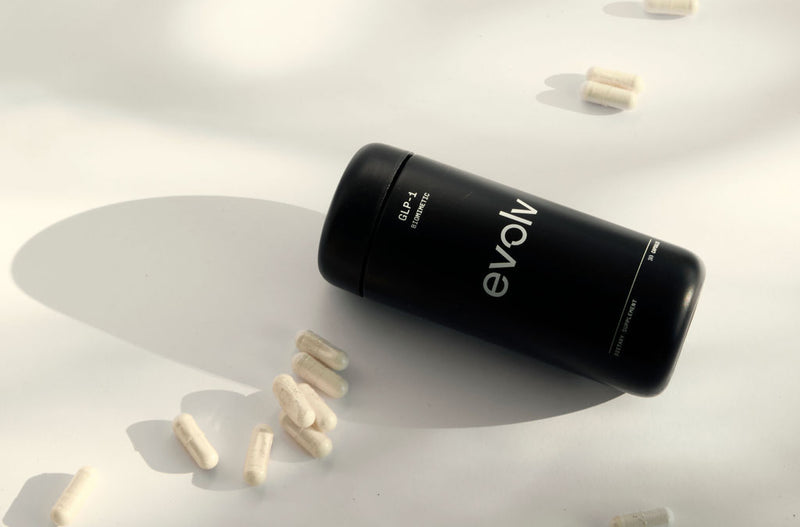
Evolv GLP-1 is a natural biomimetic dietary supplement built around a proprietary yeast-derived peptide designed to support GLP-1 and GIP appetite pathways.
The active ingredient — the bioengineered, yeast-derived EV1 Peptide — is designed to engage the body’s natural GLP-1 and GIP signaling pathways. In the brand’s 8-week data read out of their randomized controlled study, participants consumed approximately 750 fewer calories per day, with up to 12+ lbs of weight loss. The studied outcomes are metabolic and appetite-related — not mood, anxiety, or depression. Evolv does not make mental health claims.
For readers using GLP-1 receptor agonist medications under medical supervision, the mood and food noise effects discussed in this article are part of your prescriber’s clinical picture. For readers supporting natural GLP-1 and GIP pathways through diet, lifestyle, and biomimetic products like Evolv’s oral GLP-1 biomimetic peptide, the benefits sit firmly in the metabolic and appetite-regulation domain. For more on GLP-1 supplements specifically, see GLP-1 supplements for weight loss.
When to Talk to a Mental Health Professional
If you’re experiencing symptoms of depression, anxiety, or other mood conditions, professional mental health care should drive treatment. GLP-1 medications (and supplements that support GLP-1 pathways) are not first-line mental health interventions.
Signs that warrant evaluation:
- Persistent low mood, hopelessness, or anhedonia (loss of interest) lasting 2+ weeks
- Anxiety that interferes with daily function
- Significant changes in sleep, appetite, or energy
- Thoughts of self-harm or suicide — call/text 988 (US Suicide & Crisis Lifeline) immediately
- Mood symptoms appearing or worsening during GLP-1 medication use — speak with your prescriber
Mental health and metabolic health are related but distinct. Each deserves its own care.
Frequently Asked Questions
Does GLP-1 affect mental health?
Yes, recent clinical research suggests GLP-1 receptor agonist medications may improve mental well-being for many users. A 2025 JAMA Psychiatry meta-analysis of randomized trials concluded that “treatment with GLP-1 receptor agonists is safe from a psychiatric perspective and may be associated with improved mental well-being.” Reported effects include reduced food noise, lower rates of binge eating behaviors, improved mood in some users, and reduced anxiety symptoms in some studies. However, this evidence applies to prescription medications at therapeutic doses, not to supplements.
Can GLP-1 cause depression or anxiety?
The picture is mixed, and the research is evolving. Most large analyses — including a 2025 JAMA Psychiatry review of randomized trials and the 2026 Lancet Psychiatry analysis — find GLP-1 receptor agonist users do not show higher rates of depression or anxiety than control groups, and may show improvements. However, a 2026 systematic review in Diabetes, Obesity and Metabolism reported that some real-world data have flagged elevated psychiatric event rates in subgroups. Clinical consensus as of 2026: GLP-1 medications are generally psychiatrically safe but should be used with physician monitoring for individuals with active mood disorders.
Why do I feel so good on GLP-1?
Several mechanisms are proposed. GLP-1 receptors exist in brain regions involved in mood regulation (hippocampus, amygdala, prefrontal cortex). GLP-1 reduces neuroinflammation in animal and human studies, which is linked to depression. It dampens dopamine-driven reward circuits, which can quiet food noise and reduce addictive-style eating behaviors. And the indirect effects of weight loss — improved sleep, more energy, better metabolic markers — independently support mood. Individual response varies; not everyone reports the same mood effects.
Can GLP-1 help with ADHD?
Research on GLP-1 and ADHD is preliminary. There’s a biological rationale — GLP-1 modulates the dopamine system, which is central to ADHD — but no large randomized trials have evaluated GLP-1 medications for ADHD outcomes. A handful of small studies and observational data show some signals (reduced binge eating in ADHD populations, improved appetite regulation), but it’s far from established as an ADHD intervention. For ADHD specifically, established treatments — stimulant or non-stimulant medications, behavioral therapy, lifestyle structure — remain the standard.
Are there natural alternatives to GLP-1 drugs for mood support?
No dietary supplement has been clinically demonstrated to replicate the mood-related effects of GLP-1 receptor agonist medications. The evidence for natural mood support is strongest for omega-3 fatty acids, magnesium, vitamin D (for deficiency), regular exercise, adequate sleep, and Mediterranean-style dietary patterns. Supplements that support the body’s natural GLP-1 and GIP appetite pathways — like Evolv GLP-1 — operate in the appetite-regulation and metabolic-health category, not as anti-anxiety or antidepressant therapies. For active mood disorders, professional mental health care should direct treatment.
These statements have not been evaluated by the Food and Drug Administration. This product is not intended to diagnose, treat, cure, or prevent any disease.
Sources
- Pierret ACS, et al. JAMA Psychiatry, 2025. https://jamanetwork.com/journals/jamapsychiatry/fullarticle/2833558
- Taipale H, et al. “Association between GLP-1 receptor agonist use and mental health outcomes.” Lancet Psychiatry, 2026. https://www.thelancet.com/journals/lanpsy/article/PIIS2215-0366(26)00014-3/fulltext
- Gunturu S, et al. “The Potential Role of GLP-1 Agonists in Psychiatric Disorders.” PMC, 2024. https://pmc.ncbi.nlm.nih.gov/articles/PMC11062310/
- Sa B, et al. “Psychiatric effects of GLP-1 receptor agonists: A systematic review.” Diabetes, Obesity and Metabolism, 2026. https://dom-pubs.onlinelibrary.wiley.com/doi/10.1111/dom.70198
- Wong CK, Drucker DJ. J Clin Invest, 2025. https://www.jci.org/articles/view/194751
- “Quieting Food Noise: How GLP-1s and Mindfulness Rewire the Default Mode Network and Reward Circuits.” PMC, 2025. https://pmc.ncbi.nlm.nih.gov/articles/PMC12770913/
- American Psychological Association. “A new era of weight loss: Mental health effects of GLP-1 drugs.” 2025. https://www.apa.org/monitor/2025/07-08/weight-loss-drugs-mental-health
- 988 Suicide & Crisis Lifeline. https://988lifeline.org/
A note on scope: This article discusses clinical research on GLP-1 receptor agonist medications (semaglutide, liraglutide, tirzepatide). Evolv GLP-1 is a dietary supplement that supports the body’s natural GLP-1 and GIP appetite pathways — it is not a medication and does not make mental health treatment claims. The research below applies to prescription drugs studied at therapeutic doses, not to supplements.