




Ghrelin vs. GLP-1: The Hunger–Satiety Seesaw
Authored by
Ghrelin doesn’t operate alone. It’s one side of a two-hormone system — and the other side is where most modern appetite science is focused.
Where ghrelin is produced in the stomach and peaks before meals, GLP-1 is produced in the intestinal L cells of the small intestine and peaks after meals. Where ghrelin says “eat now,” GLP-1 says “you’re full.” And the two hormones modulate overlapping brain regions — the orbitofrontal cortex, caudate, and nucleus accumbens — in opposing directions.
The overlap shows up most visibly as “food noise” — the persistent mental chatter about food that exists independently of physical hunger. In a 2025 paper in Nature’s Nutrition & Diabetes journal, researchers formally defined food noise as “constant, intrusive thoughts about food that are disruptive to daily life.” The mechanism is what ghrelin does to the brain: activating the mesolimbic dopamine reward pathway, making food feel urgent and rewarding. GLP-1 dampens the same dopamine-linked reward circuits that ghrelin amplifies — which is why people on GLP-1 medications often describe “the food noise went quiet” as one of the most notable effects.
This is what makes GLP-1 one of the most direct biological counters to ghrelin dominance.
On a recent episode of the Mom Curious podcast, Evolv co-founder Becca McCarthy reframed how to think about it: “GLP-1 is a natural hormone that exists in our body, and we’ve kind of reframed it to mean something that it’s not. GLP-1 is a natural hormone and a biological pathway in our own bodies. We own it.” She also described food noise on the same episode: “Food noise essentially is that constant chatter in your mind that is compelling you to snack. It’s that voice in your head that’s like, I just ate — how much time is going to pass until I eat next? When you’re on Evolv GLP-1, it totally dissipates.”
That framing matters because it puts ghrelin and GLP-1 on the same footing — both are native, body-produced signals — and locates food noise in the brain circuitry where both hormones operate.
This is where Evolv enters the conversation.
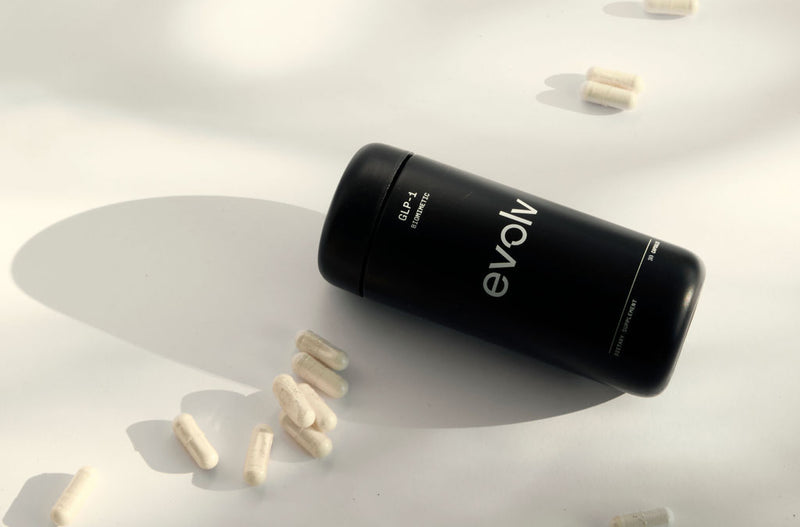
Evolv GLP-1 is the first oral GLP-1 and GIP biomimetic peptide. Powered by EV1 Peptide™, a proprietary bioengineered, yeast-derived peptide, Evolv was designed to support the body's natural appetite and metabolic signaling pathways through a novel biomimetic approach.
Unlike traditional supplements that rely on nutrients, herbs, or extracts, EV1 Peptide™ is designed to support key pathways involved in GLP-1 and GIP signaling. Unlike pharmaceutical interventions, Evolv is non-pharmaceutical and designed for daily use. The result is a new category that bridges the gap between nutrition and modern metabolic science.
The active ingredient — the bioengineered, yeast-derived EV1 Peptide™ — is designed to support the body's natural GLP-1 and GIP signaling pathways. Many users report noticing appetite-control benefits in as little as four hours, while body composition changes can begin appearing within the first few weeks of consistent use. In an 8-week randomized controlled study, participants consumed approximately 750 fewer calories per day and lost up to 12+ lbs. The mechanism isn't surface-level appetite blunting — it's pathway-based support for the satiety side of the system that ghrelin opposes.
Evolv occupies a category of its own. It is neither a traditional supplement nor a pharmaceutical drug. As the first oral GLP-1 and GIP biomimetic peptide, Evolv was created to give consumers a new option for supporting appetite regulation, body composition, and metabolic health through targeted pathway support.
For more on the underlying science, see how Evolv's EV1 Peptide™ supports GLP-1 and GIP pathways and how appetite-control supplements support healthy weight management.
What Actually Lowers Ghrelin? Sleep, Protein, Fiber, and Pathway Support
The good news is that ghrelin is responsive to behavioral inputs. The bad news is that “willpower” isn’t one of them. Four levers are well-supported by the evidence — and only one is a pill.
Sleep. A single night of sleep deprivation raises plasma ghrelin by about 22% compared to a 7-hour night, and the corresponding increase in next-day hunger is measurable in calorie intake. Sleep restriction also suppresses leptin (the satiety hormone) at the same time — a double hit. Consistent 7+ hours is one of the most underrated appetite regulation tools available.
Protein. Among the three macronutrients, protein produces the strongest ghrelin-suppressing effect. High-protein meals deliver larger and longer-lasting ghrelin reductions than equal-calorie carbohydrate- or fat-heavy meals. The general target: 25-30% of daily calories from protein, or roughly 1.2-1.6 grams per kilogram of body weight.
Fiber. Soluble fiber slows gastric emptying, which blunts the post-meal ghrelin rebound and extends the satiety window. Combining fiber with a protein-first eating order amplifies the effect.
Stress management. Cortisol and ghrelin are linked — chronic stress can elevate ghrelin independent of food intake. The intervention is the obvious one: sleep, movement, and lower psychological load.
GLP-1 and GIP pathway support. This is a different category from the lifestyle levers above. Instead of lowering ghrelin directly, it supports the satiety side of the system that naturally balances hunger signals. For more on the lifestyle and dietary inputs that support GLP-1 signaling, see natural ways to support GLP-1 signaling through diet and lifestyle.
McCarthy’s co-host on the Mom Curious podcast, Daniela Ravani, described the outcome from her own lived experience: “I’m not driven by compulsion. I’m driven by, okay, I’m hungry — and vegetables and protein and a nice carb are a good meal. I know it’s a good meal intellectually. I also know that it’ll fill me up physically.” That’s what restored agency looks like — not the absence of hunger, but the absence of compulsion.
What This Means for Your Appetite
Hunger isn’t the problem to defeat. It’s a signal that’s working exactly as designed.
The question is whether the satiety signal — the other side of the seesaw — is keeping pace. Ghrelin gets the headlines because it’s the only major hormone that drives hunger. But the experience most people are trying to change isn’t hunger itself. It’s the imbalance: too much push, not enough pull-back. The constant chatter. The dieting paradox where the harder you try, the louder the signal gets. The hunger rebounded a year after the diet ended.
That’s the system Evolv was designed to support. Not by suppressing ghrelin, but by supporting the GLP-1 and GIP pathways on the satiety side of the seesaw — pathway-based support for the body’s existing signaling systems.
For readers wanting to support the satiety side of the system directly, Evolv’s oral GLP-1 and GIP biomimetic peptide is a daily tablet designed to support appetite regulation, body composition, and metabolic health through targeted pathway support.
Sources
-
Cummings DE, Weigle DS, Frayo RS, et al. “Plasma ghrelin levels after diet-induced weight loss or gastric bypass surgery.” N Engl J Med. 2002;346(21):1623–30. https://pubmed.ncbi.nlm.nih.gov/12023994/
-
Sumithran P, Prendergast LA, Delbridge E, et al. “Long-term persistence of hormonal adaptations to weight loss.” N Engl J Med. 2011;365(17):1597–604. https://www.nejm.org/doi/full/10.1056/NEJMoa1105816
-
“Fasting appetite-related gut hormone responses after weight loss induced by calorie restriction, exercise, or both.” Meta-analysis, PMC 2025. https://pmc.ncbi.nlm.nih.gov/articles/PMC12095072/
-
“LEAP-2: An Emerging Endogenous Ghrelin Receptor Antagonist in the Pathophysiology of Obesity.” PMC 2021. https://pmc.ncbi.nlm.nih.gov/articles/PMC8428150/
-
PMC, 2021. https://pmc.ncbi.nlm.nih.gov/articles/PMC8002922/
-
“Food noise: definition, measurement, and future research directions.” Nature / Nutrition & Diabetes, 2025. https://www.nature.com/articles/s41387-025-00382-x
-
“Quieting Food Noise: How GLP-1s and Mindfulness Rewire the Default Mode Network and Reward Circuits.” PMC 2025. https://pmc.ncbi.nlm.nih.gov/articles/PMC12770913/
-
Cummings DE et al. “A preprandial rise in plasma ghrelin levels suggests a role in meal initiation in humans.” PubMed PMID 11473029. https://pubmed.ncbi.nlm.nih.gov/11473029/
-
Cleveland Clinic. “Ghrelin Hormone: What It Is, Function & Levels.” https://my.clevelandclinic.org/health/body/22804-ghrelin
-
“CaMK1D signalling in AgRP neurons promotes ghrelin-mediated food intake.” Nature Metabolism, 2023. https://www.nature.com/articles/s42255-023-00814-x
-
Becca McCarthy and Daniela Ravani, Mom Curious podcast. https://www.youtube.com/watch?v=AfX4Pim56xY