







How to Break a Weight Loss Plateau
Authored by
The Evolv Research Team
You’re doing everything right. The meals are tracked. The workouts are happening. The number on the scale hasn’t moved in four weeks.
This is a weight loss plateau — and if it feels like a personal failure, that’s the first misconception to correct. Research shows that 47.2% of weight loss attempts follow a “decrease → plateau → increase” pattern (Zhou et al., Nutrients, 2024). The plateau isn’t unusual. And it isn’t your fault.
What’s happening in your body is measurable, predictable, and — with the right approach — breakable. Here’s the biology behind why it happens and 12 evidence-backed strategies to move through it.
12 Ways to Break a Weight Loss Plateau
1. Recalculate Your Caloric Needs (Your TDEE Has Changed)
This is the most common oversight: continuing to eat at the calorie level that created your original deficit. After meaningful weight loss, your total daily energy expenditure has declined — which means your “deficit” may have closed entirely without any change in your behavior.
Recalculate your TDEE using your current weight, not your starting weight. Use a current body weight–based calculator and confirm that your intake is still below your estimated maintenance level by at least 300–500 calories. This single adjustment restores the caloric gap that drove initial progress.
2. Prioritize Protein at Every Meal
Protein does three things at a plateau: it preserves lean muscle (preventing further TDEE reduction), it produces a stronger satiety signal than fat or carbohydrates, and it has the highest thermic effect of any macronutrient — digesting it burns 20–30% of its caloric content versus about 5% for fat.
Target 1.2–1.6 g of protein per kilogram of ideal body weight daily. Distribute it across meals rather than concentrating it in one sitting.
3. Increase NEAT Before Adding Formal Exercise
Before adding another gym session, focus on unconscious movement. NEAT — non-exercise activity thermogenesis — is estimated to vary by up to 2,000 calories per day between people of similar size (Levine, AJPEM, 2004). During caloric restriction, NEAT drops unconsciously. The reversal doesn’t require effort; it requires awareness.
Adding 2,000–4,000 daily steps generates 100–200 additional calories burned. A standing desk, walking calls, and choosing stairs are measurable interventions that don’t require recovery time.
4. Add Resistance Training to Preserve Muscle
Muscle is a metabolically active tissue. Losing lean mass during weight loss permanently lowers your resting metabolic rate — the mechanism behind why plateaus that aren’t addressed tend to become permanent setbacks rather than temporary stalls.
If your current routine is predominantly cardio, add two resistance training sessions per week targeting major muscle groups. If you’re already lifting, increase intensity or volume before frequency. Explore what the research shows about whether GLP-1 causes muscle loss — and why preserving lean mass is critical to long-term metabolic health.
5. Support Your GLP-1 Pathway with the Right Foods
Endogenous GLP-1 is secreted from intestinal L-cells in response to specific dietary inputs. Foods that trigger this natural GLP-1 release include: soluble and fermentable fiber (via short-chain fatty acid production and FFAR1 receptor activation), lean protein combined with calcium, and bile acid–activating foods.
In practice: oats, lentils, Brussels sprouts, raspberries, and lean dairy consistently stimulate L-cell GLP-1 release. These foods don’t just fill you up — they engage the same appetite-signaling pathway your body is supposed to activate after meals. Learn more about natural ways to support GLP-1 signaling.
6. Add Prebiotic Fiber for Gut Hormone Support
Prebiotic fiber (psyllium husk, inulin, chicory root, oats) does something more specific than simply reducing calorie density. Fermentable fiber is metabolized by gut bacteria into short-chain fatty acids — primarily butyrate and propionate — which bind to free fatty acid receptors (FFAR1, FFAR2) on intestinal L-cells and directly trigger GLP-1 secretion.
This is the mechanism behind why high-fiber diets support appetite regulation. It’s not just bulk. It’s biochemistry.
7. Try a Short Diet Break or Calorie Cycling
The metabolic adaptation that drives plateaus partially reverses after a period of maintenance calories. A structured diet break — 1–2 weeks eating at estimated maintenance, not in a deficit — reduces adaptive thermogenesis and allows the body’s metabolic rate to stabilize at a higher level before restriction resumes.
This is not the same as giving up. It’s a physiologically grounded reset. Some protocols cycle calories weekly (higher and lower calorie days within the same week) rather than taking a full break — either approach disrupts the steady-state adaptation that sustains a plateau.
8. Cut Back on Refined Carbohydrates
Refined carbohydrates produce rapid blood glucose spikes followed by steep declines, which drive hunger signals and reduce post-meal satiety. Replacing refined carbs with whole food sources — intact grains, legumes, and vegetables — reduces calorie density, stabilizes blood glucose response, and improves the quality of the hormonal signals your gut sends after a meal.
This isn’t about low-carb as a philosophy. It’s about the difference between carbohydrate sources that support stable appetite signaling versus those that undermine it.
9. Audit Your Sleep
Poor sleep raises ghrelin and lowers leptin — compounding exactly the hormonal state that sustains a plateau. Even partial sleep deprivation (5–6 hours versus 8) measurably increases next-day food intake, with studies showing increased preference for calorie-dense foods following restricted sleep.
Seven to nine hours of consistent sleep is not a lifestyle optimization. For someone in a plateau, it’s an active intervention on two of the primary hormones driving their hunger.
10. Manage Stress to Stop Cortisol Blocking Progress
Chronic stress elevates cortisol, which competes with insulin signaling, suppresses GLP-1 response, and promotes fat storage in the abdominal region — even in a calorie deficit. Cortisol also drives carbohydrate cravings via the ghrelin pathway.
This matters specifically because stress commonly increases during caloric restriction. Hunger creates stress, which creates cortisol, which deepens fat storage resistance and hunger drive — a feedback loop that is particularly difficult to break through nutrition and exercise alone.
Stress-reduction practices (structured breathing, reduced caffeine after noon, consistent sleep timing) are not secondary lifestyle tweaks at a plateau. They’re directly addressing one of the hormonal drivers.
11. Track What You Eat Again (Even Briefly)
Research consistently shows that most people underestimate calorie intake by 300–500 calories per day. Portion sizes drift. Cooking oils, sauces, and beverages aren’t tracked. Snacks are forgotten.
This isn’t a character flaw — it’s what research has shown across multiple studies of self-reported intake versus measured intake. A two-week tracking reset (using a food scale for accuracy) is often sufficient to identify where the calorie gap has closed and restore the deficit. After two weeks, you can usually de-track again with recalibrated portion awareness.
12. Consider GLP-1 and GIP Pathway Support
The first 11 strategies address behavior, exercise, and food choices. None of them directly engages the appetite feedback loop at the hormonal level — the mechanism that research identifies as the primary driver of plateau persistence.
That feedback loop is quantifiable. Caloric restriction alone allows hunger to compensate at approximately 95 kcal per day per kilogram of weight lost. Interventions that activate GLP-1 pathways reduce this compensation rate to approximately 50 kcal per day per kilogram — nearly halving the force pushing back against continued weight loss (Hall, Obesity, 2024).
This is not a behavioral adjustment. It’s a pathway-level intervention on the root driver of the plateau.
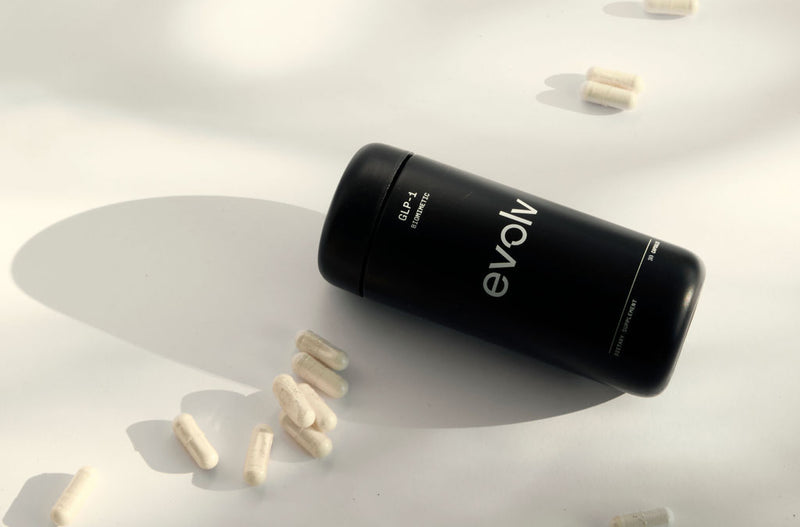
Evolv GLP-1 is a natural biomimetic dietary supplement built around a proprietary yeast-derived peptide designed to support GLP-1 and GIP appetite pathways.
Its active ingredient — the bioengineered, yeast-derived EV1 Peptide — is designed to support the body’s natural GLP-1 and GIP appetite pathways. In Evolv’s randomized controlled study, with results read out at 8 weeks, participants consumed approximately 750 fewer calories per day. Not through restriction. Through biology.
As Becca McCarthy, co-founder of Evolv, shared on the Mom Curious podcast: “It doesn’t mean you’re not hungry. It doesn’t mean that you don’t eat. It just resets your biology in a way that allows you to have a choice.”
Unlike stimulant-based or fiber-only approaches, Evolv is designed to support the underlying signaling that drives appetite and weight loss behavior — the same pathway that research shows is suppressed and disrupted during a weight loss plateau.
See what Evolv’s randomized study showed.
For more on the science behind this approach, read how Evolv GLP-1 biomimetic works and explore the research behind Evolv GLP-1.
What Is a Weight Loss Plateau?
A weight loss plateau is a period of no meaningful scale movement — typically defined as less than 0.5% of body weight change per month, despite continued adherence to diet and exercise habits. Practically: if you’ve been tracking honestly and the scale hasn’t moved by more than a pound in 3–4 consecutive weeks, you’re likely in a true plateau.
Normal day-to-day fluctuations (1–3 lbs from water, sodium, hormones, or digestion) don’t count. A plateau is a sustained, consistent stall.
Most plateaus last 8–12 weeks for standard dieters, though this varies significantly by individual. The most important thing to understand: a plateau doesn’t mean you’ve failed. It means your body has adapted.
Why Weight Loss Plateaus Happen
Standard advice reduces plateaus to one explanation: you’re eating too much. But the biology is more specific — and more interesting.
Adaptive Thermogenesis: Your Metabolism Recalibrates
When you lose weight, you’re carrying less mass. Your body needs fewer calories to sustain itself. But it doesn’t stop there.
Research shows that total energy expenditure decreases approximately 15% following 10% body weight loss, even after adjusting for reduced fat-free mass (Wang et al., Cell Reports Medicine, 2025). Part of this is expected — a lighter body burns fewer calories. But a significant driver is adaptive thermogenesis: the body actively reduces metabolic rate beyond what body composition changes alone would predict.
The mechanism is subtle but measurable. Skeletal muscle becomes approximately 25% more energy-efficient during weight loss, likely via changes in calcium futile cycling — meaning the same workout now burns fewer calories than it did when you were heavier (Wang et al., 2025).
Crucially, non-exercise activity thermogenesis (NEAT) — the unconscious movement that accounts for fidgeting, posture, and incidental activity — also collapses. In one model, NEAT accounts for 62–72% of the total energy expenditure decline after 10% weight loss (Wang et al., 2025). You move less, more efficiently, without meaning to.
The Appetite Hormone Cascade
What makes the plateau self-reinforcing is what happens to your hunger hormones while this metabolic recalibration is occurring.
Leptin — your primary satiety hormone — drops as fat mass declines. One year after significant weight loss, leptin remains approximately 35.5% below pre-diet baseline (Sumithran et al., New England Journal of Medicine, 2011). With less leptin, your brain’s sense of fullness is chronically blunted.
Simultaneously, ghrelin — the hunger hormone — increases with caloric restriction and stays elevated. One year out, fasting hunger is measurably 22% above pre-diet baseline. Not a subjective feeling of being hungry. A measurable hormonal state.
Peptide YY and cholecystokinin — gut-derived satiety signals released after eating — also decline. The result is a sustained hormonal environment that makes continued restriction feel harder over time, not easier.
This is not a willpower problem. Your body is mounting a coordinated defense against weight loss. The scale stops moving because the hunger is supposed to increase — it’s working as designed.
What Happens to Your GLP-1 During Weight Loss
GLP-1 is not a drug category. It’s a natural hormone your body produces — released by intestinal L-cells after eating to regulate appetite, slow gastric emptying, and signal satiety to the brain.
As Evolv co-founder Becca McCarthy described on the Mom Curious podcast: “GLP-1 is a natural hormone that exists in our body… GLP-1 is a natural hormone and a biological pathway in our own bodies. We own it.”
During a weight loss plateau, this natural GLP-1 system is under strain from multiple directions. First, leptin levels have dropped — and GLP-1 works in concert with leptin: research shows that leptin alone does not significantly suppress eating in normal-weight animals, but leptin together with GLP-1 substantially potentiates the appetite-suppressing effect (PMC4381768). When leptin declines during weight loss, the GLP-1-leptin synergy weakens.
Second, elevated ghrelin interferes directly: during fasting states, ghrelin restricts GLP-1 receptors to the cytoplasm of target cells, reducing GLP-1’s ability to suppress appetite at the very moment when you need appetite suppression most (PMC4381768).
The net effect is a quantifiable shift in the hunger feedback loop. Research modeling shows that during caloric restriction, hunger compensates at approximately 95 kcal per day for every kilogram of weight lost — meaning the more you lose, the harder your body pushes back against the deficit (Hall, Obesity, 2024). This feedback loop is a primary driver of why the scale eventually stops moving.
How Long Does a Weight Loss Plateau Last?
For standard dieters, most plateaus resolve within 8–12 weeks when addressed correctly. One study following 6,500+ participants found distinct plateau patterns: some lasted 3 months, others 6 or 9 months, depending on total weight lost and how the individual responded (Hendrie et al., Journal of Medical Internet Research, 2025).
One strategy doesn’t work: switching to a different diet. A 2024 crossover randomized controlled trial found that switching diet types at the 6-month plateau produced only 1% additional weight loss in the following 3 months — compared to 7% in the initial 3 months (Landry et al., Scientific Reports, 2024). The plateau isn’t a diet-compatibility problem. It’s a metabolic and hormonal one.
The metabolic adaptation does partially reverse. Research suggests metabolic rate begins to normalize after approximately 4 weeks of weight stabilization, which is the physiological basis for structured diet breaks.
Match the Strategy to the Mechanism
A weight loss plateau isn’t a sign that you’ve done something wrong. It’s a predictable biological response: your metabolism recalibrates, your hunger hormones shift, and your natural GLP-1 system comes under strain — all at the same time.
The strategies that work address these mechanisms directly. Recalibrating your TDEE closes the caloric gap. Protein and resistance training protect the muscle that keeps your metabolism elevated. Sleep, stress management, and prebiotic fiber address the hormonal environment. And GLP-1 and GIP pathways support the appetite feedback loop that none of the behavioral strategies can touch.
Understanding why you’re always hungry during a calorie deficit — and what to do about food noise — is half the battle. The other half is choosing tools that work at the level of the problem.
Most plateaus are breakable. You need to match the strategy to the mechanism.
Learn about GLP-1 supplements for weight loss and biomimetic products for metabolic health. For the science behind GLP-1 and how it impacts your weight management, visit our science page.
These statements have not been evaluated by the Food and Drug Administration. This product is not intended to diagnose, treat, cure, or prevent any disease.
Frequently Asked Questions
How do I know if I’ve actually hit a weight loss plateau?
A true weight loss plateau is no meaningful scale movement — less than 1 pound — for 3–4 consecutive weeks, despite consistent effort in your diet and activity. Normal day-to-day fluctuations of 1–3 lbs from water, sodium, or hormonal shifts don’t count. If you’ve tracked honestly and see no change for a full month, your body has physiologically adapted: it’s burning fewer calories because it weighs less and has become more energy-efficient. Most plateaus last 8–12 weeks on average.
What’s the fastest evidence-based way to break a weight loss plateau?
The highest-yield first moves are: audit your food tracking for hidden calories (most people underestimate by 300–500 calories per day), increase protein intake (protein digestion itself burns 20–30% more calories than fat or carbs, and it preserves the lean muscle that keeps your metabolism elevated), and change your exercise stimulus — add resistance training if you’ve been doing cardio only, or introduce HIIT. A 1–2 week diet break at maintenance calories has research support for reducing adaptive thermogenesis and priming the body for renewed fat loss.
Why does weight loss plateau on GLP-1 medications?
GLP-1 medications work by suppressing appetite and slowing gastric emptying, creating a caloric deficit. But as body weight drops, metabolism adapts downward — and the medication’s appetite-suppression effect reaches a ceiling at a given dose. Clinical data from the STEP 5 semaglutide trials show weight loss typically plateaus around week 60; tirzepatide users commonly plateau between weeks 24 and 36. At that point, nutrition quality becomes the critical lever — specifically protein intake to protect lean muscle mass and fiber intake to continue stimulating the GLP-1 pathway naturally alongside the medication.
Can supplements help break a weight loss plateau?
No single supplement breaks a plateau on its own, but a few have meaningful evidence as support tools. Protein is the most well-supported — preserving lean muscle keeps resting metabolism elevated. Among compounds, berberine has accumulated more research than most — it activates AMPK pathways and can modestly extend the body’s GLP-1 response, though the National Center for Complementary and Integrative Health notes evidence quality remains inconsistent, particularly for sustained outcomes. Soluble fiber (psyllium husk, inulin) stimulates GLP-1 release via short-chain fatty acid production in the gut, which supports appetite regulation between meals. These work at the nutritional input level. For direct engagement of the GLP-1 appetite feedback loop — the mechanism research identifies as the primary driver of plateau persistence — GLP-1 and GIP pathway support is designed to work at the level where behavioral and nutritional interventions can’t reach.
Why do women hit weight loss plateaus more often than men?
Women face additional plateau triggers that are largely hormonal. Estrogen and progesterone fluctuations across the menstrual cycle affect water retention, appetite, and fat storage weekly — making progress appear to stall even when fat loss is continuing. During perimenopause and menopause, declining estrogen independently slows metabolic rate and shifts fat storage toward the abdomen, creating plateau conditions regardless of caloric intake. Women also typically have lower baseline muscle mass than men, meaning less metabolic buffer as weight loss slows. The same plateau-breaking principles apply — protein, strength training, sleep, and a caloric audit — but women should account for cycle phase when interpreting weigh-ins and expect more variability week-to-week than the scale alone suggests.
As Becca McCarthy, Evolv co-founder, shared on the Mom Curious podcast: “We don’t have adequate health care around perimenopause, menopause, postnatal to help us solve around that. So, we’re left to fend for ourselves.” Understanding the hormonal terrain is the first step toward addressing it strategically rather than blaming discipline. Explore supplements to balance hormones and support weight loss for more on the hormone-weight connection.