







Body Recomposition: How to Lose Fat and Build Muscle at Once
Authored by
The Evolv Research Team
You’ve been lifting consistently. Your protein is on point. The scale hasn’t moved in six weeks. Most people read that as failure.
It isn’t.
Body recomposition — the process of losing fat and building lean muscle simultaneously — doesn’t show up where most people are looking. While the scale holds flat, your measurements shrink, your clothes fit differently, and your lifts climb week over week. That’s the result. And once you understand the three mechanisms that drive it — and the one variable that quietly stops most people from finishing — the path forward becomes a lot clearer.
What Is Body Recomposition and How Does It Work?
Body recomposition works by driving two parallel biological processes simultaneously: fat oxidation and muscle protein synthesis. Your body draws on stored fat for energy while using dietary protein and training stimulus to build lean tissue — changing the ratio of fat to muscle without necessarily moving the scale.
For years, this was considered nearly impossible, particularly in trained individuals. The current research closes that debate. A 2024 editorial in Frontiers in Physiology (Bonilla et al.) confirmed that body recomposition “occurs in untrained, trained, and highly trained populations of different ages.” The question isn’t whether it’s achievable. It’s how to structure the right conditions.
The reason the scale gets confusing during recomposition: fat and muscle have different densities. Losing five pounds of fat while gaining five pounds of lean tissue produces a net scale weight change of zero — but the physical transformation is real and measurable in every other way. Progress lives in your body measurements, how your clothes fit, your strength numbers, and your actual body fat percentage.
Who Sees the Best Results from Body Recomposition?
Three groups respond most dramatically.
Beginners and detrained individuals benefit from what researchers call “newbie gains.” The body’s anabolic response to resistance training is highest when the stimulus is novel. People returning to training after months away — or picking up consistent lifting for the first time — see the most aggressive simultaneous fat loss and muscle gain. The training signal is new enough to drive robust muscle protein synthesis even during a caloric deficit.
People with higher body fat percentages (roughly 20–30%+) carry an energy reserve in stored fat that the body can draw on to fuel muscle protein synthesis and training recovery. The caloric math works more favorably when fat stores are available as a fuel buffer.
Women follow the same underlying recomposition physiology as men. The absolute rate of muscle gain differs due to testosterone baseline differences, but the relative response — controlled for body weight — is comparable. Women starting from a “skinny fat” position (normal scale weight, higher body fat, lower lean mass) often see dramatic changes in body shape without meaningful scale movement over a 12–24-week window.
Trained individuals can still achieve body recomposition, though the rate slows with training experience. The key shift: protein requirements increase, and progressive overload must be more deliberately programmed.
1. Resistance Training
The most decisive evidence came from a 2026 study (Lahav, Yavetz, & Gepner) following 304 adults over a mean of 5.1 months. Every participant maintained a roughly 500-calorie daily deficit. But only one group achieved simultaneous fat loss and lean mass gain: the resistance training group. Men in that group lost an average of 8.9 kg of fat while gaining 0.8 kg of lean mass. Women lost 6.36 kg of fat and gained 0.90 kg of lean mass.
The aerobic-only group lost fat — but also lost lean mass. The no-exercise group lost the most lean mass of all.
That data point answers the question most people get wrong: cardio can support fat loss, but resistance training is what makes body recomposition actually work. Cardio plays a supporting role. It isn’t the driver.
Practically, the protocol that produces this:
-
Frequency: 2–3 resistance sessions per week minimum; 3–4 for more aggressive recomposition
-
Volume: Compound movements (squats, deadlifts, rows, presses) as the foundation, each major muscle group trained at least twice per week
-
Progressive overload: Adding weight or adding reps are equally valid — what matters is consistent progression week over week (Plotkin et al., 2022)
-
Recovery: 48 hours between sessions targeting the same muscle group; 7–9 hours of sleep for anabolic hormone support
One question that frequently comes up: does GLP-1 pathway support muscle retention? Research does not support that concern — and Evolv’s randomized controlled study, with results read out at 8 weeks, reported no participant-reported hair or muscle concerns. The science on whether GLP-1 causes muscle loss is covered in detail for anyone who wants to go deeper.
2. Protein — How Much and When
Protein is the structural prerequisite for everything body recomposition requires. It provides the amino acids that drive muscle protein synthesis, carries the highest thermic effect of any macronutrient (20–30% of protein calories are burned during digestion), and is the most satiating macronutrient — a fact that matters more for recomposition than most protocols acknowledge.
Evidence-based targets:
-
General exercising adults: 1.6–2.4 g/kg/day, or roughly 0.7–1.1 g per pound of body weight (ISSN Position Stand, Jäger et al., 2017)
-
During a caloric deficit, trained individuals: 2.3–3.1 g/kg/day to maximize lean mass retention
-
Practical example (Cleveland Clinic, Dr. David Creel): 110–150 g/day for a 165 lb person from lean meats, fish, eggs, and dairy
Distribution matters as much as total intake. The ISSN recommends spreading protein across meals every 3–4 hours, targeting 20–40 g per meal with 700–3,000 mg leucine per serving for optimal muscle protein synthesis signaling.
A point recomposition guides rarely explain: protein-rich meals are among the strongest natural triggers for GLP-1 and GIP release in the gut. These hormones — released within minutes of eating — signal the brain to register satiety and modulate appetite for the next meal. Understanding natural ways to increase GLP-1 and GIP signaling is part of why high-protein eating is so structurally powerful for recomposition — beyond just the amino acid story.
3. Your Caloric Strategy
The caloric math for body recomposition is straightforward: a mild deficit of 200–500 calories below maintenance — enough to drive fat oxidation without compromising training energy or suppressing muscle protein synthesis. Research suggests 10–20% below TDEE as the effective range, consistent with the ~500 kcal/day deficit used in the Lahav et al. 2026 study, where participants still gained lean mass.
Aggressive deficits backfire. A deficit above 750 calories per day significantly reduces muscle protein synthesis, depletes the glycogen needed for training performance, and elevates cortisol, which directly inhibits lean tissue retention. The math that looks like it should work faster actually produces worse body composition outcomes.
So the protocol is: mild deficit, consistently maintained, for months. And this is where most people’s body recomposition actually fails — not on the training, not on knowing the protein target, but on maintaining caloric precision across the full timeline the process requires.
The reason has a name. Research published in Nutrition & Diabetes in 2025 formally defined food noise as “persistent thoughts about food perceived as unwanted and dysphoric.” It’s the background pull toward eating that intensifies by late afternoon, compounds with stress, and — critically — doesn’t require actual hunger to operate. You can be exactly at maintenance calories and still experience the cognitive burden of constant food-focused thinking that erodes adherence over time.
For anyone who recognizes this pattern, the biology behind constant hunger and food-focused thinking explains why it doesn’t respond to willpower. The governing mechanism is the GLP-1 and GIP system — these hormones, released after protein-rich meals, signal the hypothalamus and brain reward circuitry to register satiety and quiet the food-noise feedback loop. When that signaling is well-supported, the mild caloric discipline recomposition becomes biologically natural. When it’s blunted — as research confirms is common — hunger signals arrive late, satiety is weaker, and food noise fills the gap.
What food noise is and how to address it is worth understanding if this is the variable that’s been breaking your caloric consistency.
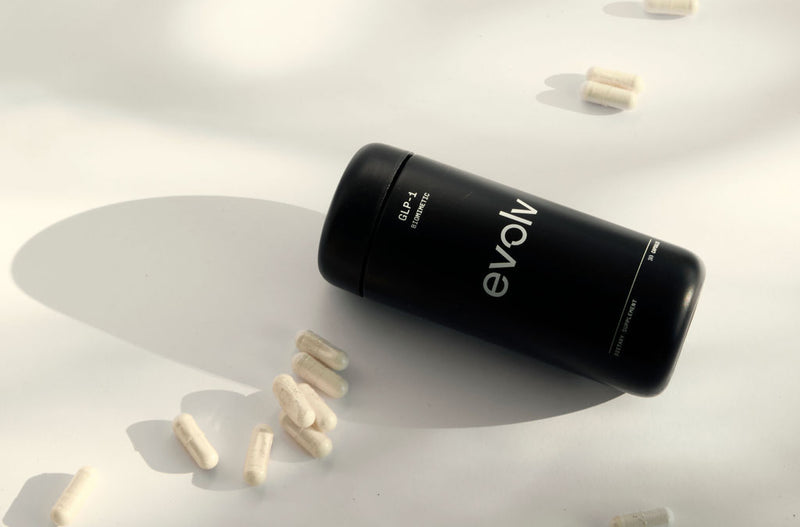
Evolv GLP-1 is a natural biomimetic dietary supplement built around a proprietary yeast-derived peptide designed to support GLP-1 and GIP appetite pathways. It doesn’t restrict portions mechanically, eliminate hunger, or function as a stimulant. As Becca McCarthy, co-founder of Evolv, described on the Mom Curious podcast: “Food noise essentially is that constant chatter in your mind that is compelling you to snack. It’s that voice in your head that’s like, I just ate — how much time is going to pass until I eat next? When you’re on Evolv GLP-1, it totally dissipates.”
In Evolv’s randomized controlled study, with results read out at 8 weeks, participants consumed approximately 750 fewer calories per day — not from restriction or willpower, but through restored appetite pathway signaling. For body recomposition, that caloric consistency over months is precisely what the 3-pillar framework requires to actually deliver.
McCarthy continued: “It doesn’t mean you’re not hungry. It doesn’t mean that you don’t eat. It just resets your biology in a way that allows you to have a choice.” For recomposition, that choice — made consistently across months — is the variable that determines whether the result arrives.
See our science page for the full mechanism behind GLP-1 and GIP pathway support, or explore Evolv GLP-1 directly.
How Long Does Body Recomposition Take?
Body recomposition is structurally slower than a dedicated cut or bulk because both fat loss and lean tissue gain are happening simultaneously at the rate each would occur in isolation. That’s the trade-off for skipping the bulk → cut → repeat cycle.
Realistic milestones:
-
4 weeks: Performance gains — weight climbing on your main lifts, improved training recovery. This is the first reliable signal that the protocol is working, well before visible changes appear.
-
8 weeks: Early measurable changes in body composition, detectable by circumference measurements; some people begin noticing clothing fit shifting.
-
12–16 weeks: Visible changes in body shape for most people following the full protocol. The “more toned without losing weight” outcome most people are after starts materializing here.
-
24 weeks: Significant recomposition documented in research. A 24-week study of older women on moderate protein intake showed +5.4% skeletal muscle mass and −3.7% fat mass.
The critical reframe for anyone mid-process: if your measurements are shifting and your strength is climbing, you are succeeding — regardless of what the scale reads. The scale measures the sum of two things moving in opposite directions. Measuring each one separately is how you actually see the result.
How to Track Body Recomposition Progress
The scale is one data point. During recomposition, it’s not the most informative one.
Body measurements (every 2-4 weeks): Waist, hips, thighs, chest, and arms capture body composition changes before the scale does, and they track the outcomes most people are actually after.
Progress photos: Same lighting, same angle, same time of day. Monthly is usually the right frequency — enough to see meaningful change without the noise of daily fluctuation.
Strength progression: Tracking compound lifts (squat, deadlift, bench press, row) is a direct proxy for lean mass development. Consistent rep or weight increases week over week indicate muscle protein synthesis is occurring.
Body fat percentage: A calibrated smart scale or DEXA scan measures what actually matters — the ratio of fat to lean tissue. DEXA is the gold standard; consistent smart scale measurements (same time of day, fasted) provide directional data over weeks.
Energy and recovery as leading indicators: Sustained afternoon energy, improved sleep quality, and faster training recovery often precede visible body changes by several weeks. These are early signals that the hormonal and metabolic environment is supporting what the recomposition protocol requires.
The Bottom Line on Body Recomposition
Body recomposition is the path for people who want a result they can sustain — not a cycle of aggressive cuts and bulks that produces a different number on the scale each quarter while underlying body composition stays roughly the same.
The three pillars — resistance training, protein, and caloric precision — are well understood. The less discussed variable is that caloric precision is an execution challenge, not a knowledge gap. Most people know approximately how many calories they need. The harder part is biological consistency: navigating the appetite fluctuations, food noise, and late-afternoon hunger that make a mild 200-calorie deficit feel manageable some days and unsustainable on others.
For a broader look at how metabolic supplements stack up for body composition goals, see the top supplements to support healthy metabolism in 2026. Body recomposition rewards consistency over intensity. The people who finish it are the ones who made the protocol sustainable.
Frequently Asked Questions
What is body recomposition?
Body recomposition is the process of simultaneously losing fat and gaining lean muscle mass — changing the ratio of fat to muscle in your body without necessarily changing your scale weight. Progress shows up in measurements, how your clothes fit, and strength gains — not the number on the bathroom scale.
Can you really lose fat and build muscle at the same time?
Yes. A 2026 study following 304 adults confirmed that participants doing resistance training achieved simultaneous fat loss and lean mass gain over an average of 5.1 months, while aerobic-only and no-exercise groups both lost lean mass. The mechanisms — muscle protein synthesis and fat oxidation — operate in parallel when you pair consistent resistance training with adequate protein and a mild caloric deficit.
If the scale isn’t moving, does that mean body recomposition is working?
A flat or barely moving scale is often one of the first signs recomposition is working. Muscle is denser than fat — if you lose five pounds of fat and gain five pounds of muscle, your scale weight holds steady while your shape changes substantially. Track body measurements, how your clothes fit, strength progression on your main lifts, and monthly progress photos instead.
Should I recomp, cut, or bulk?
Body recomposition works best for beginners, people returning after a break, and those with higher body fat (roughly 20–30%+). Experienced lean individuals gain muscle faster in a dedicated bulk. Those with very high body fat may prefer a structured cut first. The large middle group — moderate body fat, some training history, goal of looking and feeling better — typically responds well to recomposition at or near maintenance calories.
What supplements actually help with body recomposition?
The most evidence-backed options are dietary protein (from food or supplements) and creatine monohydrate, both of which support muscle protein synthesis and training output. Appetite regulation is the other area with a strong mechanistic rationale: the body naturally releases GLP-1 and GIP after protein-rich meals, signaling fullness and reducing the drive to overeat. Formulations designed to support these pathways can improve caloric adherence over the months recomposition requires, which is where most people actually fall short. For more context on the research, see GLP-1 supplements for weight loss and the full breakdown of the most effective weight loss supplements.
These statements have not been evaluated by the Food and Drug Administration. This product is not intended to diagnose, treat, cure, or prevent any disease.