







Sustainable Weight Loss: 5 Habits That Actually Last
Authored by
The Evolv Research Team
Most lost weight comes back, and it is not because people stop trying. After weight loss, appetite biology shifts against you in a way researchers have measured precisely, and it keeps pushing long after the diet ends.
The most sustainable way to lose weight is to take it off slowly enough to keep your muscle and your appetite signals intact, at roughly 1 to 2 pounds a week, using habits you would still keep if the scale stopped moving tomorrow. That last part is the whole test. A method you would abandon the moment you hit your goal is a diet, and diets have a known ending.
Sustainable weight loss doesn’t mean eating less forever. It means building habits that work with that biology instead of against it, habits that reduce the difficulty of maintenance to a level that’s actually livable. Five mechanisms determine whether weight loss lasts: protein satiety, daily movement, sleep hormones, food environment architecture, and appetite pathway regulation. A habit for each follows.
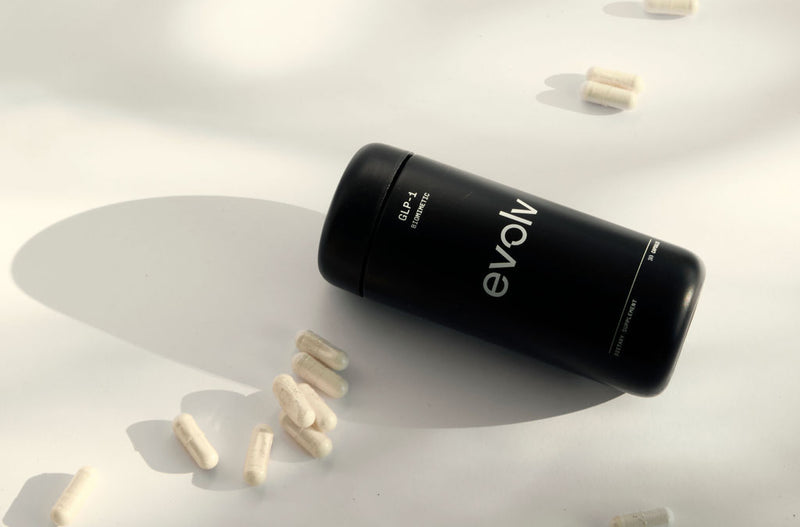
That last mechanism is the one Evolv was built around. Evolv is the biotech brand behind the first oral GLP-1 biomimetic peptide, and Habit 5 is where that gets concrete.
Why Most Diets Fail (and What Biology Has to Do With It)
The numbers are blunt. More than half of lost weight is typically regained within two years, and by five years more than 80% of it is back, according to a review by Hall and Kahan in Medical Clinics of North America. The mechanism isn’t mysterious. It’s hormonal.
When you lose weight, your body responds as if it’s under threat. Ghrelin, the hormone that signals hunger, rises. Leptin, the hormone that signals fullness, falls.
The two sides of that ledger are not symmetrical. For each kilogram lost, energy expenditure drops by roughly 20 to 30 calories per day, while appetite increases by about 100 calories per day above where it sat before. The pressure is three to five times larger on the hunger side than on the metabolism side.
That asymmetry is why “eat less, move more” fails as maintenance advice. It answers the smaller half of the problem.
That appetite increase scales with how much weight you lost, not with how hard you restricted. You cannot outrun it by dieting more politely. The body wants the fat back, and it has effective tools to pursue it.
This is not a character failure. It’s a survival response your body evolved over tens of thousands of years of uncertain food supply. The problem is that it now operates in a food environment where highly palatable, calorie-dense food is always within reach, and willpower is the only thing standing between you and it.
The solution isn’t more discipline. It’s habits that reduce how hard your biology is working against you. Each of the five habits below targets a specific piece of that biological puzzle.
1. Build Meals Around Protein (and Fiber)
Protein is the most satiating macronutrient, and not because of its calorie count, but because of its direct effect on appetite hormones. High-protein meals help reduce ghrelin levels and increase satiety hormones including PYY and GLP-1.
Research supports a target of 1.6–2.2g of protein per kilogram of body weight during weight loss, a range that preserves lean mass and measurably reduces hunger compared to standard protein intakes. One popular version of this is the 30-30-30 approach: 30 grams of protein within 30 minutes of waking, followed by easy cardio. Front-loading protein is consistent with what protein does to ghrelin, though the specific numbers are a convention rather than a tested threshold.
Fiber is the secondary lever. A 44-study meta-analysis found that fiber intake consistently increases satiety and reduces subsequent energy intake. A target of 25–30g per day from whole food sources (vegetables, legumes, fruit, oats) reinforces the protein effect by slowing gastric emptying and feeding the gut bacteria that produce additional satiety signals.
The practical shift: build meals protein-first, fiber-second. Not calorie-first. This approach replaces constant counting with a structural default that tends to naturally reduce intake without restriction feeling like restriction. Learn more about the satiety signals that drive feeling full longer after meals.
2. Move Daily (Not Necessarily Hard)
The National Weight Control Registry, a long-term study of people who’ve successfully maintained significant weight loss, finds that successful maintainers average approximately 60 minutes of moderate activity per day. Not structured HIIT every morning. Not a 5-day gym split. Walking counts.
The purpose of daily movement in sustainable weight loss isn’t primarily calorie burning. It’s offsetting the metabolic slowdown that comes with weight loss, the body’s tendency to become more efficient with calories as weight drops, and supporting insulin sensitivity, which directly affects appetite regulation.
Resistance training two to three times per week adds another layer: preserving lean mass during a deficit. More lean mass means a higher resting metabolic rate, which means less aggressive calorie restriction is needed to sustain a deficit over time.
The habit framing that works: movement isn’t a workout you fit in. It’s a non-negotiable daily behavior, like brushing your teeth. People who maintain weight long-term haven’t found extraordinary motivation; they’ve made movement structural enough that skipping it requires more effort than doing it.
3. Prioritize Sleep Like It Affects Your Appetite (Because It Does)
Sleep is one of the most underutilized levers in weight management, and one of the easiest to lose during a stressful stretch.
The mechanism is direct: poor sleep raises ghrelin and lowers leptin. In the Wisconsin Sleep Cohort, Taheri and colleagues found habitual five-hour sleepers ran about 14.9% higher ghrelin and 15.5% lower leptin than eight-hour sleepers. In other words, a bad night’s sleep puts your appetite hormones in the same state as post-diet hormonal shift. If you’re sleeping five to six hours per night while trying to maintain weight loss, your body’s hunger biology is working against you in both directions simultaneously.
Short sleep also tends to raise cortisol, which works against glucose regulation and can push cravings toward high-sugar, high-fat foods, particularly in the evening. The late-night snacking problem is often a sleep problem. Addressing food noise and appetite biology frequently begins with getting to bed earlier.
The practical target: 7–9 hours per night, consistently. Consistency of sleep timing matters as much as duration, because irregular bedtimes disrupt the circadian regulation of appetite hormones even when total sleep hours are adequate.
4. Manage Your Food Environment, Not Just Your Willpower
Research on long-term weight maintainers consistently finds one pattern: they prefer home-cooked meals over restaurant meals, and not because they’re more disciplined, but because their food environment supports better defaults by default.
Willpower is a finite resource. It depletes under stress, fatigue, and decision fatigue. Your food environment, by contrast, operates independently of your emotional state on any given day. Structuring that environment reduces how much willpower the moment of decision demands, because the work happens before the craving arrives rather than after.
Three concrete architecture changes:
-
Keep protein and fiber-rich foods accessible and visible. The first thing you reach for sets the direction of the meal.
-
Reduce friction for good defaults; increase friction for poor ones. Keeping trigger foods out of the house isn’t restriction. It’s engineering the path of least resistance to run in the right direction.
-
Establish a consistent meal schedule. Opportunistic eating driven by boredom or passing hunger tends to add calories without adding satiety. A structured schedule reduces the number of unplanned food decisions in a day.
As Evolv co-founder Becca McCarthy shared on the Mom Curious podcast: “You’re approaching the fridge or approaching the pantry or approaching a meal with less panic, more agency and more intention, you’re more motivated to make healthy choices and you’re not driven by cravings.”
Managing emotional eating patterns that derail progress is an extension of this environment-first thinking, because most emotional eating is triggered by environment cues, not genuine hunger.
5. Address the Appetite Signal, Not Just the Symptom
The four habits above reduce the caloric load and support a biological environment that makes weight management less adversarial. But the fundamental challenge remains: appetite biology actively works against sustained weight loss. The habits reduce the difficulty. They don’t eliminate the biological headwind.
The GLP-1 pathway is where that headwind originates. GLP-1 is a naturally occurring hormone released in the gut when you eat. It signals your brain, pancreas, stomach, and liver that you’ve consumed food and are full. It affects how fast your stomach empties, how your insulin responds, and whether your brain receives a clear satiety signal. After weight loss, this signaling weakens, which is why hunger returns at lower body weights.
As Becca McCarthy explained on the Mom Curious podcast: “When you eat, your body produces the GLP-1 hormone. That hormone meets its receptors and those receptors signal to various organs in your body… and tell them what to do because you’ve now consumed food and you’re full.”
There are two ways to support this pathway:
Dietary: Protein-rich foods (eggs, fatty fish, legumes), fiber, and fermented foods all extend the natural GLP-1 response after eating, reinforcing Habit 1 directly. Learn about natural ways to support GLP-1 signaling through food.
Biomimetic pathway support: Evolv GLP-1 is a natural biomimetic dietary supplement built around a proprietary yeast-derived peptide designed to support GLP-1 and GIP appetite pathways.
Worth clearing up the name, because it confuses nearly everyone. GLP-1 is a hormone, and your own gut is the only place it is made. No product contains it, prescription or supplement. What a GLP-1 product acts on is the pathway that hormone runs on, and Evolv’s active ingredient, the bioengineered, yeast-derived EV1 Peptide, is designed to do exactly that: support your own GLP-1 and GIP appetite pathways, the mechanisms that connect eating to satiety.
In Evolv’s randomized controlled study, with results read out at 8 weeks, participants consumed approximately 750 fewer calories per day, not through restriction but through supported appetite signaling, and lost up to 12+ lbs at the 8-week readout. That’s not a willpower result. That’s a biology result.
This layer and the four behavioral habits are designed to work together. The habits lower how hard the biology pushes back, and supporting the pathway is what keeps them doable on the days willpower runs low. Read more about how GLP-1 supports weight management and the research behind GLP-1 pathway support products.
Putting It Together: A Sustainable Weight Loss Protocol
The five habits build on each other. Sleep and food environment are the foundation, because they determine whether the other habits are biologically possible on hard days. Protein and daily movement are the daily behavioral levers. Appetite pathway support is the biological underpinning that makes the whole system less adversarial over time.
The rate to anchor to. A 500 to 750 calorie-per-day deficit works out to 1 to 1.5 lbs per week, which sits inside the 1 to 2 lbs per week the CDC describes as healthy weight loss. A pound of fat is roughly 3,500 calories, so a 500-calorie daily deficit is about a pound a week and a 750-calorie deficit is about a pound and a half. Cutting deeper does not buy you proportionally faster progress, because the appetite response scales with the weight you lose, and a bigger deficit costs you more lean mass on the way down. If you can hold the deficit without feeling controlled by hunger, that’s your pace.
You don’t have to install all five habits at once. Start with one. Protein-forward eating and consistent sleep are the highest-leverage starting points for most people, because they address the two hormonal mechanisms (ghrelin and leptin) that drive regain most directly. Build from there.
Most diets end. Sustainable weight loss doesn’t, because it isn’t a diet. It’s a set of habits calibrated to your biology rather than fighting it. The goal is a version of eating, moving, and sleeping that you can maintain across all of your life, holidays and stressful weeks included, and every ordinary day between now and whenever you would like to stop thinking about your weight. That’s what sustainable actually means.
To address appetite regulation at the biological level, explore Evolv GLP-1 and the science behind GLP-1 and GIP pathway support.
Frequently Asked Questions
What is sustainable weight loss?
Sustainable weight loss is weight loss at a pace and with habits that can be maintained without constant restriction, and at a pace standard guidance puts at 1 to 2 lbs per week. Slower than that is not failure, just a smaller deficit. Unlike crash dieting, it avoids the aggressive calorie cuts that spike ghrelin and drive regain. The goal isn’t a finish line; it’s building a permanent eating and movement pattern that keeps the weight off.
How many calories should you cut for sustainable weight loss?
A deficit of 500–750 calories per day creates a 1 to 1.5 lb/week rate of loss, fast enough to see progress, slow enough to preserve lean mass and avoid triggering the hormonal hunger rebound that causes regain. Cutting deeper than 750 calories per day accelerates the ghrelin and leptin shift that makes regain almost inevitable.
How long does sustainable weight loss take?
It depends on starting point, but sustainable weight loss doesn’t have a finish line. The habits that produce weight loss are the same habits that maintain it. Most people reach a stable weight within 6–24 months on a consistent, moderate approach, but maintenance mode is the destination, not a recovery from dieting.
What’s the difference between sustainable weight loss and crash dieting?
Crash dieting enforces severe restriction for rapid results, but the calorie deficit is too aggressive to maintain, and the hormonal response (sharp ghrelin rise, leptin drop) makes hunger worse after stopping. Sustainable weight loss uses a moderate deficit, builds habits that become defaults, and works with the appetite biology instead of fighting it. The result: slower initial progress, dramatically better long-term outcomes.
Which habits are most important for keeping weight off long-term?
Research consistently points to: protein-forward eating (reduces ghrelin, increases satiety), daily moderate movement (roughly 60 minutes), adequate sleep (prevents the ghrelin spike from deprivation), and a food environment engineered for good defaults. Addressing appetite pathway biology, through diet and, for some, GLP-1 and GIP pathway support, is the layer that makes behavioral habits stick when willpower runs low.
Is losing 20 lbs in 3 months sustainable?
It sits right at the top of the sustainable band, so it is achievable, but there is not much room above it. Three months is about 13 weeks, so 20 lbs works out to roughly 1.5 lbs per week, which needs a deficit near 750 calories per day held consistently for the full stretch. That is realistic for many people, though the same 20 lbs taken over four or five months is easier to hold onto, because the appetite rebound scales with the weight lost regardless of how fast it came off. The honest question is not whether you can hit 20 lbs by month three. It is whether the way you did it is something you would still be doing in month twelve.
Is GLP-1 weight loss sustainable?
It depends entirely on whether the appetite signal stays supported and whether the habits were built while it was. GLP-1 pathway support works on the mechanism that drives hunger, so when that support stops, appetite returns toward wherever the body’s biology sets it, which after weight loss is higher than it was at the start. That is not a flaw specific to any one approach; it is the same 100-calories-per-kilogram appetite rebound that makes regain common after every method. What makes the loss durable is using the window when appetite is manageable to make protein-forward eating, daily movement, and consistent sleep into defaults rather than efforts. The pathway support lowers the difficulty. The habits are what hold the result.
Is fast weight loss ever better than slow weight loss?
Faster loss is not automatically worse, and early momentum genuinely helps some people stay engaged. What matters is the method rather than the speed. Aggressive deficits cost lean mass, and lean mass is what keeps your resting metabolic rate up and your glucose handling intact, so losing it makes the maintenance phase harder in a way that does not show up on the scale. Rapid loss driven by cutting out whole food groups also tends to fail on a second count: it teaches you nothing you can keep doing. A moderate deficit is not a moral choice about patience. It is the pace at which you keep the muscle and the habits that decide what happens in year two.
These statements have not been evaluated by the Food and Drug Administration. This product is not intended to diagnose, treat, cure, or prevent any disease.