







What Is Peptide Therapy? Benefits, Uses, and Safety Explained
Authored by
The Evolv Research Team
If you’ve been exploring peptide therapy, you’ve probably hit one of two walls.
The first: a grey-market website selling something labeled “not for human consumption,” shipping research chemicals of uncertain purity to anyone with a credit card. The second: a clinic charging $200–$800 a month for physician-managed injectable protocols that most people can’t access, afford, or commit to.
Neither option works for the majority of health-conscious adults who are genuinely interested in what peptide science can do.
The science behind peptide therapy is real — over 120 peptide-based drugs are FDA-approved today, and the global peptide therapeutics market is estimated at more than $140 billion in 2025 (Grand View Research). What’s broken isn’t the science. It’s the access.
This article explains what peptide therapy actually is, which forms have meaningful clinical evidence, what separates a safe peptide product from a risky one, and where oral biomimetic peptide supplements — like Evolv GLP-1 — fit into the landscape as a third option: no prescription, no needle, and no grey-market gamble.
What Is Peptide Therapy?
Peptide therapy is the clinical use of short amino acid chains — called peptides — to trigger specific biological responses in the body. Peptides are 2 to 50 amino acids long, making them structurally simpler than proteins (which exceed 100 amino acids) but biologically precise in their targeting.
The therapeutic value lies in that precision. Where many conventional drugs act broadly, peptides function like biological keys cut for specific locks — binding to distinct cell-surface receptors and triggering targeted signaling cascades: hormone release, tissue repair, immune modulation, metabolic regulation.
Insulin is the original example. A 51-amino-acid peptide, it’s been treating type 1 diabetes since 1923. The category has expanded significantly since then — approximately 120 peptide-based drugs are on the market as of 2024, including treatments for metabolic disease, cancer, osteoporosis, HIV, and chronic pain (Al Musaimi et al., Pharmaceuticals, 2025).
How Peptides Work as Signaling Molecules
Think of amino acids as individual letters. Peptides are short, precise words that carry specific messages to cells. Proteins are full paragraphs — same building blocks, far more complexity.
When a peptide binds to its receptor, it triggers an intracellular signaling cascade that produces a defined effect. A GLP-1 peptide binding to a GLP-1 receptor in the pancreas triggers insulin release. A growth hormone secretagogue peptide binding to the GHS-R1a receptor in the pituitary triggers a growth hormone pulse. A copper tripeptide binding to its receptor in a skin fibroblast upregulates collagen production.
This receptor specificity — activating discrete pathways rather than flooding the whole system — is why peptide drugs have become important tools in precision medicine.
Peptides vs. Proteins vs. Small-Molecule Drugs
Peptides occupy a pharmacological middle ground. Small-molecule drugs (like ibuprofen or metformin) are chemically synthesized, often broadly targeted, and generally orally bioavailable. Large biologics like monoclonal antibodies are highly specific but expensive to manufacture and always injected.
Peptides sit between these: smaller than biologics, more specific than most small molecules, and — importantly — less expensive to manufacture. The tradeoff is stability. Peptides are inherently fragile in the digestive tract, which creates the central challenge of oral delivery that shapes how the entire category is formulated and delivered.
Peptide Therapy Benefits
The documented benefits of peptide therapy vary considerably by compound, delivery method, and quality of evidence. Here’s what the research actually supports — organized by use case.
Metabolic health and weight management: GLP-1 receptor agonists have the most extensive human clinical evidence in this category. The SURMOUNT-1 data on tirzepatide — 20.9% mean body weight reduction over 72 weeks — illustrates what pharmacological GLP-1 and GIP pathway engagement can produce at the prescription tier (Jastreboff et al., NEJM, 2022). This is FDA-approved, physician-managed, injectable therapy.
Skin rejuvenation and anti-aging: GHK-Cu has meaningful published data for wound healing and collagen stimulation. Topical peptide serums (including palmitoyl pentapeptide derivatives) have clinical evidence for modest improvements in skin texture and firmness. Oral collagen peptides show real benefits in well-designed trials, tempered by the funding-bias caveat above.
Recovery and tissue repair: The preclinical literature on BPC-157 and related compounds is scientifically interesting — multiple animal models show accelerated healing of tendons, ligaments, and gut tissue. The translation to humans remains unvalidated at a clinical evidence level. People report benefits anecdotally; that evidence is not yet replicated in rigorous human trials.
Sleep and hormone support: Compounds like CJC-1295 and Ipamorelin are studied for growth hormone secretion, with potential downstream effects on sleep quality and lean tissue maintenance. These remain grey-market research chemicals with no FDA-approved human indication. The regulatory environment around them tightened significantly in 2023–2024.
The honest framing: peptide science as a field is credible and advancing. The specific compounds most people encounter in wellness spaces are often the ones with the weakest human evidence, the most significant regulatory risk, and the highest likelihood of sourcing problems.
Types of Peptide Therapy
The term “peptide therapy” covers a wide range of compounds, use cases, and regulatory statuses. They are not equivalent — a peptide drug approved by the FDA after Phase III trials and a research chemical ordered online under a “for laboratory use only” disclaimer occupy entirely different categories of evidence and safety.
Metabolic and Weight Management Peptides
The best-documented peptides for metabolic health are GLP-1 receptor agonists — synthetic peptides that mimic glucagon-like peptide-1, a hormone naturally produced in the gut after eating.
GLP-1 is a 30-amino-acid peptide. Its natural functions include stimulating insulin secretion from the pancreas, suppressing glucagon release, slowing gastric emptying to extend satiety, and acting on appetite centers in the brain. In other words, it’s a key signal in the body’s own hunger-regulation system.
Pharmaceutical GLP-1 receptor agonists are synthetic, modified versions of this peptide, engineered to resist degradation and maintain high receptor affinity for days or weeks after a single injection. Tirzepatide — a dual GLP-1 and GIP receptor agonist — produced a mean body weight reduction of 20.9% versus 3.1% for placebo in the SURMOUNT-1 trial, a 72-week study of 2,539 adults (Jastreboff et al., NEJM, 2022). These are FDA-approved medications, requiring a prescription, ongoing physician management, and weekly self-injection.
To understand how Evolv fits into this picture, see what GLP-1 actually is and how it works.
Anti-Aging and Skin Peptides
GHK-Cu (glycyl-L-histidyl-L-lysine copper complex) is a naturally occurring peptide found in blood, saliva, and urine. Blood levels decline from approximately 200 ng/mL at age 20 to around 80 ng/mL by age 60 — a drop of more than 60% (Pickart & Margolina, Int J Mol Sci, 2018). Research suggests GHK-Cu may regulate thousands of human genes involved in tissue repair, collagen synthesis, and anti-inflammatory pathways.
A wound-healing randomized controlled trial using a 2% GHK-Cu gel found wound closure was three times faster versus placebo, with reduced infection rates (Fagron Academy, citing published trial data).
Collagen peptides — hydrolyzed collagen broken into short, digestible fragments — are the most widely consumed oral peptide supplement category. A 2025 meta-analysis of 23 randomized controlled trials involving 1,474 participants found significant improvements in skin hydration, elasticity, and wrinkles (AMJMED). The catch: meaningful funding bias was documented — industry-funded trials showed benefits; independent trials generally did not. Collagen peptides remain a useful topical and dietary category, but the evidence warrants calibrated expectations.
Recovery and Performance Peptides
BPC-157 (Body Protection Compound-157) and TB-500 (Thymosin Beta-4 analog) are the most discussed recovery peptides in biohacking and sports performance communities — often referred to colloquially as the “Wolverine stack” for their reputation around musculoskeletal healing and tissue repair.
The problem: the evidence base for human use is thin. BPC-157 has only 3 published human trials — all small, unblinded pilot studies, with no large randomized controlled trials completed (McGuire et al., Current Reviews in Musculoskeletal Medicine, 2025). The FDA classified BPC-157 as Category 2 in September 2023, citing “safety, impurities, and insufficient human data,” effectively barring compounding pharmacies from preparing it. WADA banned TB-500 for use in sport in 2022.
The preclinical animal data are genuinely compelling. The human clinical evidence simply isn’t there yet.
Oral Peptide Supplements: An Emerging Category
Most peptide drugs must be injected because the digestive tract is hostile territory for intact peptides. Stomach acid (pH 1–2) destabilizes peptide structure. Proteolytic enzymes — pepsin, trypsin, chymotrypsin — are designed to break peptide bonds. The result: typical oral bioavailability for therapeutic peptides is less than 1%, often less than 0.1% (Baral & Choi, Pharmaceuticals, 2025).
This is not a flaw in the science. It’s a fundamental pharmacology challenge that has driven pharmaceutical innovation. Oral semaglutide (Rybelsus) solved it for GLP-1 signaling using SNAC — an absorption enhancer that creates a protective alkaline microenvironment in the stomach, temporarily increasing gastric permeability so the peptide absorbs before enzymes can degrade it. Still only ~1% bioavailability — but semaglutide’s potency makes that clinically meaningful.
A different approach is emerging at the supplement tier: biomimetic peptide formulations that support the body’s own pathway signaling rather than delivering exogenous therapeutic peptides. These are architecturally distinct from grey-market injectables — and from GLP-1 drugs.
As Evolv co-founder Becca McCarthy explained on the Mom Curious podcast: “We took everything we know about peptide engineering and we designed a novel peptide that is all natural. It only contains canonical amino acids, unlike the pharmaceutical GLP-1s which have some synthetic material in them. And then we wrapped that in our own oral delivery platform that gives that peptide bioavailability so it survives the stomach environment.”
For a deeper look at what makes biomimetic delivery different from both pharmaceutical peptide drugs and conventional supplements, see our explainer on natural peptides and how long peptides take to work.
Is Peptide Therapy Safe?
Safety in peptide therapy depends entirely on which peptide, sourced from where, administered how. There is no single answer — there are three distinct categories that carry completely different risk profiles.
FDA-Approved Peptide Drugs
Peptide drugs that have cleared FDA review — insulin, GLP-1 receptor agonists, teriparatide for osteoporosis, carfilzomib for multiple myeloma — represent the highest evidence tier. They’ve cleared multi-phase clinical trials, GMP manufacturing standards, chemistry and manufacturing controls review, and ongoing post-market surveillance. When prescribed and dosed by a physician, these are among the most rigorously studied drugs in medicine.
The tradeoff is access. Prescription-required, physician-managed, injection-delivered, and costly — typically $200–$800/month for compounded versions and $1,000+/month for brand-name prescriptions without insurance. Not accessible to most people.
Grey-Market and Unregulated Peptides
The grey-market research chemical pathway is where most consumer-facing peptide content operates — and where the risk is real and documented.
“Not for human consumption” is the label these products legally carry. That phrase exists because these compounds have not been approved by the FDA for human use. Yet they’re widely self-injected.
The Cureus 2026 narrative review on unregulated peptide use in the biohacking space documented dosing errors ranging from 10–90% off the intended dose, contamination with bacteria, heavy metals, and steroids, and cases of mislabeled peptide sequences. There is no GMP manufacturing requirement. No sterility standard. No verified potency or purity. Some vendors use fake Certificates of Analysis.
There’s also a theoretical oncological concern: because certain peptides stimulate angiogenesis (new blood vessel growth) and tissue proliferation, researchers have raised the question of whether they could inadvertently accelerate growth in undiagnosed tumors. The evidence here is preclinical and not conclusive — but it’s a real enough concern that the FDA, the AMA, and independent researchers have all raised it.
The distinction isn’t whether peptides work. It’s whether the product reaching you has been manufactured under conditions that make it safe to inject.
Supplement-Grade Oral Peptides
Dietary supplement-grade oral peptide products occupy a different regulatory space — not FDA-approved drugs, but also not grey-market injectables. They operate under DSHEA (Dietary Supplement Health and Education Act), which permits structure-function claims backed by evidence while prohibiting disease claims.
The risk profile is fundamentally different: no injection site, no sterility requirement, no contamination from unregulated manufacturing. The burden of evidence for structure-function claims is lower than the FDA drug standard — but a meaningful clinical study raises the bar considerably above the typical supplement.
For Evolv GLP-1, the reference point is a randomized controlled study, with results read out at 8 weeks. For readers who want the detailed mechanism and study data, the research is documented in the science behind Evolv GLP-1.
How Evolv Fits Into the Peptide Therapy Landscape
Most peptide content describes two options. Injectable clinical protocols are physician-managed and expensive. Or grey-market research chemicals, unregulated and risky. The assumption is that these are the only pathways into peptide science.
They’re not.
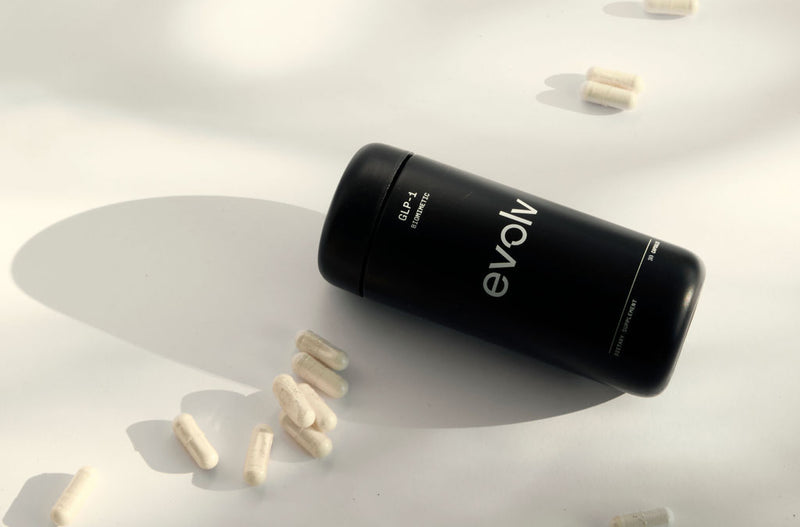
Evolv GLP-1 is a natural biomimetic dietary supplement built around a proprietary yeast-derived peptide designed to support GLP-1 and GIP appetite pathways. It’s not a clinical peptide therapy. It’s not a grey-market research chemical. It’s a third category — oral, supplement-grade, formulated to support the body’s own GLP-1 and GIP appetite pathways rather than introduce exogenous peptide drugs.
The active ingredient is the bioengineered EV1 Peptide, derived from Saccharomyces cerevisiae (yeast). Its design draws on the same peptide engineering principles underlying pharmaceutical development — but in a biomimetic implementation that keeps canonical amino acids intact, delivers orally without synthetic modification, and works within the body’s existing GLP-1 pathway architecture.
In Evolv’s randomized controlled study, with results read out at 8 weeks, participants lost up to 12+ lbs, consumed approximately 750 fewer calories per day, and reduced waist circumference by up to 4+ inches. No participant-reported hair or muscle concerns.
Becca McCarthy, Evolv’s co-founder, described the mission simply on the Mom Curious podcast: “Our whole mission as a company is to create access and affordability to these biotech-driven solutions and science-led solutions that actually work for people.”
That’s the gap Evolv is built to fill. The science exists. The access was the problem. The biomimetic supplement category is the solution Evolv engineered.
You can explore the full mechanism at our science page and the mechanism deep-dive on how Evolv GLP-1 biomimetic works.
What to Expect From Peptide Therapy
Whether you’re exploring pharmaceutical GLP-1 medications, researching recovery peptides, or evaluating oral biomimetic supplements, the timeline question is the same: how long until something changes?
The answer depends on the mechanism. GLP-1 pathway support — at any tier — affects appetite signaling, which is felt before measurable body composition changes appear. Most people using GLP-1-class interventions notice reduced food noise within days; body composition changes take weeks to months of consistent use.
For grey-market recovery peptides, the timeline claims circulating online are largely anecdote-driven and not validated in human trials. For anti-aging skin peptides, meaningful clinical improvements in skin density and hydration typically emerge after 8–12 weeks of consistent application.
The general principle across all categories: peptide signaling is not acute pharmacology. It works with biological cycles, not against them.
The Third Option
Peptide therapy is one of the most promising areas in precision health — and one of the most confusing to navigate as a consumer.
FDA-approved GLP-1 medications come with the most extensive clinical data available: well-documented outcomes for weight reduction, metabolic improvement, and cardiometabolic benefit. The access tradeoffs are real: prescription required, physician-managed, injection-delivered, and expensive.
The grey-market tier offers a shortcut that creates new problems: no quality control, no regulatory oversight, documented contamination and dosing errors, and growing regulatory pressure from the FDA.
The supplement tier — particularly for oral biomimetic formulations backed by a genuine randomized controlled study — offers a different kind of entry point. A different clinical profile from prescription GLP-1 drugs. A higher safety floor than grey-market research chemicals. Accessible without prescription, without injection, and without the sourcing anxiety that defines the research chemical market.
Peptide science was built for clinical medicine. Evolv was built to make it accessible.
If you’ve been curious about GLP-1 pathway support without the prescription or the needle, see what Evolv’s randomized study showed.
These statements have not been evaluated by the Food and Drug Administration. This product is not intended to diagnose, treat, cure, or prevent any disease.
Frequently Asked Questions
Is peptide therapy FDA-approved?
The FDA has approved more than 100 peptide-based drugs for specific medical indications — including insulin, GLP-1 medications, and several metabolic treatments — following multi-phase clinical trials. However, most peptides sold through wellness clinics and online “research chemical” sources are not FDA-approved for human use; they’re either compounded preparations or grey-market products the FDA considers unapproved. Evolv GLP-1 is a dietary supplement regulated under DSHEA — not an FDA-approved drug, and not a grey-market product.
What are the side effects of peptide therapy?
Side effects vary significantly by peptide type, delivery method, and source quality. Injectable and compounded peptides carry the most documented risks: injection site reactions, nausea, headache, fatigue, and potential immunogenicity. Grey-market products add contamination risks — bacteria, heavy metals, and steroids — along with dosing errors documented at 10–90% off the intended amount. Oral peptide supplements have a different profile: primarily mild digestive adjustment in the early days of use, because absorption occurs through the gut rather than direct tissue injection.
How much does peptide therapy cost?
Costs vary dramatically. Injectable or compounded clinical protocols typically run $200–$800 per month for standard regimens, with complex multi-peptide programs exceeding $1,500 monthly. FDA-approved prescription GLP-1 medications can exceed $1,000 per month without insurance coverage. Oral peptide supplements range from $35 to several hundred dollars per month, though efficacy and bioavailability vary widely by product and formulation.
What peptide is used for weight loss?
GLP-1 (glucagon-like peptide-1) is the most well-documented peptide for weight management — a naturally occurring 30-amino-acid hormone the body produces in response to food. It slows gastric emptying, signals satiety to the brain, and modulates insulin release. Pharmaceutical GLP-1 receptor agonists are synthetic analogs that extend these effects at high receptor affinity. For those seeking an oral, non-injection approach to GLP-1 pathway support, biomimetic supplements designed to support the body’s natural GLP-1 and GIP appetite pathways are an emerging supplement-tier option.
Is GLP-1 a peptide?
Yes. GLP-1 (glucagon-like peptide-1) is a naturally occurring peptide hormone — a 30-amino-acid chain produced in the gut in response to eating. Its natural functions include stimulating insulin secretion, inhibiting glucagon release, slowing gastric emptying, and signaling satiety to the brain. Because GLP-1 is a peptide the body already produces, pharmaceutical researchers have developed synthetic analogs (GLP-1 receptor agonists) that mimic its effects at much higher receptor affinity than endogenous GLP-1. Biomimetic supplement formulations are designed to support the body’s natural GLP-1 and GIP appetite pathways through a different, non-drug pathway.