







What Are Biomimetic Peptides? How They Work and Why They Matter
Authored by
The Evolv Research Team
Your body runs on peptide signaling. GLP-1 tells your brain you’re full. Insulin tells your cells to absorb glucose. Collagen fragments signal your skin to rebuild. These natural peptides are precise, powerful, and — for the most part — extremely short-lived.
That’s the fundamental challenge with peptide-based health products. The molecules your body needs most are also the ones it degrades fastest.
Biomimetic peptides are engineered to address this. They’re designed to replicate the shape and receptor-binding behavior of natural peptides — engaging the same biological pathways but with improved stability, specificity, and in some cases, oral bioavailability.
That’s exactly why the team at Evolv applied biomimetic engineering to GLP-1, one of the body’s most important metabolic signaling peptides. The result is the EV1 Peptide, a bioengineered, yeast-derived molecule designed to support the body’s natural GLP-1 and GIP appetite pathways using only canonical (naturally occurring) amino acids.
This article explains what biomimetic peptides are, how they differ from natural and synthetic peptides, where they’ve already been validated (skincare), and why they represent the next frontier in metabolic health.
What biomimetic means
The word “biomimetic” comes from the Greek bios (life) and mimesis (imitation). In science and engineering, biomimetics is the practice of designing systems that replicate biological processes.
Velcro was inspired by burdock burrs. Self-cleaning surfaces mimic lotus leaves. Biomimetic peptides follow the same principle at the molecular level — they replicate the structure and function of naturally occurring signaling molecules so that biological receptors respond to them the way they’d respond to the real thing.
Biomimetics are biologically informed wellness products designed to engage human signaling pathways. They don’t introduce foreign chemistry. They work within the body’s existing framework. Within the category, individual products vary widely in mechanism, ingredient design, and evidence base — biomimetic is a category descriptor, not a guarantee of any particular mechanism or outcome.
This distinction matters because the supplement and pharmaceutical industries have historically offered two options: natural compounds (plant extracts, vitamins, minerals) or synthetic compounds (lab-engineered drugs with modified chemical structures). Biomimetics sit between those categories — engineered like synthetics, but biologically native like naturals.
Evolv pioneered the oral GLP-1 biomimetic peptide approach within the metabolic health space. As the category expands, the design choices that distinguish individual products — peptide composition, delivery platform, and clinical substantiation — become the variables that matter most.
How biomimetic peptides differ from natural and synthetic peptides
Understanding the biomimetic category requires understanding what it isn’t.
Natural peptides
Your body produces thousands of peptides endogenously. GLP-1, insulin, oxytocin, defensins — these are all natural peptides with specific receptor targets and biological functions.
The limitation: most natural signaling peptides are extremely short-lived. Endogenous GLP-1 has a half-life of approximately 2 minutes. It’s produced, it does its job, and it’s degraded by the enzyme DPP-4 almost immediately. This rapid turnover is by design — your body prefers tight, moment-to-moment control over its signaling systems.
That same transience makes natural peptides difficult to supplement. If you could somehow take oral GLP-1, it would be destroyed by stomach acid long before reaching its receptors.
Synthetic peptides
Pharmaceutical companies addressed the half-life challenge by engineering synthetic GLP-1 receptor agonists — molecules like semaglutide and liraglutide that incorporate non-natural amino acids and chemical modifications (fatty acid chains, albumin binding sites) to resist enzymatic degradation.
These modifications extend the half-life dramatically. Semaglutide lasts about 7 days in the body, compared to GLP-1’s natural 2 minutes. The tradeoff: synthetic modifications can introduce side effects, require physician management, and change how the molecule interacts with the body beyond its target pathway.
As Evolv co-founder Becca McCarthy explained on the Mom Curious podcast: “The pharmaceutical GLP-1s include something called a permeation enhancer that effectively liquidizes the membrane that exists between the peptide and the receptor in order to give it access. What that does in their oral format is it means you have to take it on an empty stomach.”
Biomimetic peptides
Biomimetic peptides take a third approach. Instead of modifying the peptide with synthetic chemistry, they use canonical amino acids — the same 20 amino acids your body naturally produces — arranged to replicate the receptor-binding behavior of the target natural peptide.
The result is a molecule that receptors recognize as biologically familiar, but that’s engineered for greater stability or improved delivery characteristics. It’s the difference between rewriting a language and finding a better way to speak it.
As McCarthy described the Evolv approach: “We designed a novel peptide… It only contains canonical amino acids, unlike the pharmaceutical GLP-1s which have some synthetic material in them.”
The skincare proof of concept: Argireline
Biomimetic peptides aren’t theoretical. They’ve been validated commercially for over a decade — in skincare.
Argireline (acetyl hexapeptide-3) is a biomimetic peptide designed to engage a fragment of SNAP-25, a protein involved in the neuromuscular signaling that causes facial muscle contraction. By engaging the same pathway, Argireline reduces the mechanical force behind wrinkle formation — without the paralytic mechanism of Botox.
The clinical data: a controlled study showed Argireline achieved a 48.9% reduction in wrinkle depth versus 0% for placebo. That’s a biomimetic peptide engaging a natural signaling pathway and producing a measurable, clinically validated result.
Argireline didn’t replace Botox. It created a new category — a topical biomimetic option for people who wanted pathway engagement without injection. Sound familiar?
The skincare industry proved that biomimetic peptides could be designed, manufactured at scale, and delivered effectively to biological targets. The next frontier is applying that same approach to metabolic signaling — specifically, GLP-1 pathways.
GLP-1 biomimetics: the metabolic frontier
GLP-1 is one of the most important metabolic signaling peptides in the body. It regulates appetite, supports insulin release in response to food, slows gastric emptying, and signals across multiple organ systems from the heart to the brain. The benefits of GLP-1 extend well beyond weight.
The pharmaceutical industry built a $50+ billion market around synthetic GLP-1 receptor agonists. The supplement industry tried to participate with plant-extract products that claim GLP-1 on the label — but as McCarthy pointed out: “Typically a supplement that has GLP-1 on the label is including an ingredient like berberine or green tea extract — a plant that we know can elicit a slightly longer GLP-1 response in your body and extend that from about 3 minutes to four, five, 10 minutes. That created a lot of confusion.”
GLP-1 biomimetics represent a different design approach entirely. Instead of trying to nudge the body’s natural GLP-1 response with an indirect plant extract, a biomimetic peptide is designed to engage the GLP-1 pathway directly — the way your body was designed to.
This is where the category meaningfully shifts. The gap between a berberine capsule and a bioengineered peptide that supports both GLP-1 and GIP signaling is not incremental. It’s architectural. Evolv was created precisely because of this gap — to offer sustained GLP-1 and GIP pathway support at a level that plant-extract products were never designed to reach.
How Evolv fits
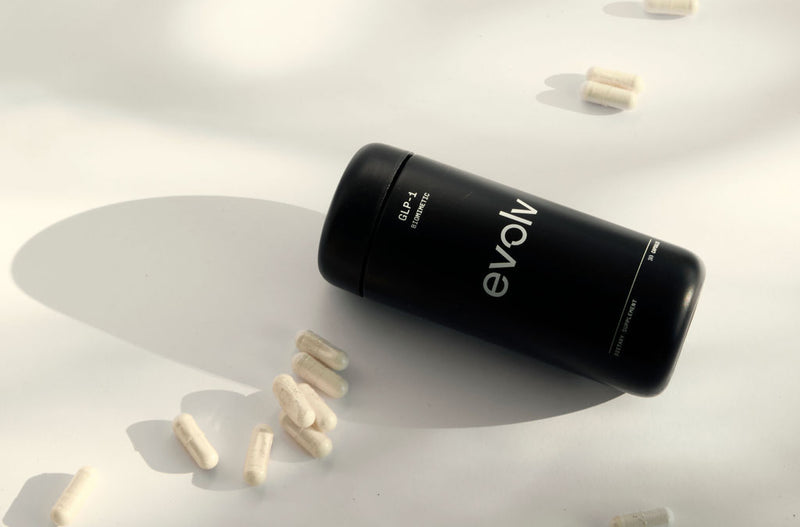
Evolv GLP-1 is a biomimetic dietary supplement built around a proprietary, yeast-derived peptide designed to support both GLP-1 and GIP appetite pathways.
Its active ingredient — the bioengineered, yeast-derived EV1 Peptide — is derived from Saccharomyces cerevisiae and contains only canonical amino acids. It’s wrapped in a proprietary oral delivery platform designed to survive the stomach environment and maintain bioavailability — the same challenge that has limited oral peptide products for decades. The peptide and its sustained pathway-engagement design are unique to Evolv, not features of the biomimetic category at large.
In an 8-week randomized controlled study, participants using Evolv GLP-1 consumed approximately 750 fewer calories per day and lost up to 12+ lbs. Evolv GLP-1 is designed for daily oral use with no harsh side effects — in our 8-week clinical study, no participants reported hair or muscle concerns. These outcomes sit in the same magnitude range that published prescription GLP-1 trials report at the 8-week timepoint.
Unlike stimulant-based or fiber-only approaches, this is designed to support the underlying signaling that drives appetite and weight loss behavior.
For a detailed look at the mechanism, see how the Evolv GLP-1 biomimetic works.
To understand how GLP-1 supplements work to naturally control appetite and how biomimetic products compare to traditional approaches, that guide covers the landscape.
Frequently Asked Questions
What does biomimetic mean in supplements?
Biomimetic means “mimicking biology.” In the supplement context, biomimetic products are designed to replicate the shape and signaling behavior of natural molecules your body already uses — engaging the same receptors and pathways but with improved stability or bioavailability. Biomimetics are biologically informed wellness products. Individual products within the category vary in mechanism and evidence — the label alone doesn’t determine outcome.
Are biomimetic peptides safe?
Biomimetic peptides that use canonical (naturally occurring) amino acids are designed to work within the body’s existing biological framework. In skincare, biomimetic peptides like Argireline have been used for decades with strong safety profiles. In metabolic health, Evolv GLP-1 is designed for daily oral use with no harsh side effects — in our 8-week clinical study, no participants reported hair or muscle concerns. As with any supplement, consult your physician before starting.
How are biomimetic peptides different from synthetic peptides?
Synthetic peptides often incorporate non-natural amino acids or chemical modifications to extend their activity — pharmaceutical GLP-1 drugs are examples. Biomimetic peptides use only canonical amino acids found naturally in the body and are designed to engage natural signaling pathways. The goal is engagement within natural biology, not chemical override.
What is an example of a biomimetic peptide?
In skincare, Argireline (acetyl hexapeptide-3) is a biomimetic peptide that engages a protein fragment involved in muscle contraction, reducing wrinkle appearance by up to 48.9% in clinical testing. In metabolic health, Evolv’s EV1 Peptide is a biomimetic peptide designed to support GLP-1 and GIP appetite pathways.
Can biomimetic peptides replace GLP-1 injections?
Biomimetic peptides and GLP-1 injections are different categories of products serving different needs. Injectable GLP-1 medications are physician-managed pharmaceuticals. Biomimetic peptides like those in Evolv GLP-1 are dietary supplements designed to support the body’s natural GLP-1 and GIP appetite pathways. They are not pharmaceutical substitutes — they represent a different daily-use approach to pathway engagement.
These statements have not been evaluated by the Food and Drug Administration. This product is not intended to diagnose, treat, cure, or prevent any disease.