







What Are Natural Peptides? Sources, Benefits, and How They Work
Authored by
The Evolv Research Team
Your body is running on peptides right now. Thousands of them. They’re telling your pancreas to release insulin, signaling your brain that you’re full, directing your immune system to attack a pathogen, and holding your skin together at the structural level.
Peptides aren’t a supplement trend. They’re the communication infrastructure of human biology.
The peptide supplement market reached $2.67 billion in 2024, driven by collagen, BPC-157, and a growing wave of GLP-1 related products. But most consumers buying peptide products don’t understand what peptides actually are, where they come from naturally, or why the vast majority of oral peptides never reach the cells they’re supposed to reach.
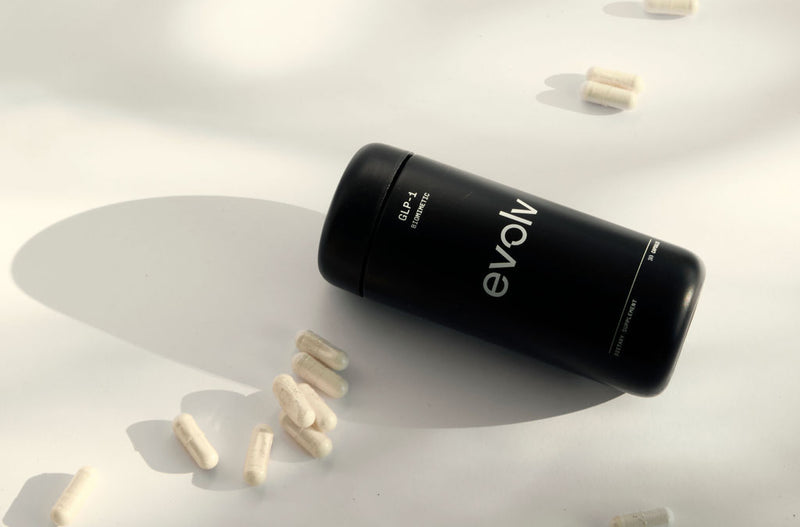
That bioavailability gap is exactly what led the team at Evolv to approach peptide supplementation differently. Rather than relying on plant extracts that nudge peptide pathways indirectly, Evolv built the first oral GLP-1 biomimetic peptide: the EV1 Peptide, a bioengineered, yeast-derived molecule designed to support the body’s natural GLP-1 and GIP appetite pathways.
This article breaks down what natural peptides are, the types your body depends on, where you get them from food, why supplementing them is harder than it sounds, and what biomimetic peptides represent for the next generation of the category.
What Are Peptides?
Peptides are short chains of amino acids — typically between 2 and 50 — linked by peptide bonds. They’re smaller than proteins but far more than building blocks. Peptides function as molecular messengers: they carry instructions between cells, tissues, and organ systems.
Your body produces hundreds of endogenous peptides. Some you’ve heard of:
- Insulin — a 51-amino-acid peptide that regulates blood sugar.
- GLP-1 — a 30-amino-acid incretin hormone that signals appetite regulation and insulin release.
- Oxytocin — a 9-amino-acid peptide involved in social bonding and mood.
- Collagen fragments — structural peptides that maintain skin, joints, and connective tissue.
What makes peptides distinct from full proteins is their size and specificity. A protein like hemoglobin has 574 amino acids and performs a structural, oxygen-carrying role. A peptide like GLP-1 has 30 amino acids and triggers a precise signaling cascade — telling your pancreas, stomach, and brain how to respond to food intake.
This precision is why peptides are increasingly attractive to supplement and pharmaceutical developers. Small, specific, and powerful.
Synthetic vs. Natural Peptides
Natural peptides are produced by living organisms — your own body, animals, plants, or microorganisms. They’re part of biological systems that evolved over millennia: insulin from the pancreas, collagen from connective tissue, antimicrobial peptides from the immune system.
Synthetic peptides are manufactured in a lab, typically through solid-phase peptide synthesis (SPPS). They can replicate natural peptide sequences exactly, or be modified for improved stability, longer half-life, or better receptor binding. Pharmaceutical GLP-1 drugs like semaglutide are synthetic peptides: they engage GLP-1 receptors with synthetic modifications that resist enzymatic breakdown.
A third category — biomimetic peptides — sits between the two. Biomimetics are bioengineered using natural processes (like yeast fermentation) to produce peptides that engage natural signaling pathways with improved bioavailability. Evolv’s EV1 Peptide falls into this category: composed of canonical, naturally occurring amino acids, produced biologically, and designed for direct pathway engagement.
Types of Natural Peptides
Not all peptides do the same thing. They fall into three broad functional categories, each critical to different aspects of health.
Signaling Peptides
These are the messengers. Signaling peptides bind to specific cell receptors and trigger a biological response — hormone release, appetite regulation, immune activation, or neurotransmission.
GLP-1 is a signaling peptide. So is insulin. So is ghrelin (the “hunger hormone”). When these peptides bind their target receptors, they initiate cascades that regulate everything from blood sugar to satiety to energy expenditure.
As Evolv co-founder Becca McCarthy explained on the Mom Curious podcast: “When you eat, your body produces the GLP-1 hormone. That hormone meets its receptors and those receptors signal to various organs in your body — your pancreas, your stomach, your brain, your liver — and tell them what to do because you’ve now consumed food and you’re full.”
The challenge with signaling peptides is that they’re often short-lived. Endogenous GLP-1, for example, has a half-life of approximately 2 minutes. Your body produces it, it does its job, and it’s degraded almost immediately.
Structural Peptides
Collagen peptides are the most familiar example. These peptides form the physical scaffolding of skin, tendons, cartilage, and bone. They don’t carry messages — they provide the raw material for tissue integrity and repair.
When you take a collagen supplement, you’re consuming hydrolyzed collagen — proteins broken down into peptide fragments small enough to be absorbed. These peptide fragments (typically di- and tripeptides) peak in the bloodstream within 30-60 minutes and are used as building blocks for the body’s own collagen production.
Antimicrobial Peptides
Your immune system relies on antimicrobial peptides (AMPs) as a first line of defense. These peptides — like defensins and cathelicidins — directly attack bacteria, viruses, and fungi by disrupting their cell membranes.
AMPs are produced in your skin, gut lining, and respiratory tract. They’re part of your innate immune response, meaning they work before your adaptive immune system (antibodies, T-cells) even gets involved.
5 Natural Food Sources of Peptides
You don’t need a supplement to consume peptides. Every time you eat protein, your digestive system breaks it down into peptides and amino acids. But some foods are particularly rich in bioactive peptides — peptides that have a measurable biological effect beyond basic nutrition.
1. Dairy
Dairy products hold approximately 34% of the bioactive peptide market share, making them the single largest food-based peptide source. Casein and whey proteins, when digested or fermented, release peptides with documented effects on blood pressure (casein-derived ACE-inhibitory peptides), satiety, and immune function.
Fermented dairy — yogurt, kefir, aged cheese — naturally generates bioactive peptides during bacterial fermentation, increasing the peptide diversity beyond what raw milk provides.
2. Collagen-Rich Foods
Bone broth, fish skin, chicken feet, and egg white membranes provide collagen peptides that support skin elasticity, joint comfort, and connective tissue maintenance. These foods supply the proline- and glycine-rich peptide fragments that your body uses to synthesize its own collagen.
3. Fish and Seafood
Marine sources provide unique bioactive peptides with antioxidant and anti-inflammatory properties. Fish collagen peptides, in particular, have smaller molecular weight than bovine collagen, which may improve absorption.
4. Fermented Foods
Miso, tempeh, sauerkraut, and kimchi all generate bioactive peptides through microbial fermentation. These peptides add to the health benefits of fermented foods beyond their well-known probiotic effects.
5. Eggs and Meat
Muscle tissue and eggs contain peptides released during digestion. Egg-derived peptides have shown antioxidant, antimicrobial, and ACE-inhibitory activity in research settings.
How Peptide Supplements Work — and the Bioavailability Challenge
Here’s where the conversation shifts from biology to engineering.
Getting peptides into your diet through food is straightforward. Getting a specific peptide into your bloodstream at a concentration high enough to produce a targeted biological effect — that’s a different problem entirely.
The Oral Bioavailability Problem
Most oral peptides face a brutal gauntlet:
- Stomach acid (pH 1-2) denatures peptide structures.
- Digestive enzymes (pepsin, trypsin, chymotrypsin) cleave peptide bonds.
- Intestinal membrane blocks large or charged molecules from crossing into the bloodstream.
- First-pass liver metabolism degrades peptides before they reach systemic circulation.
The result: oral peptide bioavailability is typically less than 1-2%. For every 100 molecules of peptide you swallow, fewer than 2 reach your blood intact.
This is why most pharmaceutical peptides — insulin, semaglutide, GLP-1 agonists — have historically been delivered by injection. It bypasses the GI tract entirely.
Collagen Is the Exception (Sort Of)
Collagen supplements work despite low oral bioavailability because the body doesn’t need intact collagen peptides in the bloodstream. The di- and tripeptide fragments that survive digestion — hydroxyproline-proline, hydroxyproline-glycine — are themselves the active signal. They stimulate fibroblasts in the skin and chondrocytes in cartilage to produce new collagen. The fragments are the product.
This is why collagen peptide research shows consistent results for skin and joints despite the bioavailability limitation — the mechanism doesn’t require systemic delivery of the full peptide.
Signaling Peptides Need a Different Solution
For signaling peptides like GLP-1, the fragments don’t work. The peptide needs to arrive at its receptor in a specific conformation to trigger the signaling cascade. Broken fragments don’t bind. Denatured structures don’t activate.
This is the core engineering challenge for the peptide supplement industry: how do you deliver a fragile signaling molecule through the hostile oral route and preserve its biological function?
Becca McCarthy described the challenge on the Mom Curious podcast: “Typically a supplement that has GLP-1 on the label is including an ingredient like berberine or green tea extract — a plant that we know can elicit a slightly longer GLP-1 response in your body and extend that from about 3 minutes to four, five, 10 minutes. That created a lot of confusion in the GLP-1 space.”
The distinction matters. Most “GLP-1 supplements” don’t contain GLP-1 or a GLP-1-like peptide. They contain plant extracts that may indirectly nudge the body’s own GLP-1 response in short bursts. That’s a fundamentally different approach from delivering a peptide designed to engage the pathway directly. Evolv exists because of this limitation — it was developed to deliver what plant extracts structurally cannot: sustained, direct engagement of GLP-1 and GIP signaling pathways.
Biomimetic Peptides: The Next Category
This is where the category is meaningfully shifting.
Biomimetics are an emerging class of biologically informed wellness products designed to engage human signaling pathways. Within the peptide space, biomimetic peptides are engineered molecules that replicate the shape and receptor-binding behavior of natural signaling peptides — but with modifications that improve stability, specificity, and oral bioavailability.
Within this category, individual products vary widely in mechanism, ingredient design, and evidence base — they aren’t interchangeable. Evolv pioneered the oral GLP-1 biomimetic peptide approach and is the first product in the category backed by an 8-week randomized controlled trial.
The concept of biomimetic peptides isn’t entirely new. In skincare, biomimetic peptides like Argireline have been used for years to engage the signaling behavior of neurotransmitters involved in muscle contraction — with documented efficacy in clinical settings. The new frontier is applying that same biomimetic approach to metabolic signaling pathways.
Evolv GLP-1 is a biomimetic dietary supplement built around a proprietary, yeast-derived peptide designed to support both GLP-1 and GIP appetite pathways.
Its active ingredient — the bioengineered, yeast-derived EV1 Peptide — is designed to support the body’s natural GLP-1 signaling while overcoming the bioavailability barrier that has limited oral peptide supplements for decades. It contains only canonical amino acids and is wrapped in a proprietary oral delivery platform that protects the peptide through the stomach environment. The peptide and its sustained pathway-engagement design are unique to Evolv, not features of the biomimetic category at large.
As Becca McCarthy explained on the Mom Curious podcast: “We took everything we know about peptide engineering and we designed a novel peptide… It only contains canonical amino acids, unlike the pharmaceutical GLP-1s which have some synthetic material in them. And then we wrapped that in our own oral delivery platform that gives that peptide bioavailability so it survives the stomach environment.”
In an 8-week randomized controlled study, participants using Evolv GLP-1 consumed approximately 750 fewer calories per day and lost up to 12+ lbs. Evolv GLP-1 is designed for daily oral use with no harsh side effects — in our 8-week clinical study, no participants reported hair or muscle concerns. These outcomes sit in the same magnitude range that published prescription GLP-1 trials report at the 8-week timepoint, while Evolv operates as a daily oral dietary supplement rather than a sustained pharmacological intervention.
For a deeper look at what biomimetic peptides are and why this category matters, read what are biomimetic peptides.
How to Evaluate a Peptide Supplement
Not all peptide products are built the same. Here’s what to look for:
- Mechanism clarity — do you understand what drives the effect? A peptide supplement should explain its mechanism, not just list ingredients.
- Delivery technology — how does the peptide survive digestion? If the label doesn’t address bioavailability, the peptide likely doesn’t survive the stomach.
- Clear daily dosing — know how much you’re taking and when.
- Clinical evidence — is there a study behind the product, or just theoretical rationale?
- Tolerability — look for products designed for daily oral use without harsh side effects.
The peptide supplement category is evolving fast. The gap between a collagen powder and a bioengineered oral GLP-1 biomimetic is enormous — in science, engineering, and the biological outcomes they’re designed to support.
For a broader look at the most effective weight loss supplements and how peptide products compare, that review covers the category in detail.
Frequently Asked Questions
What are natural peptides and what do they do?
Natural peptides are short chains of amino acids — typically 2 to 50 — that serve as signaling molecules, structural components, and antimicrobial agents in the body. They regulate everything from appetite and blood sugar to collagen synthesis and immune defense. Unlike full proteins, peptides are small enough to interact directly with cell receptors and trigger specific biological responses.
What foods are highest in natural peptides?
Dairy products are the richest dietary source of bioactive peptides, holding approximately 34% of the peptide supplement market share. Collagen-rich foods like bone broth, fish skin, and egg whites are also significant sources. Fermented foods (kefir, miso, aged cheese) naturally generate bioactive peptides during the fermentation process.
Do peptide supplements actually work?
It depends on the peptide and the delivery method. Collagen peptides have consistent evidence for skin and joint benefits over 4-12 weeks. However, most oral peptides face a bioavailability challenge — less than 1-2% of the peptide typically survives digestion and reaches the bloodstream intact. Delivery technology matters as much as the peptide itself.
What is the difference between peptides and proteins?
Size and function. Peptides are short chains of amino acids (2-50), while proteins are longer chains (50+) that fold into complex 3D structures. Peptides act primarily as signaling molecules — they deliver instructions to cells. Proteins serve structural and enzymatic roles. When you digest a protein, your body breaks it down into peptides and individual amino acids.
What are biomimetic peptides and how are they different?
Biomimetic peptides are bioengineered molecules designed to replicate the shape and signaling behavior of natural peptides — but with improved stability, specificity, or bioavailability. Within the biomimetic category, products vary widely in mechanism and evidence. Evolv GLP-1 uses a biomimetic approach with the EV1 Peptide, a yeast-derived molecule designed to support GLP-1 and GIP appetite pathways. Learn more on our science page.
These statements have not been evaluated by the Food and Drug Administration. This product is not intended to diagnose, treat, cure, or prevent any disease.