







Bioavailable Supplements: How to Identify Them and Why It Matters
Authored by
The Evolv Research Team
You’re not under-supplementing. You’re under-absorbing.
That $40 bottle of magnesium? If it’s magnesium oxide, your body absorbs roughly 4% of it. The rest passes through. That peptide product promising GLP-1 support? If it doesn’t have delivery technology, less than 1-2% of the peptide survives your stomach acid.
The supplement industry has a bioavailability problem. Most consumers evaluate products by what’s on the label — ingredient name, dose, and marketing claims. Almost no one asks the question that actually determines whether a supplement works: how much of this ingredient reaches my bloodstream?
That question is central to how the team at Evolv approached building an oral GLP-1 peptide. When the active ingredient is a fragile signaling molecule that stomach acid destroys in seconds, bioavailability isn’t a nice-to-have — it’s the entire engineering challenge. Evolv’s solution is the EV1 Peptide, a bioengineered, yeast-derived molecule wrapped in a proprietary oral delivery platform designed to survive digestion and support both the body’s GLP-1 and GIP appetite pathways.
This article explains what bioavailability is, why it’s the hidden variable behind supplement efficacy, what delivery technologies exist to improve it, and how to identify bioavailable supplements versus products that look good on paper but fail in your body.
What Is Bioavailability?
Bioavailability is the percentage of an active ingredient that reaches your systemic circulation — your bloodstream — in a form your body can use. It’s the gap between what you swallow and what your body actually receives.
When a drug or supplement is delivered intravenously, bioavailability is 100% by definition — everything goes directly into the blood. When you take something orally, bioavailability drops because the ingredient has to survive a series of biological barriers before reaching circulation.
For most supplements, this isn’t a minor reduction. It’s catastrophic.
- Magnesium oxide: ~4% bioavailability.
- Standard curcumin: ~1% bioavailability.
- Oral peptides (unprotected): <1-2% bioavailability.
- Standard CoQ10: ~3-6% bioavailability.
Compare that to:
- Magnesium glycinate (chelated): ~50-70% bioavailability.
- Liposomal curcumin: up to 20-30x standard absorption.
- Liposomal vitamin C: ~27% higher blood levels than standard vitamin C.
Same ingredient. Radically different outcomes. The difference is delivery.
What’s the Relationship Between Bioavailability and Absorption?
Absorption is the process of an ingredient crossing from your gut into your bloodstream. Bioavailability is broader — it accounts for absorption plus everything that happens afterward, including first-pass liver metabolism that can deactivate a compound before it ever reaches its target.
A supplement can be absorbed through the intestinal wall but still have low bioavailability if the liver breaks it down before it circulates. This is why bioavailability is a more useful measure than absorption alone — it reflects what actually reaches your cells, not just what crosses the gut lining.
How Do Bioavailable Supplements Differ From Conventional Ones?
Conventional supplements deliver a raw ingredient and rely on your body’s digestion to do the rest. Bioavailable supplements are engineered with the delivery challenge in mind — they incorporate specific technologies (liposomal encapsulation, chelation, enteric coating, or proprietary delivery platforms) to protect the ingredient and improve how much reaches systemic circulation.
The practical difference: a bioavailable supplement at a lower dose can deliver more active ingredient to your cells than a conventional supplement at a higher dose. Engineering matters more than milligrams.
Why Bioavailability Matters More Than Dose
Most consumers fall into the “more is more” trap — if a supplement isn’t working, take a higher dose. But if only 4% of the ingredient is being absorbed, doubling the dose doubles the waste. You go from absorbing 4% of 400mg to absorbing 4% of 800mg.
Bioavailability determines the effective dose. A 100mg supplement with 80% bioavailability delivers 80mg to your bloodstream. A 500mg supplement with 4% bioavailability delivers 20mg. The higher-dose product delivers less.
This is why bioavailable supplements represent a fundamental shift in supplement evaluation. The question isn’t “how much is in the capsule?” It’s “how much reaches my cells?”
For context, this is the same reason pharmaceutical companies invest billions in drug delivery research. The molecule is only half the product. The delivery system is the other half.
5 Factors That Affect Supplement Bioavailability
Understanding what reduces bioavailability helps explain why most oral supplements underperform.
1. Stomach Acid Degradation
Your stomach maintains a pH of 1-2 — highly acidic. This environment is designed to denature proteins and destroy microorganisms. It’s excellent for digestion and harsh for fragile supplement ingredients. Peptides, probiotics, and many enzymes are particularly vulnerable to acid degradation.
2. Enzymatic Breakdown
Even if an ingredient survives stomach acid, digestive enzymes in the small intestine (pepsin, trypsin, chymotrypsin) can cleave molecular bonds before absorption occurs. This is especially relevant for peptide-based products, where enzymatic cleavage destroys the specific molecular shape needed for receptor binding.
3. Intestinal Permeability
The intestinal lining acts as a selective barrier — it allows small, lipophilic (fat-soluble) molecules to pass while blocking large, hydrophilic (water-soluble) molecules. Most peptides are hydrophilic and too large to cross the intestinal wall passively. Without a mechanism to facilitate transport, they’re excreted.
4. First-Pass Metabolism
Ingredients that cross the intestinal wall enter the hepatic portal vein and pass through the liver before reaching general circulation. The liver’s cytochrome P450 enzymes can metabolize and deactivate compounds during this “first pass,” further reducing the amount that reaches target tissues.
5. Nutrient Interactions
Some supplements compete for the same absorption transporters. Taking calcium and iron together, for example, reduces absorption of both. Fat-soluble vitamins (A, D, E, K) require dietary fat for absorption — taking them on an empty stomach dramatically reduces bioavailability.
Delivery Technologies That Improve Bioavailability
The supplement and pharmaceutical industries have developed several approaches to overcome these barriers. Understanding them helps you evaluate products more critically.
Liposomal Delivery
Liposomes are phospholipid spheres — microscopic fat bubbles — that encapsulate active ingredients and protect them through the digestive tract. Because the liposome membrane is structurally similar to human cell membranes, it can fuse with intestinal cells and deliver its payload directly.
Liposomal vitamin C has demonstrated approximately 27% higher circulating blood levels compared to standard vitamin C. Liposomal curcumin has shown up to 30x improved absorption over unformulated curcumin in some studies.
Liposomal technology works best for small molecules. For larger molecules like peptides, the engineering becomes more complex.
Enteric Coating
Enteric-coated supplements have a polymer shell that resists stomach acid but dissolves in the higher-pH environment of the small intestine. This protects acid-sensitive ingredients through the stomach and releases them where absorption conditions are better.
Common for probiotics, digestive enzymes, and some anti-inflammatory compounds. The limitation: enteric coating protects against acid but doesn’t address enzymatic degradation or intestinal permeability.
Mineral Chelation
Chelated minerals are bound to amino acids or organic acids, making them easier for the intestinal wall to absorb. Magnesium glycinate (chelated) has dramatically higher bioavailability than magnesium oxide (inorganic salt). Zinc picolinate absorbs better than zinc sulfate.
Chelation is one of the simplest and most well-established bioavailability improvements — and one of the easiest to check on a supplement label.
SNAC Technology (Sodium N-[8-(2-Hydroxybenzoyl) Amino] Caprylate)
Developed for the oral version of semaglutide (Rybelsus), SNAC is a permeation enhancer that temporarily increases the absorption of the co-administered molecule through the gastric mucosa. It’s one of the few technologies that has successfully delivered a peptide drug orally at pharmaceutical scale.
The tradeoff: SNAC works by transiently disrupting the stomach lining to allow peptide passage — which is why oral semaglutide must be taken on an empty stomach with minimal water. As Evolv co-founder Becca McCarthy noted on the Mom Curious podcast: “The pharmaceutical GLP-1s include something called a permeation enhancer that effectively liquidizes the membrane that exists between the peptide and the receptor in order to give it access.”
Proprietary Oral Delivery Platforms
Some companies have developed their own delivery systems designed specifically for their active ingredient. These platforms typically combine protection from stomach acid, enzymatic resistance, and enhanced intestinal absorption — engineered as a system rather than a single-mechanism coating.
Evolv’s oral delivery platform falls into this category — a proprietary system designed specifically for the EV1 Peptide.
6 Tips for Choosing the Most Bioavailable Supplements
Most supplement labels tell you what’s inside the capsule. Very few tell you what reaches your bloodstream. Here’s how to filter:
- Check the form, not just the ingredient. “Magnesium” tells you nothing. “Magnesium glycinate” tells you the form — and the form determines bioavailability. Any bioavailable supplement should specify the exact chemical form of its active ingredient.
- Look for delivery technology disclosure. If a supplement contains an ingredient with a known bioavailability challenge (peptides, curcumin, CoQ10, probiotics), the label or product page should explain how the product addresses absorption. No explanation usually means no solution.
- Prioritize clinical evidence over label claims. The strongest signal of bioavailability is clinical data showing measurable blood levels or downstream biological effects. A study demonstrating that an ingredient reached the bloodstream or produced a physiological outcome is worth more than any label claim.
- Question unusually high doses. Bioavailable supplements often require lower doses precisely because more of the ingredient is absorbed. If a product’s dose seems unusually high compared to the studied effective dose, it may be compensating for low bioavailability with higher input.
- Check for nutrient interaction guidance. A well-formulated supplement includes instructions about when and how to take it — with food, without food, separated from other supplements. These details matter for absorption.
- Look for mechanism clarity. The product should explain how the ingredient reaches your cells, not just what the ingredient is. If you can’t find this on the label or the product page, move on.
The Oral Peptide Challenge
Peptides represent the most dramatic bioavailability challenge in the supplement industry. And it’s also where solving the problem creates the biggest impact.
As noted above, oral peptide bioavailability typically sits below 1-2% without specialized delivery. The pharmaceutical industry acknowledged this reality for decades by delivering all major peptide drugs — insulin, GLP-1 agonists, growth hormones — via injection.
The breakthrough of oral semaglutide (Rybelsus) proved that oral peptide delivery was possible at pharmaceutical scale, but it required the SNAC permeation enhancer and strict fasting requirements. Oral octreotide (Mycapssa), another peptide drug delivered orally, achieves approximately 0.7% bioavailability even with its specialized capsule technology.
These numbers illustrate the difficulty. Even with pharmaceutical-grade engineering and billion-dollar R&D budgets, getting peptides through the oral route remains one of the hardest problems in drug delivery.
For GLP-1 pathway support products, this challenge explains why most “GLP-1 supplements” don’t actually contain peptides — they use plant extracts (berberine, bitter hops, mango extract) that indirectly nudge the body’s own GLP-1 response in short bursts. Evolv took a different path — developing a bioengineered peptide that delivers sustained GLP-1 and GIP pathway support where plant-based extracts cannot.
How Evolv Solves the Oral Peptide Bioavailability Problem
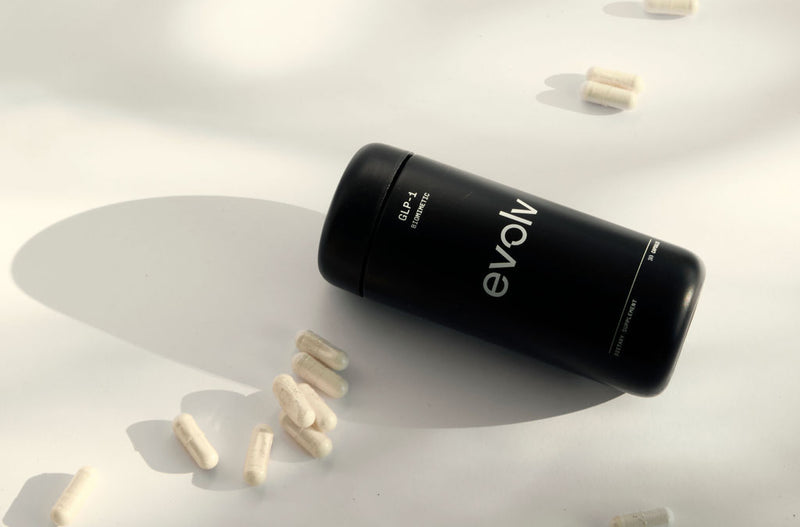
Evolv GLP-1 is a biomimetic dietary supplement built around a proprietary, yeast-derived peptide designed to support both GLP-1 and GIP appetite pathways.
Its active ingredient — the bioengineered, yeast-derived EV1 Peptide — is delivered through a proprietary oral delivery platform specifically engineered to protect the peptide through the stomach environment and support intestinal absorption.
McCarthy described the engineering on the Mom Curious podcast: “We took everything we know about peptide engineering and we designed a novel peptide… It only contains canonical amino acids. And then we wrapped that in our own oral delivery platform that gives that peptide bioavailability so it survives the stomach environment.”
The clinical evidence supports the delivery: in an 8-week randomized controlled study, participants using Evolv GLP-1 consumed approximately 750 fewer calories per day and lost up to 12+ lbs. Evolv GLP-1 is designed for daily oral use with no harsh side effects — in our 8-week clinical study, no participants reported hair or muscle concerns. These downstream outcomes — measurable calorie reduction and weight change — indicate that the peptide is reaching its target and engaging the intended signaling pathways.
Unlike stimulant-based or fiber-only approaches, this is designed to support the underlying signaling that drives appetite and weight loss behavior. For a deeper look at the mechanism, visit our science page or read about how the Evolv GLP-1 biomimetic works.
Bioavailability isn’t a marketing differentiator. It’s the reason a product works or doesn’t. When evaluating the most effective weight loss supplements, the bioavailability question should be the first filter — before ingredient, before dose, before price.
Frequently Asked Questions
What does bioavailability mean in supplements?
Bioavailability is the percentage of an active ingredient that reaches your bloodstream in a usable form after you take it. A supplement with 90% bioavailability delivers 90% of its active ingredient to systemic circulation. A supplement with 2% bioavailability means 98% of what you swallowed was destroyed or excreted before reaching its target. Bioavailability is the single most important factor in determining whether a supplement actually works.
Why do some supplements have low bioavailability?
Multiple barriers reduce bioavailability: stomach acid destroys pH-sensitive ingredients, digestive enzymes break down proteins and peptides, the intestinal lining blocks large or charged molecules, and the liver metabolizes compounds before they reach general circulation. Fat-soluble nutrients also require dietary fat for absorption. Without delivery technology designed to overcome these barriers, many ingredients are wasted.
How can I tell if a supplement is bioavailable?
Look for delivery technology disclosure (liposomal, enteric coating, chelated forms), clinical evidence showing blood levels or measurable outcomes, mechanism clarity about how the ingredient survives digestion, and clear daily dosing instructions. If a supplement label doesn’t address how the ingredient reaches your bloodstream, it probably doesn’t.
What is liposomal delivery and does it work?
Liposomal delivery wraps active ingredients in phospholipid spheres that protect them through digestion and fuse with intestinal cell membranes for enhanced absorption. Liposomal vitamin C has shown approximately 27% higher blood levels versus standard vitamin C in research. The technology works best for small molecules — it becomes more complex for larger molecules like peptides.
How does Evolv solve the peptide bioavailability problem?
Evolv wraps its bioengineered EV1 Peptide in a proprietary oral delivery platform designed to protect the peptide through the stomach environment and deliver it to the intestinal absorption site intact. This addresses the core challenge of oral peptide bioavailability, which is typically less than 1-2% without specialized delivery technology. Explore Evolv GLP-1 to learn more.
Sources
- Magnesium oxide bioavailability (~4%): Firoz M, Graber M. J Am Coll Nutr. 2001.
- Standard curcumin bioavailability (~1%): Anand P, et al. Mol Pharm. 2007.
- Liposomal vitamin C (~27% higher blood levels): Davis JL, et al. Nutr Metab Insights. 2016.
- Liposomal curcumin (up to 30x absorption): Cuomo J, et al. J Nat Prod. 2011.
- Oral peptide bioavailability (<1-2%): Bruno BJ, et al. Ther Deliv. 2013.
- Oral octreotide (Mycapssa) ~0.7% bioavailability: Tuvia S, et al. Pharm Res. 2012.
- SNAC permeation enhancer: Buckley ST, et al. Sci Transl Med. 2018.
- Evolv GLP-1 8-week randomized controlled study: evolvlife.com/blogs/bts-behind-the-science/clinically-studied-the-research-behind-evolv-glp-1.
These statements have not been evaluated by the Food and Drug Administration. This product is not intended to diagnose, treat, cure, or prevent any disease.